A Movie, A Song, and Annie Ross
When I write about vintage jazz music, a few of you might wonder how I decide on the subject. Sometimes, like last month, it is a big name that is only waiting on me to take the time to 1) do the necessary research and 2) decide upon some good performances to showcase. Other times, it is pure serendipity. Like today. And here is how it happened.
A couple of weeks ago, Marianne and I watched an old movie. It was a 1941 film called Blues In The Night. An odd mashup of musical and film noir, it is about a small band trying to make it playing good jazz. It was also the place where the famous title song made its debut. The music, all by Harold Arlen and Johnny Mercer, included another, less celebrated song that has had a long life – This Time The Dream’s On Me.
This second song (performed here in the film by Priscilla Lane) tugged at my memory, and I recalled a version on June Christy’s defining 1954 album, Something Cool. (1) June’s version was quite short, and I became curious about who else had kept the song alive. It turns out that it got some traction early on with both the Glenn Miller and the Woody Herman bands (in very different treatments) right after the movie was released. The pioneering bebop saxophonist Charlie Parker gave the song a second wind when he incorporated it into his repertoire in the late 1940’s.
So, at that point, I had decided to feature that song and noodled through some other versions. It was purely by chance (and by the Tube of You’s algorithm) that I stumbled upon this sublime rendition by Annie Ross and Gerry Mulligan. At first, I could not place Annie Ross. But I (and devoted readers here) know Gerry Mulligan. One listening lead to another (and another), and I decided that Annie was enough of a topic that she could elbow my new (and temporarily) favorite song aside.
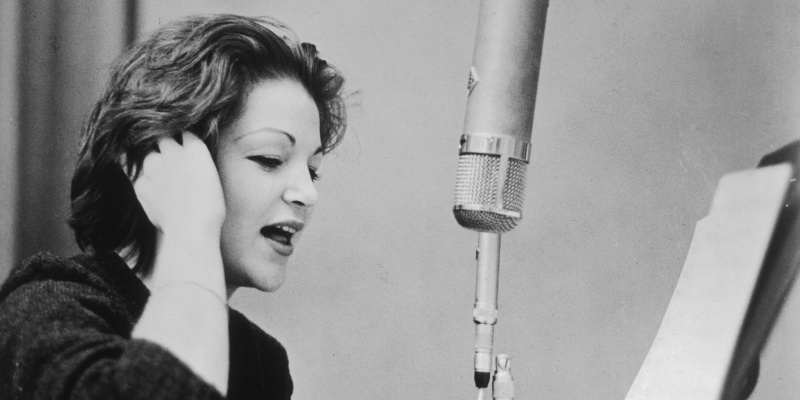
So, who was Annie Ross? She was born Annabelle Short to a family of Scottish vaudevillians on July 25, 1930. Her family came to America for a short time in the 1930’s, giving young Annabelle the chance to enter (and win) a radio contest run by bandleader Paul Whiteman. The prize was a contract with MGM, which led to her living in Los Angeles with an aunt in show business (Ella Logan), while the family returned to Scotland. Young Annabelle got a couple of movie roles, including a 1938 performance with Our Gang when she was age 7. Her swinging-kid version of Loch Lomond can be seen here. And at 14 (as Annabel Logan) she won a songwriting contest for Let’s Fly, which was later recorded by Johnny Mercer and The Pied Pipers (here).
Halfway through high school she headed back for Europe, where she began a professional singing career. But then she was back on the west coast in 1952, when she plugged into the local jazz scene. She met the head of the small Prestige record label, who asked if she could write lyrics. After her “yes”, she was handed a stack of the company’s records to see if she could come up with words for any of them. The next morning she came back and sang the Wardell Gray composition Twisted, which was good for an immediate recording session – her first.
Twisted was an early version of something called “vocalese”, in which lyrics are added to an instrumental jazz piece. (For those wanting a really deep dive today, here is the tenor saxophonist Gray’s original version of the song.) Ross’ lyrics for Twisted were quite clever, and her performance earned her Downbeat Magazine’s New Star award for the year – something she did not learn of until later because she had been asked to travel back to Europe for a tour there with the Lionel Hampton band. Twisted has been covered a few times, notably by Joni Mitchell in the mid 1970’s.
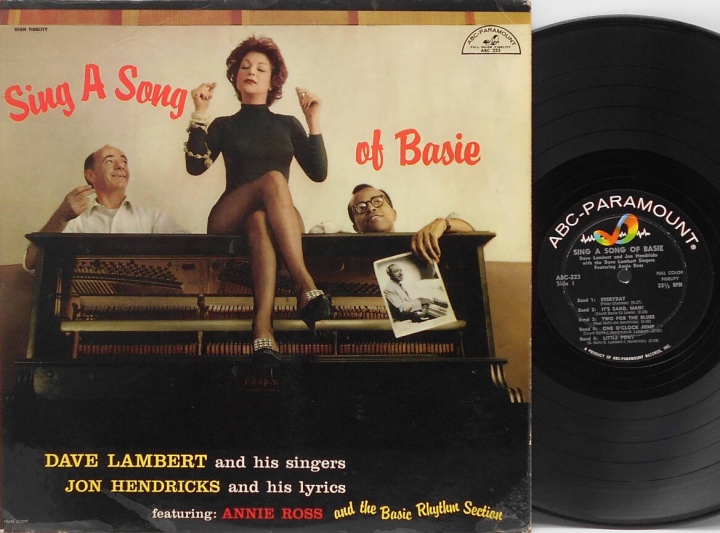
In 1957 she was introduced to a pair of singer-lyricists, Dave Lambert and his friend, Jon Hendricks. The two were working on a project that would put vocals to some Count Basie instrumentals. In an interview later in life (2), Ross remembered that the professional singers hired for the date simply didn’t (and couldn’t) swing. At the last minute, Lambert and Hendricks tried multi-tracking Annie and themselves doing the various vocal parts, which brought the whole thing together. That album, their first of five, was released in 1958 as Sing A Song of Basie, under the group which was soon named Lambert, Hendricks & Ross.
LH&R won wide recognition and won the Readers Poll in Downbeat Magazine four years in a row, starting in 1959. They popularized vocalese singing and paved the way for later popular groups like The Manhattan Transfer. I usually prefer studio performances to live ones because the careful sound engineering usually does a better job of showing off the music. Here, however, I will share a televised performance of Horace Silver’s Doodlin’. This is a clip from a 1959 or 1960 episode (3) of Hugh Hefner’s syndicated program, Playboy’s Penthouse – from a time when Playboy could make people think of jazz and cocktail parties instead of fat middle aged men staring luridly at girlie magazines. Silver’s instrumental version is here, for the curious.
Sadly, Annie Ross followed many other jazz musicians of her era in becoming addicted to heroin. She left LH&R in 1962 following a performance in London. She stayed there, got clean, got married, and opened a jazz club. She later worked her way into British cinema and had a regular series of small parts in film and television into the 1990’s in both England and the U.S. She became a U.S. citizen in 2001 and spent several of her last years as a cabaret singer in New York. She died there on July 21, 2020, just four days shy of age of 90.
After this quick trot through her life and career, it is fitting that we come back to where I started with Annie – the 1959 album with Gerry Mulligan. What might be my favorite track of the whole (and most excellent) album is How About You. Older readers might associate the tune with Frank Sinatra’s 1950’s association with Nelson Riddle, and those younger will probably think of the Will Ferrell holiday movie Elf.
Ross said that she never enjoyed singing before a big band because it was too confining. This recording shows how adroitly she could riff with a small number of top jazz musicians. A treat on the album is the appearance of Chet Baker on trumpet, several years after his time with Mulligan in their quartet of the early 1950’s. Baker and Mulligan had an eerie ability to predict where the other was going musically and adding Ross to that mix only makes it better.
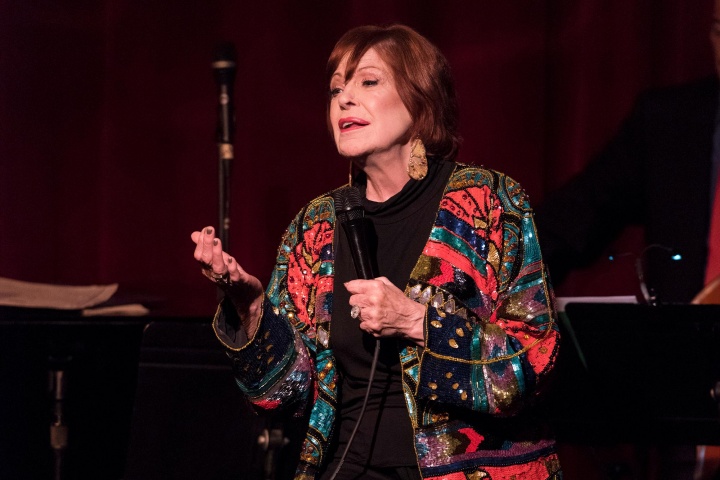
Annie Ross is one of those old jazz performers who lives in the borderlands between fame and obscurity. She lived a hard life with substance abuse and financial instability for many years, but eventually became recognized (at least in her New York musical circle) for the living legend she was. I am so glad to have discovered her and spent some time listening. And I am also glad to be able to share my discovery with all of you. She left a lot for us to enjoy.
(1) The song was not on original 1954 version of the album, which was released in the short-lived 10-inch L.P. disc format. A year later the album was re-issued as a 12-inch disc with four additional songs, including this one.
(2) Annie Ross’ recorded interview with Monk Rowe, January 13, 2001, which can be viewed here.
(3) Other guests on this episode included singer Tony Bennett and the great Count Basie, who plays the piano behind LH&R’s numbers.


So did do more as a writer, or singer? 🤣😎🙃
LikeLiked by 1 person
Hard to say!
LikeLiked by 1 person
I make no secret that I entered jazz through the “gateway drug” of Joni Mitchell and her increasing use of jazz musicians on her albums. Listening to them, made me research and listen directly to some of the musicians she was working with (like Wayne Shorter Tom Scott, et.), and then to just spread out into the wider jazz world. This is how I learned of Annie Ross. Joni’s 1974 album Court & Spark had her version of Twisted sung on there (with voicing by Cheech & Chong, no less), and was so different to my ear, that I had to find out more about Annie Ross, Wardell Gray, Lambert, Hendricks, and Vocalese. An example of how everything leads to something else. LH & R albums always sounded like the definition of 50’s “Beat” America to me: coffee houses and poetry readings!
A look at the jazz personnel on Court & Spark will give you an idea of who Joni was working with:
https://en.wikipedia.org/wiki/Court_and_Spark
…and Joni’s version:
LikeLiked by 1 person
You are absolutely right – everything in jazz leads to everything else, and it’s incredible how many ways there are to discover your way to a particular place.
I first heard LH&R on some cuts from a second album they did in combination with the Count Basie band in 1958 or 59. At the time I thought they got in Basie’s way, but later appreciated them – though never in a deep dive. Yes, they are very, very late 50s jazz – which is a good thing.
LikeLike
Very nice. Thanks for turning me on to Annie!
LikeLiked by 1 person
My pleasure! This was a really fun dive for me, with mostly all new discoveries.
LikeLike
At first when I saw the title “Twisted” I thought of a song I learned from The Sweetback Sisters called “Rattled” (which turned out to be a song by the supergroup The Traveling Wilbury’s). But as soon as I hit the Twisted play arrow in your post, I was flung back in time to memories of Bette Midler’s version.
LikeLiked by 1 person
I was not aware of the Midler version, but I suspect this one has been covered by a wide variety of later performers – especially those who have a taste for the offbeat.
LikeLike
Great story, and thanks for introducing me to a singer I really didn’t know.
I really love seeing clips from the Playboy tv show when I come across them. They just exude sophistication in a way that simply seems impossible in our modern world. They also always make me think that being on the set when one of those was recorded would be like the best party ever held in Rob and Laura Petrie’s living room 🙂
LikeLiked by 1 person
Hard to believe I was born and living in Chicago during the Playboy Penthouse years, and it started when I was about 6 years old (1959?), and was recorded, syndicated and aired by WBKB (which I think turned into WLS, or at least channel 7 turned into WLS). Their program director was Chicago broadcast history royalty and responsible for “breaking” Frank Reynolds and Bob Newhart. I remember watching TV back then, but don’t remember my parents watching Playboy Penthouse (at least, not when I was awake). I think it lasted only a few years, then superseded by Playboy After Dark (which I DO remember) in 1969-1970, filmed in Los Angeles. People say this foray to the west coast started the migration with Playboy moving the “mansion” from Chicago to Los Angeles in 1975. Jeff, you are most correct using the word “sophisticated”…not “hip”, but sophisticated, like Miles Davis wearing Egyptian cotton shirts and driving a Ferrari, and “dry martini” cool jazz.
LikeLiked by 1 person
It’s a little hard to fathom Playboy being spawned in a Midwestern city like Chicago instead of on one of the coasts. It must have been quite a hot thing in 1959-60 to lure all of those stars for a broadcast.
LikeLike
Chicago was the second largest city in the U.S. until 1984, and Chicago and Milwaukee were huge printing industry cities, so if you were starting a magazine that was going to be printed and distributed nationally, that was probably the place to be (and a lot of jazz people played Chicago on tour, right after the east coast). Hefner also was born and raised in Chicago, so probably a case of “being in the city you know”. In addition, I know the major networks had production facilities there (I remember a big CBS production facility near downtown when I was a lad), and it had something to do with time zones. Something like if you produced and aired something in Chicago, it was automatically an hour later on the east coast, and an hour earlier in the mountain time zone, and then you only had to make one transcription copy for the west coast. I’m not quite sure how it all worked, but it was something like that.
LikeLiked by 1 person
I love sharing my random musical finds! You are right about the Playboy show clips. How can it not be a great party when Count Basie is at the piano? But doesn’t Hefner come off as a bit of a dweeb? How did a guy like that get all those girls?
LikeLike
I enjoyed this article a lot. I knew a bit about her, but now I know much more.
LikeLiked by 1 person
Thanks! I learned a lot in pulling this together and am glad that I could add something.
LikeLiked by 1 person
This was interesting about another singer that I was not familiar with. I liked that catchy tune with a funny topic of doodling from when she was in the trio with Dave Lambert and Jon Hendricks – it’s too bad that drugs made her leave that relationship. I think of drug abuse in musicians that I grew up with in my teenaged years and beyond, more so than with musicians who were popular in the 50s. I was thinking back then it was more about alcohol abuse than drugs, so that surprised me. Well, good thing you and Marianne picked this movie to watch as it provided you some blog fodder!
LikeLiked by 1 person
Yes, inspiration can come in the most unusual ways. And I loved the words they wrote for Doodlin’ too!
It didn’t hit Main Street until years later, but there were a lot of musicians who struggled with heroin in the 50s – some more successfully than others.
LikeLike
Doodling was very clever! Interesting about heroin use about those early musicians – I had no clue.
LikeLiked by 1 person
Excellent post! You do such a good job of researching and presenting a story!
‘Tube of You’ – I like that!
LikeLiked by 1 person
Thanks! I appreciate the kind words.
LikeLiked by 1 person
“This Time the Dream’s On Me” had me thinking about something I should’ve asked you a long time ago, J P. Do you have a favorite Spotify vocal jazz playlist or two you’d recommend? The ones that come up from a basic search are generic – the stuff any novice ear would recognize. I’m looking for more of the soft vocals like this one; the sort of thing you’d put on in the background of the house while you’re making dinner or some other such task. As usual, a great sampling of music here with an interesting back story.
LikeLiked by 1 person
I actually do not – I just stumble around for individual tracks and find stuff. I prefer YouTube for discovery – lots of people have posted things – and Spotify once I have identified a particular album. Perhaps I need to explore the Spotify Playlists.
LikeLiked by 1 person
She had an interesting life….and an unusual voice. Her later stuff sounds lower/deeper? than the early stuff?
LikeLiked by 1 person
A lower, older voice wouldn’t surprise me, that’s not so uncommon. As for the interesting life, I couldn’t find a way to work in that she had a fairly long term relationship with the famously blue comic, Lenny Bruce. She certainly hung out with interesting people!
LikeLiked by 1 person