Thoughts On A Semiquincentennial

We are about a month out from marking the 250th birthday of these United States. And it seems to me that things are strangely quiet. Maybe people would be more excited if it were billed as America’s Semiquincentennial. That is what the interwebs tells me is the proper term for a 250th birthday. Or maybe calling it a semiquincentennial will not help. Anyway, I have random thoughts on this subject and because I need a blog post for today, this is as good a place as any to put them down.
I am old enough to have a decent memory of America’s Bicentennial in 1976. There was a lot of hype to the Bicentennial. I remember quite clearly that I resisted the thing. This was probably because of the intersection of my tendency to resist popular fads and my being a teenager (which amped up many of my tendencies). But I was quite alone, because the entire United States wallowed in a Bicentennial fever.
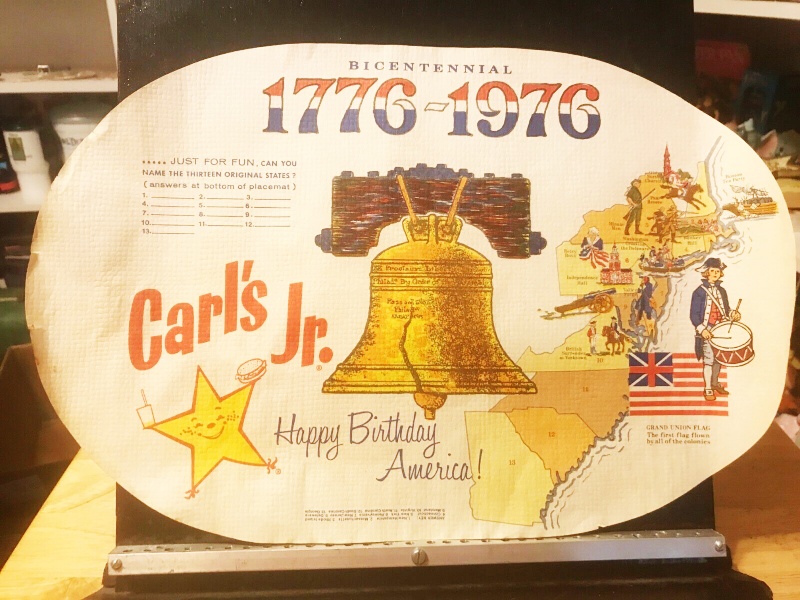
I remember that the entire American corporate establishment went all-in on Bicentennial-themed merchandise. Beyond the “official” Bicentennial coins and stamps from the government, there was almost nothing you could buy that didn’t come with some kind of Bicentennial tie-in. Whether it was a place mat from Carl’s Jr. . . .
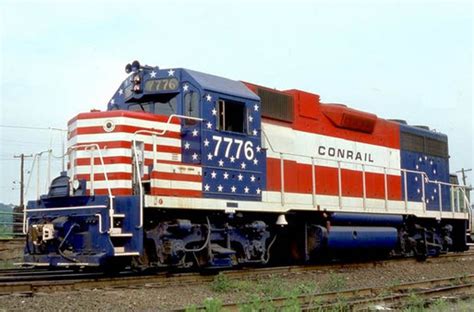
Or a Conrail locomotive, the “Spirit of ’76” slogan and red, white & blue color schemes were everywhere.

Did you know that Buick gave bicentennial names to every single paint color on its 1976 models? How more American could you get than a lineup that included Revere Red, Liberty White and Continental Blue? Fifty years later I see none of this enthusiasm. Scratch that – I just bought what used to be a 5 pound bag of sugar that is only 4 pounds, but which brags about its processer being a proud supporter of America 250. Is this the best we can do now? I wonder why this is.
It was not in celebration of 1776-to-2026, but by pure coincidence that I began a project of reading biographies of each American President. (1) A month out from the Big 250, I have now completed bios on Washington, Adams, Jefferson, Madison and just a couple of days ago, James Monroe (who left office in 1825, just shy of the country’s 50th anniversary). I don’t remember this era being extensively covered when I was in school and I suspect that it is covered even less now, but I came across some interesting things.
At the time of the Declaration of Independence in 1776, Great Britain was the world’s superpower and virtually everywhere in the world was under the control of one monarch or another. The history of democracies and republics had largely been one of failure when this confederation of colonies declared independence. All of the world powers were monarchies and most of them looked on the fledgling United States as either a curiosity or as something to be stamped out lest republican fever overtake their own populations.
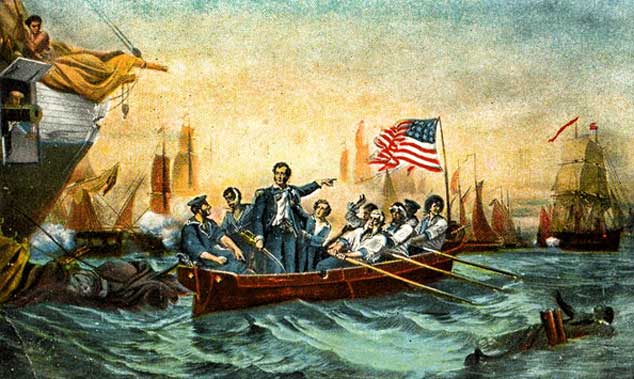
We had no real allies. France gave some assistance during the Revolutionary War, but only because we were causing problems for their arch-nemesis, England. After that war, the fledgling United States tried a program of neutrality with the major powers. The result was that Britain seized our ships and stole their cargo because we were trading with France. Then Napoleon’s France seized our ships and stole our cargo because we were trading with England. Britain was worse because it also impressed American maritime crews to service on British ships. This led to the War of 1812, when the British actually set fire to our Capitol Building and The White House.
But somehow, we survived as a free nation and, following a new 1787 Constitution, began electing Presidents. George Washington was the glue that held everything together at the beginning. John Adams, a leading voice in adopting independence, tried to emulate Washington, but met with stiff partisan resistance. Thomas Jefferson had written the Declaration of Independence and James Madison had written the Constitution, but believed that Adams and the other Federalists were too sympathetic to a system akin to monarchy. James Monroe, the last of the “founding fathers” who was President, had fought in the Continental Army and finished a 50-year job of pushing European colonial powers out of the North American continent – at least that part that was south of the Canadian border.
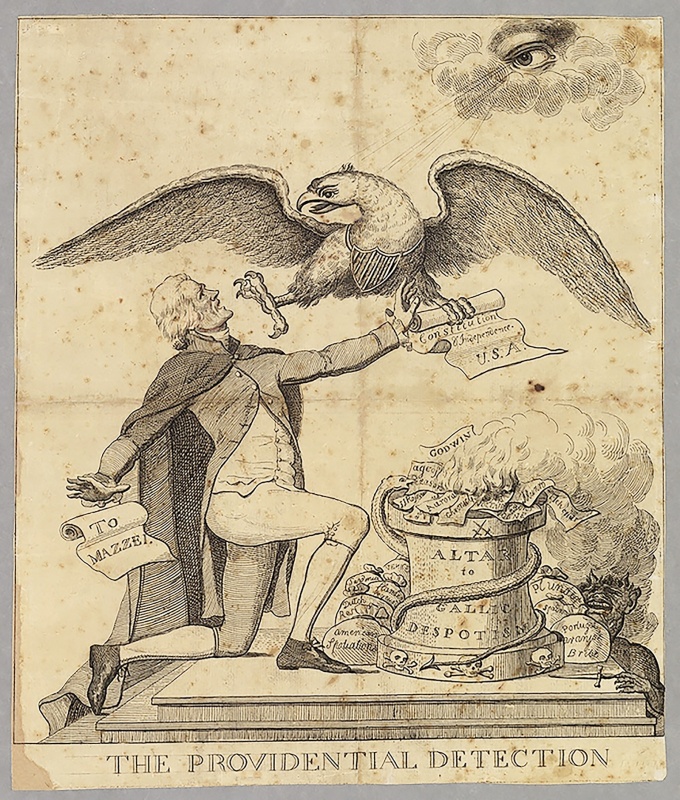
During that entire gestational period, “we the people” proved ourselves to be an acrimonious, antagonistic and argumentative lot. The election of 1800 between John Adams (who lost) and Thomas Jefferson (who won) was one of the nastiest and most bitter, right up to the present day. Partisan rancor took hold even during Washington’s administration (to his great sorrow), with “Republicans” seeing the threat of a new monarchy everywhere and “Federalists” fearing a French-style mobocracy of the guillotine.
The arguments went beyond party and were also geographical. Virginia was the 800 pound gorilla of the early American republic, being the home of four of the first five Presidents. Each of those Virginia Presidents owned slaves, with Washington being the only one who freed those he could at his death. (2) But the disputes were about more than slavery. The north (then called the east) lived a simple, life of small farms, seafaring and manufacturing while the south was a cash-poor economy of large plantations and export of raw materials, whose (free) citizens were often in bondage themselves to massive indebtedness. Then there was the opening of the west (then consisting of places like Ohio, Kentucky and what is today West Virginia), whose citizens resented being pushed around by the growing economic power of “the east” and the political power of “the south”.
Among the conclusions I have drawn is that the present existence of the United States is something close to a miracle. Despite the near constant failures from human weaknesses like greed, jealousy, lust for power and plain old incompetence, the form of government created by a singularly gifted collection of men persists. This despite constant tugs of war by groups on various sides of multiple issues riven by deep divisions.
We are deeply divided today, as we all know. But after my reading tour of the first five decades of our American experiment, I do not believe that we are more deeply divided now than we were then. The things that divided early Americans were just as real as the things that divided us now, with real or perceived threats of secession of one part of the country or another being an almost constant fact of life in those early years. The difference now is our ability to receive constant real-time floods of information about the many things we disagree over.
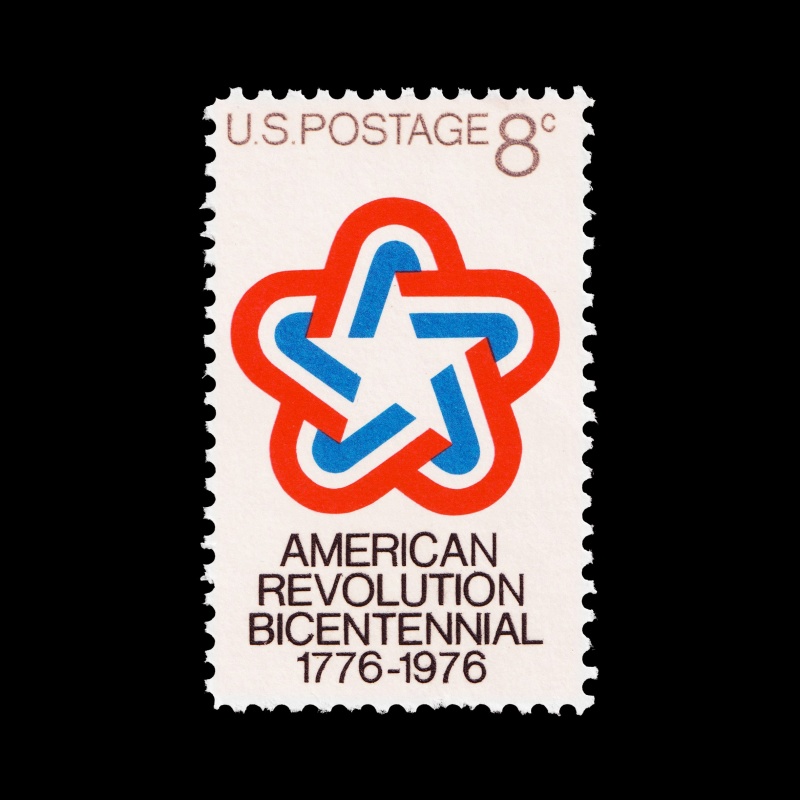
As we approach the 50th anniversary of the American Bicentennial and the 250th anniversary of the Declaration of Independence, I have recovered from my case of teenage truculence (and even my dislike of the graphic art that celebrated things then) and am ready to celebrate this achievement. Even if my local fast food purveyors will not provide me with the place mats. Probably because they cannot fit “America’s Semiquincentennial” on them.
(1) The following is the list of Presidential biographies I have read (or listened to in audiobook form) and which cover the first five decades of our country’s history:
- Washington: A Life, Ron Chernow (2010), Penguin Press
- John Adams, David McCollough (2001), Simon & Shuster
- Thomas Jefferson: The Art of Power, Jon Meacham (2012), Random House
- James Madison, A Biography, James Ketcham (1970), University of Virginia Press
- James Monroe, A Life, Tim McGrath, (2020), Penguin Press
(2) About half of the slaves owned by the Washington household were legally under the control of an estate from Martha Custis Washington’s ancestors. At his death, George Washington freed the slaves he had owned himself, but could not free those under the control of the Custis Estate, who remained in bondage.


Good comments, good books. I think there was buzz for July 4, 1976. July 4, 2026 is hype.
LikeLiked by 1 person
I also think that 200 years was a bigger deal than 250. Maybe the Tricentennial will generate a genuine buzz (though I doubt that I’ll be around to find out).
LikeLike
You are not alone in having noticed the silence about the semiquincentennial. While I’m a bit younger than you, I do vaguely remember the bicentennial, but it’s pretty dim in my memory. I suspect the reasons for this relative silence now are division (but that has always been a constant although to varying degrees), political, and the public’s ever-diminishing attention span. Oh, and it’s also hard to say “semiquincentennial”.
Uniquely, the timing would have been ripe given July 4 is on a Saturday this year. If I play my cards right, I’m hoping to see the tricentennial.
LikeLiked by 1 person
I had not thought about the tricentennial – let’s see, another 50 years? That would put me at age 117. I don’t think you had better mark me down for attending.
One interesting bit of trivia – I had already learned that both John Adams and Thomas Jefferson died on the same day – July 4, 1826, exactly 50 years from the signing of the Declaration of Independence. Did you know that James Monroe also died on July 4th? But in his case it was 1830. 3 of the first 5 Presidents dying on the 4th of July is quite a coincidence.
LikeLiked by 1 person
A “coincidence” or a plot of the Knights of the Templar!
LikeLiked by 1 person
I remember reading about the coincidence of Adams and Jefferson dying on the Fourth of July. Adams last words were reported to be “Thomas Jefferson still lives”, though in fact, Jefferson had died hours before.
LikeLiked by 1 person
Great topic – no matter how timely; and it could be trendy, if things like the Semiquincentennial (which seems more like a word from a Spelling Bee than something we ought to celebrate) were able to pierce the public’s otherwise rapt attention to things like endless videos about jiggling AI-generated women or doorbell camera footage of people getting covered with orange paint when the Amazon packages they are stealing blow up.
50 years ago, the only videos we had were those offered up by network television, and of those, I was an absolute fanatic for the Bicentennial Minutes. I’m pretty sure that tuning in for those every weeknight on CBS at 8:30pm was largely what drove me, and millions of other Americans to our TV sets (not unlike videos of cats walking into walls and swatting at dogs do for us nowadays). The fact that the Minutes started nearly 3 years before the actual Bicentennial only built the hype/anticipation. It was delicious for me…a completist who loves series. I do recall being slightly let down when it was Betty Ford who narrated the 7/4/1976 Minute…and then somewhat mystified as to why the things continued until the end of the year (with Jerry Ford narrating, who arguably could have done the one on the literal Bicentennial instead of his wife).
We needed Semiquincentennial Minutes this year (they could have starred jiggling and swaying AI-generated women). Maybe we’ll get Tricentennial Minutes in 48 years or so.
LikeLiked by 1 person
I had forgotten all about the Bicentennial Minutes! And you are right – no wonder Gerald Ford lost if he couldn’t even be bothered to do the Bicentennial Minute on the 4th of July! I wonder if those Bicentennial Minutes are collected somewhere for viewing – they would be a great history refresher, now that I am old enough to care.
I was wondering if this anniversary is getting any more traction in New England, that seems built for this kind of celebration. It has been interesting reading about all of the antipathy between New England and Virginia during the first 50 years of the country, and I will confess that my sentiments tend to sway towards New England on those issues. I had no ancestors on these shores at the time, but my Grandfather Cavanaugh hailed from Massachusetts. But somehow, the only 2 Massachusetts guys who broke the Virginians’ stranglehold over the presidency in the first 50 years (John Adams and John Quincy Adams) were the only 1-term presidents out of the first 6.
LikeLike
Indeed, it was MA vs. VA in those days.
I guess I would say that today, MA is not getting any better traction on the Semiquincentennial than anywhere else in the nation. I mean, we have lots of history to honor – e.g., I was inspired by the guys I met on a project in Springfield, MA a few years ago who were headed to re-enact Henry Knox’s expedition to drag canons from Ft. Ticonderoga (VT) to Cambridge (MA)…300 miles…in 1775/76 for the Battle of Bunker Hill ( https://1776history.com/2023/01/11/henry-knoxs-cannons-save-boston/ ). And they in fact did that, without virtually any media attention. This was going to be a Smithsonian-sponsored event…until most of the Smithsonian people who were organizing that got fired and the press about it pretty much collapsed.
So, we’re doing the same kind of honoring the history we have out here for the past 200 years or so without a whole lot of attention.
LikeLiked by 1 person
Hauling cannons for 300 miles- that should have received a lot of press. What an incredible feat, both originally and even as a reenactment. If anything should be above the political tug of war, it should be something like this.
LikeLike
Thanks for the reminder that this Republic has survived harder times than we’re experiencing now. I’m struggling to be excited about our 250th birthday for reasons I plan to articulate on July 4.
LikeLiked by 2 people
A good dive into history can get us exposed to the messiness of life and politics rather than the sanitized and smoothed-over version most of us have been exposed to.
LikeLiked by 1 person
Anything that begins with “Semi” sounds half-hearted to me. That naming scheme isn’t helping enthusiasm, besides the fact it is so long and almost un-decipherable.
LikeLiked by 1 person
Agreed – which is probably why nobody is using it. I had to look it up!
LikeLike
One interesting semiquincentennial event is the Freedom Plane tour. To quote its website (www.freedomplane.org), it is a “National Archives traveling exhibition bringing nine original Founding-era documents to eight U.S. cities in commemoration of America’s 250th anniversary in 2026.” I live in a host city (Houston) and felt like it “flew” under the radar while it was here. I visited on a quiet morning and had time to actually view and read the documents.* I was blown away by the signature page of the Treaty of Paris (1783). In this treaty, Britain acknowledged the United States as a sovereign nation. John Adams, Benjamin Franklin, and John Jay signed for the United States. A “D. Hartley” signed for Britain. I wonder if he is a household name across the pond as the others are here…
The documents will be in your neck of the woods (Detroit) in July.
*I recall visiting the National Archives in DC as a 9 year old in 1988 and my mom being yelled at by a security guard for holding up the line when she lingered too long in front of the Constitution.
LikeLiked by 1 person
I had not heard of this at all! Isn’t this the kind of thing that should have been promoted like crazy? I would love to see these things.
LikeLike
Saw this online during some research I was doing, and damn if I haven’t thought the same during the Reagan era:
“Short answer – roughly 200 to 250 years between massive regime/governmental upheavals. Even if the country retains its name, every couple hundred-ish years some massive gives, in a big way. Go back and look all through recorded history – asian dynasties, european kingdoms, african empires. I don’t know why it happens, as every upset seems to have a really different cause, but I noticed this cyclical period about 15 years ago, and damn if it doesn’t keep popping up.”
I don’t consider the 50 year mark to be much of a benchmark, so kind of a “shrug” for me. I take a dim view of celebrations associated with “we are the best” or any of those other jingoist motivations. I cringe, and refuse to buy, anything from a company calling themselves “Patriot”, or using the term “Patriot” as a model name; hoping the “slack-jawed-rubes” will just automatically buy it. There are many things to celebrate about the U.S., and a lot of things to be embarrassed about as well, and probably since the Viet Nam war, maybe not so much to be proud of.
I always come back to this:
https://www.youtube.com/watch?v=wTjMqda19wk
LikeLiked by 1 person
That’s a powerful clip…and one that people I know in Gen Z go to repeatedly (as they do for quite a number of The Newsroom scenes). While the clip is emblematically illustrative of “OK, Boomer…” there’s fortunately much more substance to it than that. So I guess I would still ask, what are we – those of us who resonated with McAvoy’s Sorkin-authored monologue – going to do about that?
LikeLiked by 1 person
The 250 year cycle is interesting, I will have to start paying attention to it.
I see your other points, but it seems to me that when you look at a modern world of representative democracies, we are pretty much the template or inspiration for all of them. I think that’s worth celebrating, if nothing else.
Also, I remain a fan of our founding documents. When we have tried to adhere to them, we have been better for it. We argue over what they mean, but those arguments go back to the beginning.
LikeLike
The problem with our founding documents, is that they depended on moral and ethical people to carry them out, they never imagined that there would be people like we have in government right now, running roughshod over them, and others, unwilling to fight with their fear of the wealthy. They were not written “fast” enough to deflect this onslaught.
I see this happening in my city today, where the laws and rules were written decades ago, with moral and ethical Germans in charge, and the “assumption” that they would “do what’s right”. Now all the loopholes are being exploited by those without those morals and ethics.
LikeLiked by 1 person
I have mixed feelings on the Jeff Daniel’s speech. Most of it is true, of course, but the contrarian in me bristles at the standard boomer Hollywood leftishness that is so smugly sure of itself, seemingly unaware that there are some good-faith disagreements to consider.
LikeLiked by 1 person
Most of Jeff Daniels speech IS true, especially when we talk about democracies that exist all over the world, and those of us who have traveled enough to see them. I’m OK with people who are “smugly sure”, provided they are correct! As a person who’s had family members and friends who are journalists, working hard to get stuff “correct”, I’ve seen decades of Republicans calling “foul”, when the truth was they really were trying to pull unethical shenanigans at a much greater rate than Democrats. They were “featured” in reporting because their behavior was the story at a much greater level than Democrats. There wasn’t a “bias” in the amount of reporting done on them vs. Democrats; the amount of reporting being done on them was because their actions WERE the story! Automatically being suspicious of something because you are a “contrarian”, is the paving material on your road to hell. When you look at the stats, I’m kind of done playing “nice” by claiming “everyone’s dirty”, and “we all have problems”, just to calm the waters. Our current administration shows you what you get thinking like that! I can tell you from years of living in D.C., that there’s always been a subset of wealthy that walked off the Mayflower, and believed that if you don’t have connections, you should be slave labor.
LikeLiked by 1 person
I agree with you JP – the hype is just not there and I also find it strange that they have multiple names to describe this 250-year anniversary. What’s with that? I will be doing a short post for 4th of July reminiscing about my memories of the Bicentennial year, although it seemed to me the whole nation was caught up in this 200th celebration and it wasn’t just the one day, but an entire year, from bumper stickers to snack foods and lots of commercials, gimmicky stuff. This year will be lackluster in comparison, just another 4th of July. You’re certainly chugging through a lot of presidential biographies – will you get through all of the U.S. presidents by the end of the year 2026 (akin to your car A-Z challenge)?
LikeLiked by 1 person
Oh, I don’t see any way of completing presidential bios this year – especially with my need for changes of pace in subject matter.
And you are right that Bicentennial fever lasted well over a year.
LikeLiked by 1 person
Yes, it may be a bit boring with biographies only.
LikeLiked by 1 person
Wow That’s quite a story. I have often wondered how this country has stayed together. But it was worse than even I thought. 🤣😎🙃
LikeLiked by 1 person
I know! The number of early elections decided in congress after no outright majority in the electoal college is kind of amazing. I think being argumentative fighters is in our American DNA. And that’s before most of us Irish showed up!! 😛
LikeLiked by 2 people
So true. We don’t take no s**t from nobody. Not even ourselves. 🤣😎🙃
LikeLiked by 1 person
My X ‘For You’ feed is almost non-stop talk about preparations for the Anniversary. There are a number of websites listing the larger events that are planned including numerous ones at the National Mall in Washington; Philadelphia; New York Harbor and Macy’s Fireworks; Rushmore; Boston; San Diego. Many small towns and county fairgrounds are also planning events!
There is an America250 congressional Commission to plan and execute events and a White House Task Force aligned with the previous administration to promote celebrations.
One would have to wonder how much the seeming ‘lack of hype’ depends on the media and whether it is pro or anti Trump.
LikeLiked by 2 people
It’s amazing to me how personalized our news has become. The algorithms decide what we see. I doubt that this is healthy.
LikeLiked by 1 person
I think that is why people should read their news from more than one source and from the left, middle and right on the political spectrum!
LikeLiked by 2 people
Appreciate you writing those lessons learned from the books as well as your personal POV. McCullough’s book is on my reading list now. Have you read DeTocqueville’s “Democracy in America” ?
LikeLiked by 1 person
I have not read that, but should! I will make a reminder note. I also feel a need to read a bio of Alexander Hamilton. He never became President, but seemed to be instrumental in causing the reaction that led to the early Republicans Jefferson, Madison and Monroe.
LikeLiked by 1 person
The phrase “50th Anniversary of the American Bicentennial” caused me pause since it brought my advancing age to the surface. My memories of the mementoes and celebrations of 1976 are still pretty darned vivid, probably because my sense of patriotism is as strong today as it was back then. I don’t know when or how political agendas bled into (and soiled) patriotism, but I think the trend explains the lack of enthusiasm for America’s 250th. It’s sad, yes, but I think it’s also a cycle. The glass half-full in me predicts our 300th will celebrated with unabashed pride.
LikeLiked by 2 people
I hope you are right!
LikeLiked by 1 person
As an aside, Dave brings up those “momentos” of the 1776 Celebrations, and my brother, a savage thrift shop searcher, will tell you they are all at the thrift shops, junking everything up, and nobody is buying them on the second (or third) hand market. That stuff went straight to the junk shops when kids were closing down their deceased parents estates. It’s amazing what goes from a treasured reminder of an event or an era, to “toss-able” and how fast that happens.
LikeLiked by 2 people
I don’t know much about US history, and while not a US president, I’ve heard the biography of Benjamin Franklin by Walter Isaacson is worth a read. I’ve read some of his other bios.
LikeLiked by 1 person
PS. I’m trying to think of a restaurant that still has place mats?
LikeLiked by 1 person
That sounds like a great suggestion.
LikeLiked by 1 person
I always appreciate a good history lesson. I just got my Buc-Cee’s 250th anniversary plush Beaver with Uncle Sam hat and Flag along with a new coffee mug, so I’m all set.
LikeLiked by 1 person
Haha, I keep hearing about Buc-Ees (or however it’s spelled) and feel the need to see one some time. It will involve a significant trip.
LikeLiked by 1 person
I don’t know if it’s worth a special trip by itself or not but if you are reasonably near one for whatever reason it’s a definite must-see.
LikeLiked by 1 person
I remember the Bicentennial Minutes on television. I also remember that Chevrolet offered “Spirit of America” versions of some of its vehicles, but those came out in 1974! (Maybe Chevrolet was trying to goose sales during a bad year while getting a jump on the Bicentennial?)
I wonder if one reason there hasn’t been as much hype is that our media is now so fractured. In 1976, virtually everyone watched either ABC, CBS or NBC, and many television stars were household names. Every household subscribed to at least one daily paper, and Time, Newsweek and People were all widely read.
Fast forward 50 years, and there are so many more options when it comes to news and entertainment sources. The only television personalities are I recognize are the hosts of Survivor, The Bachelor/Bachelorette and NCIS (because it has been on the air since the Bicentennial..or so it seems!). Magazines and newspapers are either dying or downsizing, and an increasing number of people are getting their news from non-network sources.
LikeLiked by 1 person
Yes, if you asked me to name the main news anchors for the 3 networks, I couldn’t do it. Although as relevant as they are convinced they still are, it’s interesting that they have not done more on this theme.
LikeLike