When Old Becomes New – Stan Kenton Does Hi-Fi
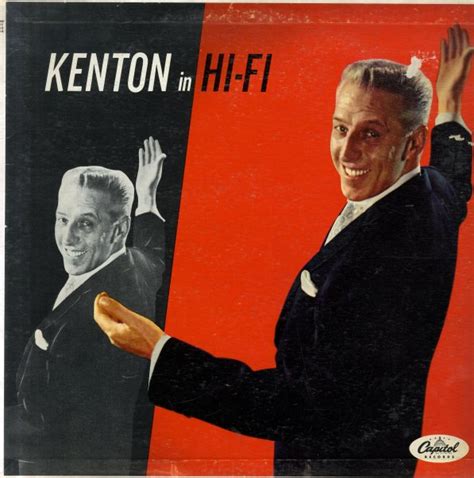
In the old jazz music that I like to cover, it was a fairly common thing for an artist to re-record an old favorite. Much of the time, however, the newer versions – while they can boast of better sound quality – lack some of the sparkle and originality of the older performances. But as with any rule, there are a few exceptions, and Kenton In Hi Fi is one of them.
“Hi-Fi” – now there’s a term that just oozes 1950’s. What does it mean? Technically, it means “high fidelity” and describes recording and playback techniques and equipment that offered a more lifelike sound than had been common through the late 40’s when the 78 rpm record still ruled. In common parlance, it was how people described high-quality audio equipment before stereo started to become a thing in the late 1950’s.
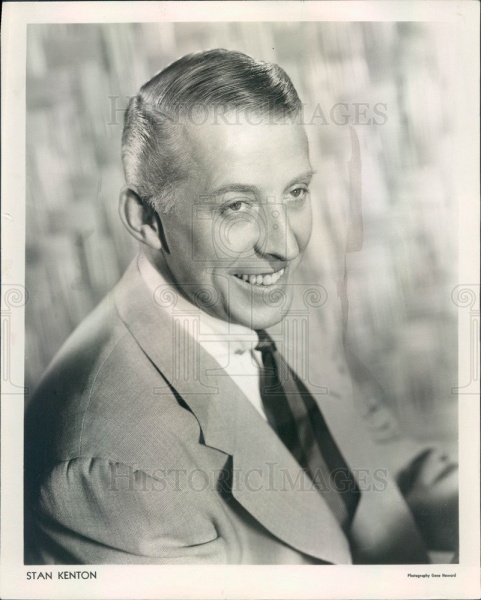
It has been awhile since we have listened to Stan Kenton’s band. Stan got started a little later than many of the big bands, and didn’t hit it big until 1941, with a band that didn’t sound like any other. Stan Kenton liked power, and his bands almost always had more of it than the recording equipment of the day could handle. And like few other leaders, Kenton was always striving for something new and unique. He did not have the broad fan base of many of his contemporaries, but the fans he had were deeply, deeply loyal. Sometimes dubbed “Kentonistas”, they lapped up almost all of Stan’s different styles and phases.
One of those phases was in the late 1940’s. Those postwar years were a struggle for some bands as they tried to stay abreast of changing tastes and sounds. Stan Kenton did better than many, with a sound that wasn’t quite swing but also wasn’t quite bebop. It was modern and had an edge to it and settled into the groove Kenton’s various bands would inhabit for years, in which music fans either hated it or loved it. For the most part, however, fans loved it and Kenton’s band was never more popular than it was in 1947.
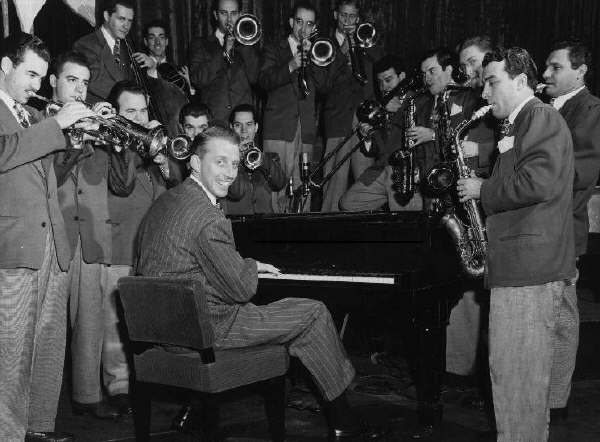
The problem with a powerful band like Kenton’s in the 40’s was that recording tech of the day could not capture everything that was coming out of the horns. And there was nothing anyone could do about it, except experience the band in person. As time moved on, the recording industry adopted audiotape in place of wax discs for capturing music and the LP record brought massively improved sounds to the listener’s living room. Stan Kenton moved on too, with three different generations of band(s) which went off in all kinds of different directions.
Some time in late 1955, Stan Kenton had an idea. His music from the late 40’s remained popular with his fans, but fewer and fewer people wanted to keep spinning their old 78’s. He had re-(re-re) formulated his band and drummer Mel Lewis brought a more swinging rhythm than the band had seen in several years. This was probably a better band than he had fronted in 1946-47, so what if he could rework some of the older arrangements for this modern band in a modern studio? One thing that was missing from this new band was the raspy tenor saxophone of Vido Musso, whose sound had been such a part of the older group. Kenton solved this problem by bringing Musso back for this one project – an album that would be called “Kenton In Hi Fi”.
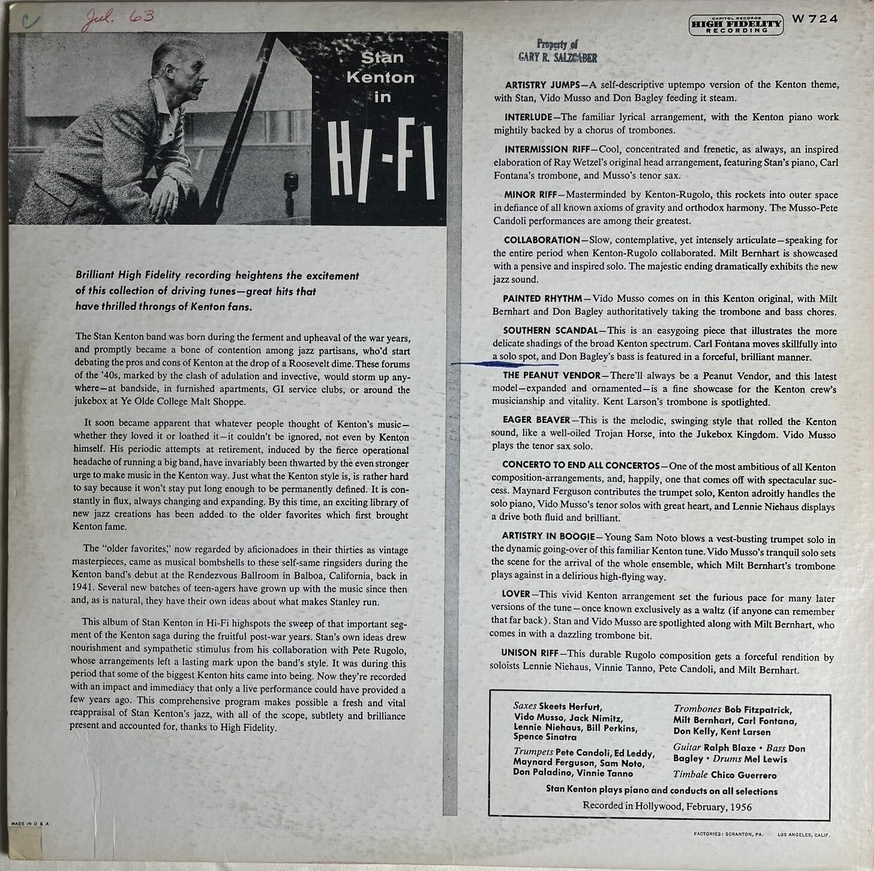
It turned out to be a great idea, because “Kenton In Hi Fi” would become one of Stan’s most enduring albums. Recorded February 11, 1956 and released later that year, it hit No. 22 on Billboard’s album chart (in the days before albums were the domain of rock & roll). The album’s initial popularity has persisted and the it has remained at or near the top of any Kentonista’s list of the band’s best work.
I discovered this album in the summer of 1982 when I was starting to explore big band jazz of the 50’s – I checked a copy of the album out from my local library and copied it onto a cassette tape. At first I was disappointed when I learned that it was a refresh of his work from the 1940’s, but was soon captivated by how fresh and modern it still sounded. There is not a single track on the album that I would take out. But to keep from overwhelming my long-suffering readership, I will pare things down to three to feature here.
Which is hard, but let us listen to Minor Riff. This is credited to both Kenton and to his ace arranger Pete Rugolo. The title says it all – a repeating riff in a minor key. It starts with piano and rhythm, expands to reeds, then fills out with low brass before the bright, clean trumpet solo of Pete Candoli and the harsh, raspy tenor sax of Vido Musso. (It was Chico Alvarez and Musso who had solos on the 1947 version.)
Another Kenton alum was back for this session, the squealing trumpet of Maynard Ferguson – Maynard gets no solo here, but you can hear him at the top of the trumpets near the end of the cut. This recording session predated the great studios in the Capitol Records building, which was being completed around that time. There was an alternate take of this piece in stereo, but it was not released until a 1959 edition of this album. Frankly, I prefer the hi-fi mono that had been pretty much perfected by this time, while stereo recording and mixing was in its infancy (and Capitol seemed to struggle with a steeper learning curve than some other record labels).
Not everything Stan Kenton did was at full throttle and full volume. Interlude is a piece that shows how Stan had an introspective side. This is another Pete Rugolo composition and arrangement and is unique because it uses nothing but Kenton’s piano, the rhythm section and the band’s five trombones.
Stan Kenton’s was a great band if you were a trombone player, because he was one of the few who shined the spotlight on his low brass players frequently. There may have been other big jazz bands of the era that featured five trombone players, but I cannot think of them. While they were frequently turned loose at full power, this piece shows their ability to go mellow. Then there is Stan’s piano work. There are a million styles of jazz piano, but few could emulate the flavor of a classical concert pianist like Kenton. I find Stan’s piano work cleaner and more listenable than in the 1947 recording. All in all, this is a lovely piece I could listen to for hours.
Few pieces in jazz are as associated with a single performer as The Peanut Vendor is associated with Stan Kenton. Which is interesting, because it is an old, old piece first recorded by the Cuban singer Rita Montaner in 1928 and popularized in the U.S. by Don Apiazu and his Havana Casino Orchestra in 1930. Louis Armstrong was the first jazz performer to record it (1931). Pete Rugulo arranged it as an instrumental for Kenton, who recorded it in December of 1947.
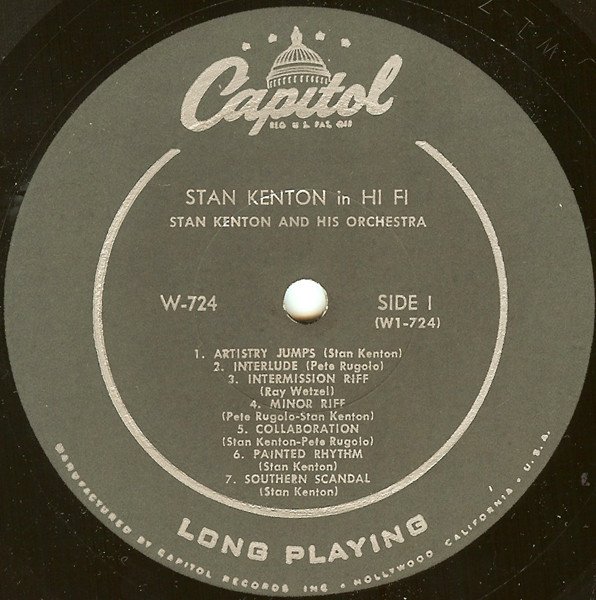
This 1955 recording drives far harder than the more relaxed 1947 version, but still manages to evoke the sound of a street vendor calling “pea-nuuuuuuts” amidst a bunch of others hawking their wares. This (the opening track on Side 2 of the record) is a playground for the Kenton band’s awesome brass section, whether the foundational riff of the trombones to the soaring (and sometimes dischordant) trumpets.
Stan Kenton and his band(s) went through more chapters than a James Michener novel. He seems to have hit a real sweet spot with this one, captured on a record where he combined the best of some of his older work with the best of his new. To me, this record would make a part of a great full-immersion 1950’s experience. My recommendation is to make it complete with a dry martini and a place to put your feet up, and then imagine this disc on the Hi-Fi.


Real good essay. A whole lot of talented players were with Kenton at one time or another.
LikeLiked by 1 person
In his later years, he devoted a lot of attention to jazz education in high schools and colleges. He was a unique force in his time.
LikeLiked by 1 person
Kenton’s another one of those guys that’s not getting his “due” in this day and age! The Big Band show I listen to on Sundays plays him occasionally, but concentrates mostly on music from the 20’s up until the mid 40’s, and he was really coming into his own in the later 40’s and beyond, and with maybe a little “fresher” and more modern approach. The straight ahead Jazz-o-philes are already clocking bebop and hard bop. This is the type of stuff my parents would have been happy to listen to on their Magnavox, well into the 60’s, as an updated large format orchestra of familiar music without being “assaulted” by the bop movement… Seems like Kenton’s contemporaries, were bands like Les Brown, who was backing Sinatra and Nat “King” Cole…
As a guy that likes quality audio equipment, I’m always sort of fascinated by the era of the Mono Hi-Fi. Being in my early 70’s, it’s easy to think that stereo audio has been there forever, but even the Beatles released all their albums as both mono and stereo until 1969 (I was 15!), and all their singles were mono until 1969. I remember seeing an audiophile magazine from the 50’s where there were some pretty interesting pieces of equipment, many pieces home-built electronics, and all of it mono. This is also the era where audiophiles bought mono reel-to-reel recorders and went out and recorded trains passing by and planes taking off at the airport, for home “realistic” listening. A wild and short lived era between disc cutters and stereo. Interesting to note, the big audiophile store in Milwaukee at the time, near the Marquette Uni campus to capture that college crowd, was a place called “Hi-Fi-Fo-Fum” (their theme music then went on to say “26th, and Wisconsin-um”).
LikeLiked by 1 person
I have decided that time finally caught up with Kenton’s late 40s sound and it seemed perfect for the mid 1950s. He recorded a lot of stuff that didn’t satisfy the mainstream and a lot of stuff that didn’t satisfy his fans. This was the rare record that hit a sweet spot with both.
I don’t know if you have listened to many early stereo releases from Capitol, but they often carried a kind of reverb effect I don’t think worked very well. That short period of mono before stereo took over actually sounded quite good.
LikeLike
JP, yesterday after I commented, I was doing an internet search on 50’s era Hi-Fi mono equipment to see what was out there, only to find out that even today, there are “mono-philes” (if that’s the correct term), who believe that in many cases, the high fidelity mono sound can be superior to stereo! They are out there keeping mono equipment alive and collecting mono records! I remember my brother, who had a “power-pop” band during the new wave era, getting his first few 45 RPM’s singles mixed down to mono, for juke boxes, to sound better in crowded bars where there was a lot of speaker blockage. They sounded pretty good as well.
LikeLiked by 1 person
Love that album and I have the 1956 mono version…that I periodically play on my “hi-fi” 🙂
I also love those late ’50s, early ’60s album covers with the extensive notes on the back of the album cover. At what point did music listeners stop wanting to read about the music that they had bought and were listening to? I’d contend that music listeners never stopped wanting to read…but rather, record publishers (and most everyone else) just decided to stop giving us stuff to read.
LikeLiked by 1 person
Jeff, the last three jazz albums I bought were available as CD AND Vinyl, with extensive album notes on the back (and unreadable on the CD booklet). I was listening to a pretty interesting moody jazz number while streaming Jazz One Radio out of Britain, and when I went on-line to find it, it was two years old, available only as vinyl, and released in Britain with none available in the U.S.! I think there are a lot of fans of the “old format” vinyl album and it’s readability, but maybe only among the type of people that listen to jazz and classical?
LikeLiked by 1 person
Agreed on the liner notes! I used to love reading them (and still do).
You being familiar with this album makes me curious about something. I struggled to decide what tracks to feature. The Peanut Vendor is kind of mandatory, but do you have a favorite that I did not pick? I think the odds are pretty high, given the riches to choose from.
LikeLike
I’m sure I originally picked up the album for The Peanut Vendor and have probably gone back for that track most often. Still, I am also pretty fond of the version of Lover on this. Intermission Riff is also quite good, IMO.
The opening track (Artistry Jumps) is a favorite too because it just sounds so filmic. If it was never used in the opening credits of some film, it should have been.
LikeLiked by 1 person
I cannot disagree with anything you say! I stumbled on the random fact that Pete Rugulo did the music for The Fugitive TV show in the 60s, and surely some others. Maybe that’s why I hear some great themes for TV show that never were on this album.
LikeLike
Very nice. I agree that Interlude is one of those pieces you could just listen and listen to.
LikeLiked by 1 person
Plus I am a sucker for a good trombone section!
LikeLiked by 1 person
I’m guessing a lot of people thought that naming followers of bands or singers was something relatively new, like Jimmy Buffett followers were/are called “Parrotheads” so I guess “Kentonistas” proves that theory wrong. That is nice that Kenton let other people get credit for their contributions to records and I saw on the one record (the relaxed 1947 version of “The Peanut Vendor”) that Milt Bernhart was listed as Trombone Solo.
LikeLiked by 1 person
There was an active music press in those days, with Metronome and other popular magazines. The writers/reviewers were always good for nicknames for both the various bands and their fans.
I have read that Stan was a pretty good guy to work for.
LikeLiked by 1 person
It’s nice when the star of the show shares the accolades with his associates – it shows what kind of man/employer he/she is.
Today I saw a very interesting car. It was parked behind the Dearborn Historical Museum, but I don’t think there were any vintage car events today. I took some pics which I’ll include in a future post. I thought it was a vintage Rolls Royce as it was so long and the hood rose up so high in front. It had a special plate that said “1977 Clenet – #13” … I Googled and found the car. It was a cream-colored convertible and he had the top down. The owner said it was French.
LikeLiked by 1 person
I remember reading about the Clenet. It was a small California company that made neoclassical cars on modern running gear in the 70s. Nice catch!
LikeLiked by 1 person
I was lucky to round a corner and see this classy-looking car. It had Florida plates and I’ll bet he only drives it on sunny, perfect weather days like we had today. 🙂
LikeLiked by 1 person
Anyone interested in the Clenet, should really look at the Excalibur from Brooks Stevens design studio in Milwaukee. Over 3500 sold, many to Hollywood “types”. Started in the 60’s The earlier units modeled on the Mercedes SSK, had Studebaker running gear, and seems to have the best design, the later series, started to look “clunky” and boxy around the rear end. It wasn’t unusual to see these on the street in Milwaukee, getting shipped or tested. The Clenet, started about 10 years later, only produced about 485 units before production was halted. It’s amusing that the owner thought his was “French”.
https://en.wikipedia.org/wiki/Excalibur_(automobile)
LikeLiked by 1 person
BTW, I was super surprised at Stans up-tempo version of Peanut Vendor! My only experience with this song is the Red Nichols 1931 version. I was doing some research on artist Len Lye and ran across his 30’s animation tests for this song, on the Youtube, which utilizes the Nichols version, which is way down-tempo compared to this. What a difference twenty years makes!
https://www.youtube.com/watch?v=ojsRWoYpVfU&list=RDojsRWoYpVfU&start_radio=1
LikeLiked by 1 person
Nichols’ was the one I had not heard, so thanks! And that was one creepy monkey!
Even Kenton’s 1947 version is significantly slower than the 1956 arrangement.
LikeLike
JP, here’s a “late entry” that I ran across and made me laugh!
https://www.youtube.com/watch?v=7XJkbRiLfDI&list=RD7XJkbRiLfDI&start_radio=1
LikeLiked by 1 person
That was good! It seems that everyone has a unique way to approach this piece.
LikeLike
Nice sampling of his music. It’s funny, in this day of duper accurate digital recording, many artists are searching for the low quality old steem microphones of the forties and fifties. Their low quality gives a warmer sound. 🤣😎🙃
LikeLiked by 1 person
Audiophiles’ preference for old-style analog sound reminds me of my own preference for film over video or digital images – sometimes the analog approximation of reality is better (or at least more appealing) than actual reality.
LikeLiked by 1 person
Pingback: Becoming Billie Holiday, 1935-37 | J. P.'s Blog