Battle Of The Bands – Chick Webb And Benny Goodman Stomp At The Savoy.
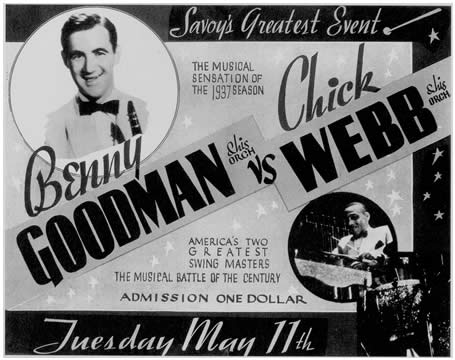
“Battle of the bands” was a popular gimmick in jazz of the 1930’s, wherein two bands would compete for a night in a shared venue. Bands that took part always brought their “A” games to see if their skills could cash the checks that the musicians’ egos wrote.
One famous battle took place on May 11, 1937 at the Savoy ballroom on Lenox Avenue, the heart of Harlem’s music scene. The participants were two bands we have written about before – Benny Goodman and Chick Webb. Both of these bands were forces in the new sound of swing, and each had something to bring to the fight.
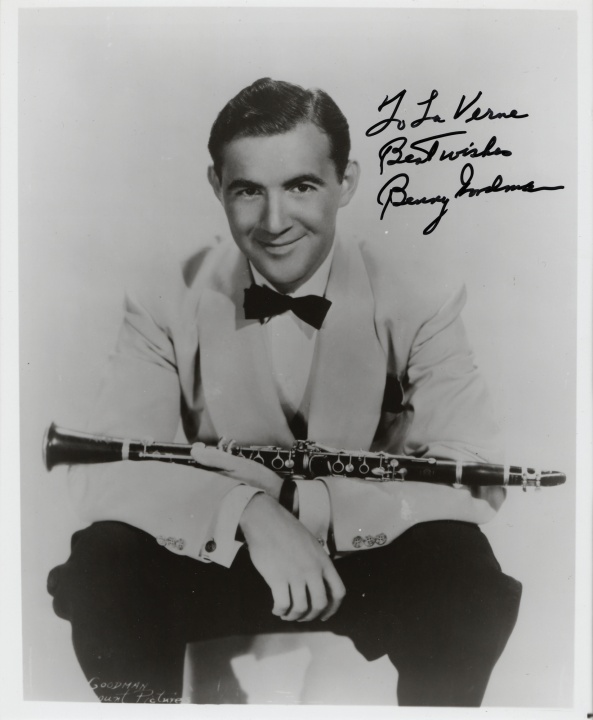
By the spring of 1937, Benny Goodman was fronting the hottest band in America. Dubbed “The King of Swing”, Goodman was known for doing what Elvis Presley did a generation later, which was to bring leading edge music by black musicians to mainstream audiences. And just as with Presley, those mainstream audiences ate it up. Goodman’s music may have been a little less edgy, but his band played with precision and had a natural and infectious swing to its beat.
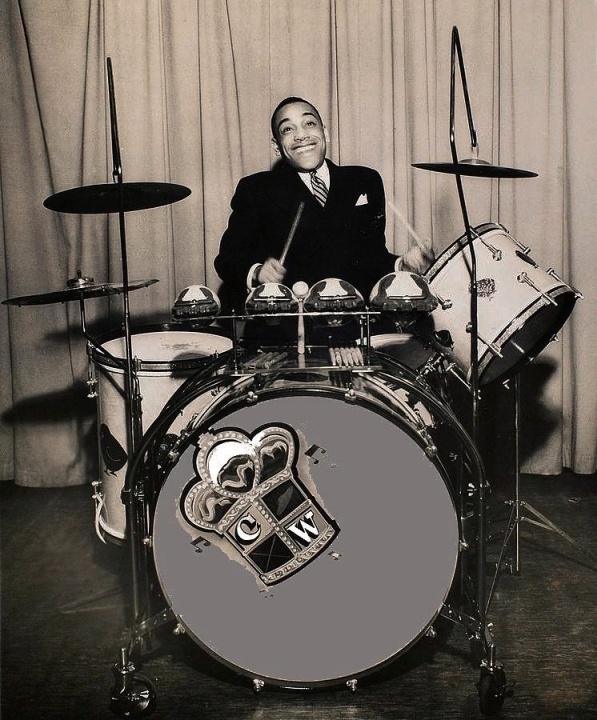
One of those black bands that was less well known to middle America was led by Chick Webb. Webb was under 5 feet tall and suffered from a spinal injury, but that didn’t stop him from leading a top band from the stool behind his drum kit. Webb may be best remembered today as the guy who hired a green singer named Ella Fitzgerald in 1935, but that was well after he had proved his jazz chops in the early days of the swing era.
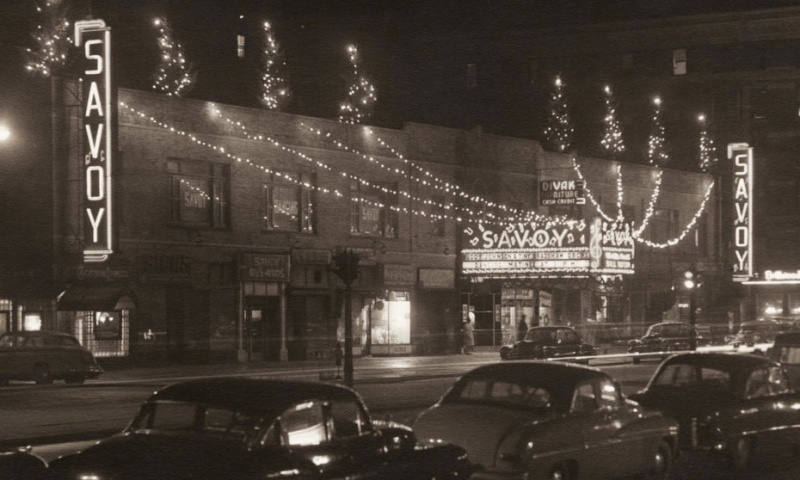
New York’s Savoy Ballroom was an impressive venue by any standard. Built in 1926, its dance floor was a full city block long and boasted of a bandstand on each end so that two bands could take turns providing nonstop music from the time the doors opened until the wee hours of the morning. Called “The place for happy feet”, it was one of the few places of its day where black and white patrons were encouraged to come out for a good time together.
There is, of course, no recording of that memorable battle between Webb (considered the Savoy’s “house band”) and Goodman, who would have been considered the visiting challenger. But we can come close with two records of a tune identified with both of them – and with this venue: “Stompin’ At The Savoy”.
The tune is credited to Edgar Sampson, who wrote it for Rex Stewart’s band in 1933. When Stewart disbanded, Sampson was hired by Chick Webb and brought the song with him. Webb recorded it on May 18, 1934, and it was a natural fit for his band, which called the Savoy its home.
Although Webb recorded the song first, Goodman’s status as challenger in this bout has convinced me to lead with his version – which is undoubtedly the best known of the two. This will be a battle that matches up extremely well because not only is it the same song from the same general time frame, but also because both performances use very similar arrangements – something quite uncommon for the time.
We are not, however, going to use the version recorded for Victor on January 24, 1936. That one is the best known, but it came out about six months after Goodman’s first version, which was recorded June 5, 1935 – and what we will use for this battle. Benny Goodman was still clawing his way out of obscurity in mid 1935 and just starting his meteoric rise. This recording for radio broadcast (1) is not quite as polished as the later studio recording, but it is closer in time to the Webb version and makes for a more even contest. (2)
The backbone of this early Goodman band was its rhythm section, which started with drummer Gene Krupa. He was joined by the piano of Jess Stacy, George Van Eps on guitar and Goodman’s brother Harry on bass. These four provide the motive force that propels the rest of the men. The other building block of the piece is the “call and response” style which pairs the brass and reed sections off against each other.
Solo work by (probably) trumpet Bunny Berigan, trombone (either Jack Lacey or Red Ballard) and tenor sax (likely Art Rollini) are well done and keep the performance building up to Goodman’s clarinet solo near the end. This recording captures a highly uncommon flub near the end of Goodman’s solo, something that Goodman would never, ever have tolerated in a recording for retail release. But all in all, Goodman puts on a solid, swinging number that does credit to everyone in his band as they were finding their place in things.
Now, on to the home team. Benny Goodman gave it everything he had, but we have to acknowledge that this contest is Webb’s to lose. Webb’s band was responsible for the arrangement (which Goodman largely used) and recorded the song first. Webb’s band of mid-1934 was also far more established as an outfit than Goodman’s was the following year. And, of course, Chick Webb was “Mr. Savoy” who was more identified with that ballroom than any other bandleader.
First off, Webb counts off a much faster tempo for the piece. And as the drummer, he took personal charge of the band’s rhythm section and becomes really noticeable towards the end of the record. Either Taft Jordan or Sandy Williams turns in a solid trombone solo, broken up by an interlude by Elmer Williams on tenor sax. Not a lot of Webb’s musicians were big names, but his best soloist may have been Mario Bauza on trumpet, a man who was among the founders of the Afro-Cuban jazz movement in the 1940’s. (3)
Really, there is no loser in this match-up, which makes a final vote hard. Personally, I like both of these records a lot. I think that the Goodman band’s soloists might have been better as a whole, but would give the overall edge to Webb, who really provides the stomp that the title promises. Fortunately for readers, you get a chance to weigh in and cast your own votes in the comments.
So, how did the actual battle of May 11, 1937 go? It was a genuine event, with reports of 3,000 dancers in attendance and another 5,000 standing outside who could only experience the music through the Savoy’s open windows in that era before air conditioning. Admission was $1.00 (almost $23 today), a princely sum at the time for an evening of dancing. And that event almost certainly included both bands performing this song.
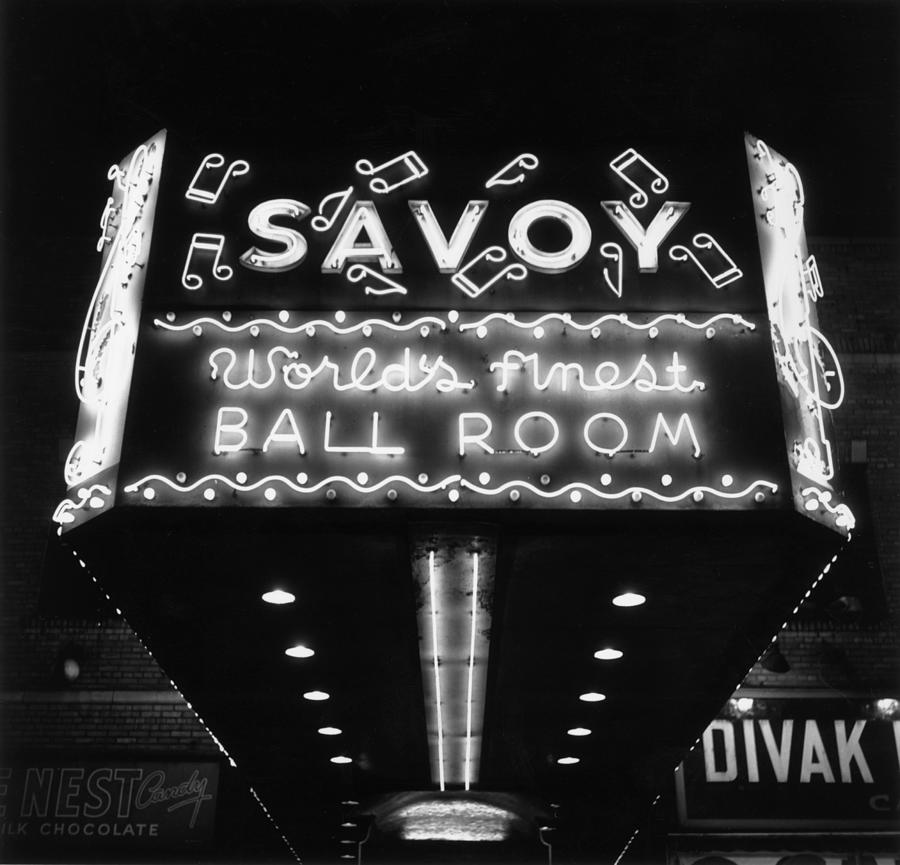
At the end of the night, it has been reported that Webb’s band won the contest in a rout. Maybe it was the advantage of the home crowd, or maybe not. Goodman’s star drummer Gene Krupa is said to have bowed to the little drummer who had bested him.
I love the exuberance of these jazz records from the mid 1930’s, when a swing rhythm was getting its foothold in the music – a foothold that remains in place even today in the more traditional styles of jazz music. And there are no better examples of the state of jazz-as-popular-music that gave people a way to forget their troubles by going out dancing.
(1) Radio “transcription discs” are an interesting and uncommon source for music of that era. We went into some detail on transcription discs here , but the digest version is that they were an early version of the long play record and were mailed out to subscribing radio stations for play over the air in a way that would simulate a live program.
(2) Those familiar with Goodman’s 1936 Victor record will immediately notice that this 1935 version is taken at a significantly quicker tempo. Which, it would seem, is appropriate for something called a “stomp”.
(3) Mario Bauza was the friend, brother-in-law and musical director of the band fronted by his fellow Afro-Cuban musician who was known as Machito (who was featured here about 5 years ago). Bauza’s time with Chick Webb clearly laid a foundation for Machito’s jazz cred in the 1940s and beyond.
 J. P.'s Blog
I agree In the case Webb takes it. But I wonder, with 3k people dancing if they could really listen to the bands at all? 🤣😎🙃
LikeLiked by 1 person
I have been close to a big band like this, and I can tell you they are LOUD!
LikeLiked by 1 person
I’ve been in a band like this, and my ears are still ringing!
LikeLiked by 1 person
I’ll bet!!
LikeLike
I’m a big fan of Chick Webb, and always happy when the jazz stations play a cut from him. He has a relatively extensive discography but doesn’t seemed to be played much except on the big band shows.
BTW, yesterday, April 30th, 2026, was International Jazz Day! Not to mention, it’s the 100 year anniversary of Miles Davis (if he had lived), and more than a few jazz stations are planning all day Miles days later in May. My pal Debra Richards on One Jazz Radio out of Britain, is planning a segment on her Fuse radio show of all of Miles film and tv work, worth a listen! A big jazz spring!
LikeLiked by 1 person
It’s too bad, but you are right that Webb doesn’t get the attention he deserves. I imagine that his early death and the lack of any output in the 40s and beyond is what has fenced him into a dusty corner.
I saw that there were some jazz events going on here yesterday and Miles Davis’ birthday is certainly worth celebrating. But I have to confess that my knee-jerk reaction to Miles is like my reaction to 60s Camaros. They get plenty of love from almost everyone, so I will turn my affections towards some cars and jazz players who don’t often get a spotlight.
LikeLike
Miles is really well known for his “outlier” prominence in the jazz world, pushing the envelope for modernism of the genre, but he was a mean, mean, man; which I generally don’t excuse. My Miles “story” is that a gal pal of mine told me her husband took her to some jazz concert and she couldn’t remember the player, all she remembered was he played to whole concert with his back to the audience! Miles, of course…
LikeLiked by 1 person
Your entry reminds me there was always a few great Chick Webb posters I intended to buy for my living space!
https://www.ebay.com/itm/193436487052
LikeLiked by 1 person
Ooooh, love it!
LikeLike
Another vote for Chick Webb here.
I love what you say about the exuberance of these records. It’s what drew me to this music once I discovered it in my 20s. This was after a childhood of hearing from my parents (who came of age in the 1950s) that this was “old people’s” music. Everything’s relative.
I’m particularly interested in the legendary “events” and hype that these bands generated at the time. It fascinates me to juxtapose that media landscape (with rivalries between bands, routine engagements where 3000 !!! people would come out to dance, national touring, record sales, and radio) with what might be equivalent today. So very much the same sort of thing…only also very different.
LikeLiked by 1 person
Yes, it was a very different world where a person had to go somewhere to do or experience something. Records of the time were a poor substitute for the actual sound of a band, and there was no opportunity at all for a visual experience, except in the rare performances captured (usually in black and white) on film. Harlem in the 1930’s was a happenin’ place for people who wanted to go out dancing to the latest music.
I am fascinated by the culture of big ballrooms and dancing that ruled in the 1920’s and 1930’s and that seemed to die after the war. Was it television? Or the popularity of bowling? The changing musical styles? Or maybe that so many young adults were moving to places like Levittown and raising a gaggle of children. I should have added that the Savoy hung on into the 50s, but was torn down in 1958 to make way for a housing project.
LikeLike
Lots to say here (let’s say about a doctoral thesis or so 😉 ) but quickly, I think the main reason for the change is what you hit upon in mentioning Levittown. Post-WWII, the movement was on to the suburbs, which in itself was reflective of an overall rise in prosperity. This is when the number multi-generational families in the US dramatically declined (although that number is now rising, again). Basically, it was no longer as important to escape a crowded, multi-generational, household to seek entertainment outside of the home…and entertainment became more home-centered.
TV took off in large part due to that underlying demographic and economic shift (given that it had been around since the 1930s, but who really wanted to sit at home and watch a tiny fuzzy screen when you could go Stompin’ at the Savoy?). This is at the same time we also started to lose a number of public amusements. Amusement parks – something that nearly every small city and larger used to have – were another example. And of course, don’t forget that many amusement parks also had large dance halls/ball rooms that regularly hosted these bands.
LikeLiked by 1 person
I’ll go with the Chick Webb version. I can also see his version being more likely to be featured in a period movie – either as a solo piece during a dance number, or as background music.
LikeLiked by 1 person
An interesting thought! I think it did get used as background in Ken Burns’ PBS documentary series some years back.
LikeLike
Well JP, I am no jazz expert as you well know, but I like the second version by Chick Webb better as it had more pizazz – I felt the Benny Goodman version seemed more like elevator music, to me anyway. I felt like I was in the same room when Chick Webb was playing. Yes, I concede it could be the quality of the recording too. I have heard of the Battle of the Bands concept for modern bands, but didn’t realize this competition named as such has been around for so long. Even now a $23.00 fee (the equivalent of the $1.00 fee) would be a steal considering how much it costs to even go to a movie theatre, with no live entertainment.
LikeLiked by 1 person
Good point on crazy modern prices. But I’ll bet that $23 ($46 per couple) would have been a whole lot of money during the great depression.
Webb is doing as well here as he’d did in the real life battle!
LikeLiked by 1 person
Silly me JP – I was thinking just of one admission … yes, a couple would be more, unless they went stag. Good for Webb – he livened up that song considerably!
LikeLiked by 1 person
Haven’t heard much of Chick Webb, although I made a dutiful Wikipedia search. If he influenced Krupa and Buddy Rich, then that’s fine for me. I’ll do a deep-dive soon.
LikeLiked by 2 people
He died young and this probably hurt his exposure to later audiences. But I think he deserves more recognition than he has received.
LikeLike
Chick Webb wins easily but I’d be in way over my head to try to explain why. It’s, uh, jazzier?
LikeLiked by 1 person
Yours is as good an explanation as it needs to be! I agree, there’s more drive to it.
LikeLiked by 1 person
As an aside, I immediately noticed that your photo of Chick at his drum set has the “mid century modern” grey paint on the drum head that newspapers used to use to block out things they didn’t want seen on black & white photos they were running in the newspaper. Wonder what it was? A quick check on alternates shows some “art” of musical notes on there, and even his name in script, but nothing that would warrant “censorship”. I wonder if they grey painted it to run type over it for the newspaper story? A mystery.
LikeLiked by 1 person
I didn’t notice that until you mentioned it. Good questions!
LikeLike
I like the slower temp myself. I was vaguely familiar with it, but not the story behind it.
LikeLiked by 1 person
Aha, this makes you the contrarian on this round. That’s usually my seat! 😛
LikeLiked by 1 person
I don’t mind taking my turn.
LikeLiked by 1 person