The Incredible Jazz Guitar Of George Van Eps
After last month’s dive into Red Norvo (and his singing wife, Mildred Bailey), I dug a little farther into an earlier Norvo group. I became captivated by one of those records (which will likely become the subject of a future look) which included a guitar solo by a guy named George Van Eps. Who, I wondered, was George Van Eps, and did he ever do anything else worth listening to? I soon learned that Van Eps was one of those players who spent a lifetime being obscure to the listening public, but who was a giant among his peers. And for good reason.
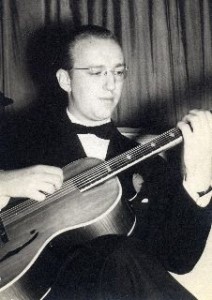
“It is difficult to convey to the uninitiated the awe that the work of George Van Eps inspires among guitarists. ‘He’s the world’s greatest guitar player,’ says Allen Reuss, and there are plenty of other players from the top ranks of guitardom who speak of Van Eps in tones of near reverence.” (1) This quotation opens the section on Van Eps in an anthology on jazz guitar. Some liner notes on an old album quote a former Van Eps student who said that he can find “notes on the guitar that just aren’t there.” (2) All that I can add is that some time spent listening to him impresses this non-guitar-playing blogger plenty.
George Van Eps was born in Plainfield, NJ on August 7, 1913. His father was a well-known ragtime banjo player who was a friend of George Gershwin, and his mother was accomplished on the piano. One of four musical siblings, George had learned the banjo by age 11, and was good enough to do some playing in public as a member of the musicians’ union. However, hearing Eddie Lang’s guitar work on an early crystal radio set a couple of years later convinced him to pick up the guitar instead.
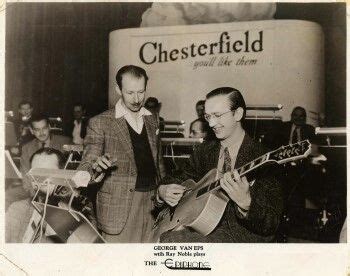
Van Eps played professionally with some bands in the first half of the 1930’s, including the one that Benny Goodman rode to a breakout success in 1935-36. Even then, the young Van Eps was displaying a unique style that has been described as guitar played with the mind of a piano player. By the mid 30’s, Van Eps had apparently had enough of the life of a touring musician and moved to the Los Angeles area where he made a life as a studio musician, blending into the background of records made by a Who’s Who of mid-century music. Being part of the orchestra behind some of Sinatra’s classic 1950’s records was no way to show off his jazz chops, but it certainly paid well enough to support a life that was much more stable than those lived by more famous names.
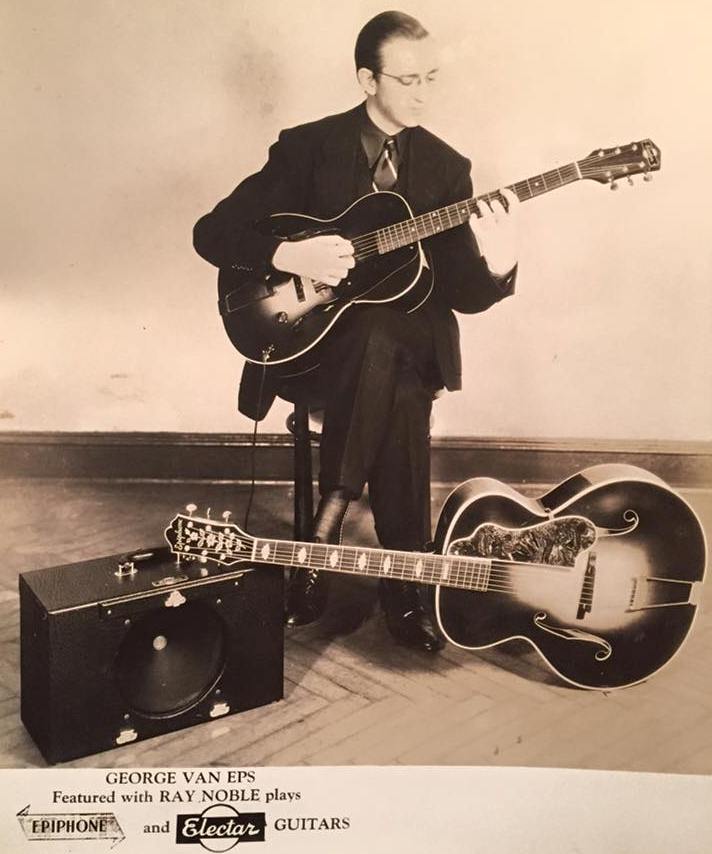
It was early in this part of his career (1938) that he asked the makers of his Epiphone guitar to reconfigure his six-string instrument by adding an additional bass string, thus making him the pioneer of the 7-string jazz guitar. It was this unusual setup, as well as his unique approach to playing it, that led to his publishing a lesson book for his 7-string method (one that was updated and expanded in the early 1980’s).
Finding some Van Eps recordings to feature here proved daunting. There are several examples of his early work with a handful of early big bands, that while interesting, restrict us to short solos within a larger band. Then there was a series of recordings he did starting in the 1950’s and that lasted well into the 1990’s. Those show the fully mature Van Eps, but one that gravitated towards a more sedate (though very satisfying) style. Fortunately, Van Eps sat for a pair of 1949 recording sessions for the obscure Jump label which, for me, present a Goldilocks-like balance between his early and late selves.
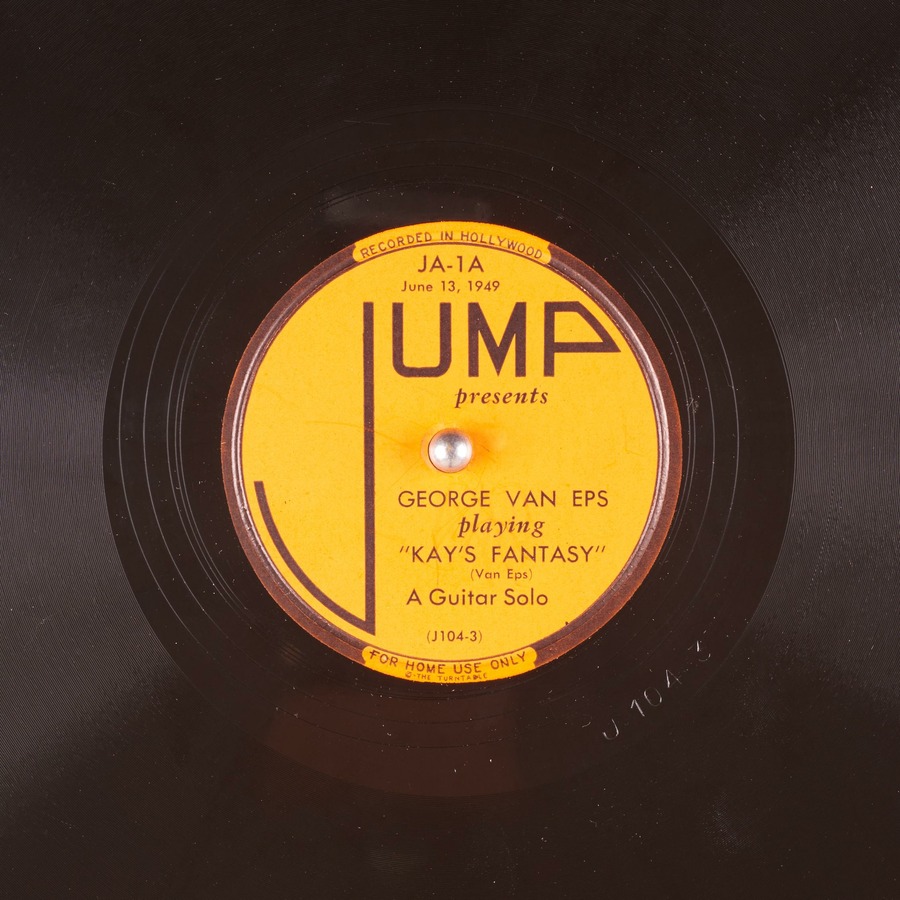
“Kay’s Fantasy” is one of Van Eps’ own compositions, recorded June 13, 1949 and named for his then-11-year-old daughter. Some jazz guitarists were known for a “single note” style that mimicked a horn’s sound, while others did more with chords. Van Eps did both, and both at the same time. It would be easy to jump to the conclusion that there are two guitars in front of the bass (Phil Stephens) and drums (Nick Fatool), but no – it was just George Van Eps doing what came so naturally to him. (3)
This is a complex tune that is augmented with some complex chords that sound almost like something from Dizzy Gillespie’s bebop style that was the cutting edge of jazz. At the same time, this piece swings like crazy and never loses a toe-tapping beat.
“I Wrote It For Jo” is another Van Eps composition that is slower and more in line with his later work. Many times, Van Eps referred to his guitar as a “lap piano”. He did not think in terms of basic chords or of a melody line, but rather, multiple continuous lines that came together in chords, but were always coming from somewhere and heading to somewhere. These “lines” made for multiple “voices” that often came out in a kind of counterpoint – easy for a two-handed piano player, but not so much on a guitar.
Van Eps was universally described as a kind and unassuming man, and also as being a brilliant intellect – two traits that are not often enough seen in the same person. But those characteristics come through on this track, recorded April 1, 1949, with bassist Jack Ryan and drummer Nick Fatool. Jo, incidentally, was also known as Mrs. Van Eps.
Finally, we have Van Eps’ treatment of a lesser-known standard, “Once In A While”, from the June, 1949 session noted above. I think this video chops the first couple of notes from the beginning of the piece, but with material so difficult to find online, allowances must be made. This version is interesting because someone has transcribed the notes to allow any guitarist with mad sight reading skills to try and play along. Van Eps takes this piece at a much faster tempo than normal, and his piano-like approach really comes through in a piece that can wow us all these years later, both for the performer’s technical mastery and for how listenable it is for we poor dumb non-guitar guys.
There was a fourth record released as part of the original 2-disc set, the well-known “Tea For Two”. I was not able to find the version originally released by Jump, but there is an un-released alternative take that has found its way online (here).
After listening to George Van Eps intricate playing, it should come as no surprise that some of his non-musical hobbies included watch-making (which he learned from his grandfather) and the building of both a full-sized seaplane in his garage and the world’s smallest (1/10th inch scale) operating steam locomotive. Imagination and hard work came out of Van Eps in all kinds of interesting ways.
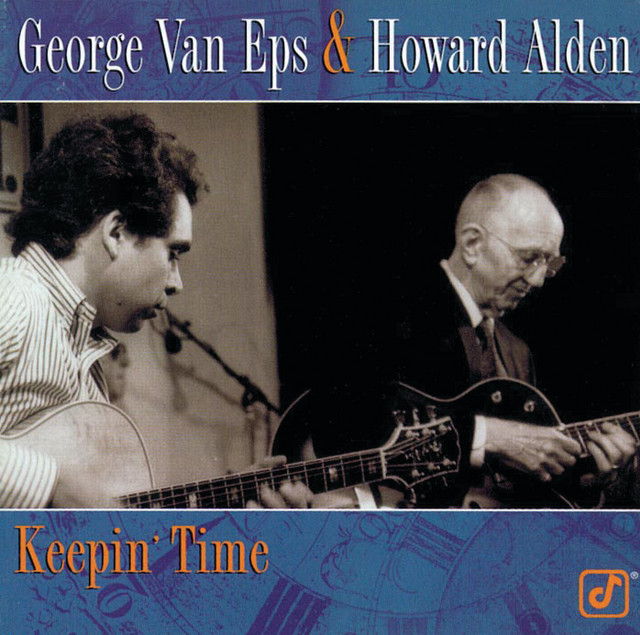
Van Eps eventually recorded a full album in the 1950’s (“Mellow Guitar”) and at least three others the following decade, including 1969’s “Soliloquy”. It was not until the 1990’s that his album output really got going, with at least 5 albums released on the Concord Jazz label, most of which were duets with other jazz guitarists, including another 7-string player, Howard Alden. George Van Eps continued playing in public (and sharing anecdotes from his long life) almost right up until his death on November 29, 1998 at the age of 85. His obituary in the Los Angeles Times reported that the bass player who managed their little group had to hire two guitarists to replace Van Eps.
You might think that after a solid 50+ year stretch of listening to old jazz from the heyday of the 78 rpm record, I would have heard it all. But every time I start to wonder if I have hit the farthest edges of what is available, I surprise myself with a rich new vein, like this one. The older I get the more I appreciate the jazz guitar. We have featured a couple of early stars of the guitar like Eddie Lang and Charlie Christian. Those two, along with Django Reinhardt (whose day here will come) are the best known, but this dive into my latest rabbit hole proves that there are others worth knowing. And George Van Eps is indisputably one of them.
Notes:
(1) The Guitar In Jazz, An Anthology, James Sallis, editor, 1996, at p. 97.
(2) 1949 Jump Records release of The Guitar Of George Van Eps.
(3) Discography information from album notes of a Jump Records release of this material.
 J. P.'s Blog
After giving a couple of those a listen, I think modern seven-string players might be under-utilizing the range.
I’m actively working on improving my own guitar playing skills, and doing the chords/rhythm and solos at the same time is one of those areas I’m focused on. The example I guess I would give is Freddie King’s Hideaway. (I even find myself a little conflicted on which to play when switching from lead to rhythm parts as in Pink Floyd/David Gilmour’s Coming Back to Life).
It’s fascinating to hear one guy do all of it.
It’s also kind of funny to hear how old the seven-string is. I’m not a Jazz guy, but some of the music-related stuff I’ve seen on YouTube intersects with Jazz — Though I admit my depth is shallow, I’ve never seen anyone do seven-string (guitar) Jazz. 🤔 I have seen a few extended-range basses, though (6-string, etc).
LikeLiked by 1 person
If you play a guitar, you are far more advanced than I am in the ability to assess playing styles. Before diving into this rabbit hole, I had no idea that the 7-string guitar was even a thing. And guitars of all kinds were really under-used for quite a few decades in jazz, despite their being around almost from the beginning once electrical recording in 1925 saw string players switch over from louder banjos. I also think the guitar is one of the easier ways for music fans to cross over from jazz to rock and back again. I’m glad you found something of interest in this, and good luck in continuing to hone your skills!
LikeLiked by 1 person
I think you’re right about the instrument’s cross-over ability. The under use of guitar in a band setting, of the type we’re discussing, makes a bit of sense. When you have an array of instrumentation that fills all the “gaps”, a guitar doesn’t really bring much a piano couldn’t do. Once you start paring down the sonic options, though… the guitar comes into its own more readily.
Thanks.
LikeLiked by 1 person
I’ve been listening to jazz for 50 years, and probably listen to streamed jazz radio, from both America and Britain, easily 20 hours a week, and I can’t remember ever hearing anything about Van Epps! Great entry this week, and another example of things unknown to be discovered still, every single day!
LikeLiked by 1 person
I know, right? I wondered if anyone reading has heard of him – and I figured that you were as likely as anyone if someone has. I love that the thrill of a new discovery can still happen even after all these years.
LikeLike
Thanks for the introduction. I wasn’t familiar with him.
LikeLiked by 1 person
You’re welcome. I don’t think very many are, but I think he deserves the exposure. Or maybe it’s us who deserve the exposure. 🙂
LikeLiked by 1 person
Good, now I can introduce Epps into conversation with my musician friends!
LikeLiked by 1 person
I’m here for you!
LikeLiked by 1 person
As others here are saying, I was definitely not familiar with Van Eps. And I’ll go further by saying that I had no idea that a 7-string guitar was even a thing!
He has a sound that to my ear is much more modern than Charlie Christian or Django. He brings to mind (ear?) some of the work of Chet Atkins. Thanks for the introduction!
LikeLiked by 1 person
I am embarrassed to say that I have not listened to Atkins. One source on Van Eps that I came across made the same comparison, so you have some company.
LikeLike
I can imagine you were surprised to find a new musician/jazz guitarist after immersing yourself in this musical genre for so many years (and to find even more for future posts). I wonder how some people get all the talent. George Van Eps had musical talent, yes, but reading about his non-musical hobbies was interesting too, maybe some hobbies to ease stress from his line of work, or also a backup plan in case the music biz ever faltered?
LikeLiked by 1 person
I think some people just have extra active minds and like new challenges.
LikeLiked by 1 person
Yes, this is true – I wish I was more like that!
LikeLike
Well that sent me down a rabbit hole. 🙂 The music part was nice, I don’t know exactly what I mean, but I feel like “Kay’s Fantasy” almost feels like a song from the ’60s but played in ’40s style. That one definitely grabbed me more than the other two.
But what really caught my attention was the steam locomotive. I’d forgotten that TT scale was a thing for a while in the US. Apparently it was much more popular behind the Iron Curtain and has remained somewhat relevant in Europe and the UK. I found a picture of Van Ep’s engine. Instagram and I’d say that is impressive model building at that size for that time even if it wasn’t live steam. That just makes it incredible. The smallest I’ve seen is one in HO scale which is about a third larger and that was pretty touchy to make work.
LikeLiked by 1 person
That is some excellent detective work on the train! I had wondered if the scale as I read it was a misprint, but evidently not.
I agree with you on Kay’s Fantasy. What’s really weird is that much of Van Eps’ outside work at that time was with a Dixieland group, so he could clearly play/comprehend/enjoy almost any style.
LikeLike
It almost sounds as if two people are playing. Good stuff. 🤣😎🙃
LikeLiked by 1 person
I agree, and apparently people who have more experience playing guitar do too!
LikeLiked by 1 person
Really enjoyed this post, J P. I never think of polished guitar – let alone jazz guitar – as dating back as far as the 1930s. I’m guessing its prevalence in 1950s rock ‘n’ roll makes me think it came along decades later. The “lap piano” description resonates with me, as it should with any piano player. Without it there was no way to comprehend how Van Eps plays the chords and the melody all at the same time. Of course, his abilities also requires his intelligence, which in my case feels woefully short after listening to his compositions.
LikeLiked by 1 person
It’s funny how jazz from the later 20s through at least the 50s made a guitar so common, but almost always as a background/rhythm instrument, so we got very little exposure to brilliant solo work compared wind players.
You would think that someone like this (especially one who wrote a method book) would have inspired lots of imitators, but maybe his combination of skills and intelligence makes imitation almost impossible.
LikeLiked by 1 person
Today, seven-strings are used a lot in hard rock and metal. My own bass is a five-string with a low string tuned to B, also prominent in metal but also gospel.
Long time Journey bassist Ross Vallory was known for tuning his four-string like a five-string, BEAD.
LikeLiked by 1 person
I had never thought about the number of strings on a guitar until I came across this guy. Now I am learning how much variety there is!
LikeLike
Pingback: Battle Of The Bands – Chick Webb And Benny Goodman Stomp At The Savoy. | J. P.'s Blog