Sidemen In The Spotlight – Four Classic Jazz Performances Where The Leader Defers To A Featured Soloist
Today we jump back into the fat years of big band jazz, but with a twist. In those days of the three minute record, time was scarce, and even the best soloists were given only a few bars to strut their stuff. But occasionally, a bandleader would dedicate a piece to a star soloist, who could stand front and center for the entire record. Let’s take a look at (and a listen to) four of them: Two pairs each of featured sidemen by the piano playing bandleaders Duke Ellington and Count Basie, and by those led by clarinet players Benny Goodman and Artie Shaw.
The musical ecosystem in the heyday of big band jazz was different from what most of us have grown up with. The bandleaders were boss, and the players (called sidemen) were employees. There was always plenty of collaboration, but that collaboration existed within a hired-fired relationship rather than the cooperative arrangements that predominated in the rock era.
And in that time, most all bandleaders were known for their prowess on a particular instrument. Count Basie and Duke Ellington were piano men, Benny Goodman and Artie Shaw battled each other with their clarinets, just to name a few. And of course, those leaders got plenty of solo time on their bands’ recordings and on stage.
There was, however, an interesting subset of old jazz records – those where an arrangement was written to feature a particular sideman. If you listen to enough of this kind of music, you will be sure to find a handful of records where one favorite soloist was put front and center.
Our first (and earliest) example is “Boy Meets Horn” from 1938, in which the Duke Ellington band features the cornet of Rex Stewart. Stewart was about four years into an eleven year tenure with the Duke when the two co-wrote this piece.

Stewart had the ability to play certain notes with an unusual fingering technique that pushed the horn’s valves only halfway, and gave the notes a “squeezed” sound. Ellington and Stewart composed this piece around those notes and that sound.

Duke Ellington’s music was always exquisitely crafted, with interesting chords and melodies, and this piece is no exception. The relaxed pace and easy swing make a perfect vehicle for Stewart’s horn. You will notice several places where Stewart seems to struggle – it is not because of his lack of skill, but because of the difficulty trying to get a cornet (a slightly deeper variation of the trumpet) to make sounds it is not designed to make, with valves pushed only halfway down.
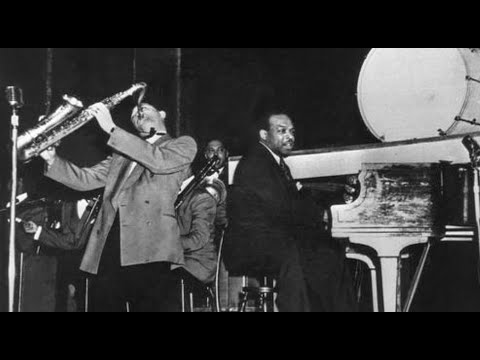
Next up is the band that was the polar opposite of Ellington’s – that of Count Basie. The tune is called “Lester Leaps In” from 1939, and features the tenor saxophone of the great Lester Young at the peak of his powers.
In some ways, this is a typical Basie record, with an opening theme followed by lots of solo time. Where it is not typical was in the group – it was not the full Basie band, but a small part of it that Basie called his Kansas City Seven. And while Lester Young always got plenty of solo time on Basie records, this time he gets it all, except where the Count takes his turns on piano.

Lester Young was one of the most influential saxophone players of his generation, with a light, airy sound and solo phrases that almost always went in unexpected directions. This is a prime example of Young’s craft in a loose, swinging record that is one of the best ever made.
The combination of Count Basie and Lester Young is as delicious as those of peanut butter and chocolate, or bacon and eggs. I cannot decide which I prefer – Basie’s background playing during Young’s solos or the way they throw phrases back and forth as they trade 8 bar solos. Take your pick, the whole thing is nothing but fun from start to finish.
Let’s turn now to this 1941 recording of “Solo Flight”, in which the Benny Goodman band features the electric guitar of Charlie Christian. This is a record I have shared before, in a deeper look into Charlie Christian, a pioneer of the electric guitar in jazz. In short, Christian became a mainstay of Goodman’s small groups but was not often featured with the full band.

The digest version is that Christian won over a reluctant Goodman and became one of the few who changed jazz guitar from a background rhythm instrument into something for the soloist’s spotlight. He is not well known today because he died at age 25 in 1942, the year after this record was cut. But musicians know him well enough to have inducted him into the Rock and Roll Hall of Fame in 1990.

The Goodman band of the early 1940’s carried on Goodman’s nickname “The King Of Swing”. Benny doesn’t completely step into the background, but it was unusual for him to give this much of a feature to a single instrument. The result is an unusual treat, in which an electric guitar and a big jazz band come together for three minutes of fun.
Artie Shaw didn’t lead a band so much as he led a series of them, and his 1944-45 version was one of his best. In his personal life, Artie Shaw could be a very difficult man (he was married eight times). But if a sideman made the cut to be in his band, nobody gave that player more respect and latitude than Shaw. This 1945 recording of “Little Jazz” went the whole way – The piece was written for, named for and carried by Shaw’s star trumpet man, Roy Eldridge.
Roy Eldridge had led his own bands and played in several others before Shaw hired him in 1944. Eldridge played with a fire and intensity that was rarely matched, and Shaw considered him as the spark plug that really ignited the band’s playing. “Little Jazz” was Eldridge’s nickname, based his short physical stature, but there is nothing puny about his playing, whether on this record or any other.

Artie Shaw’s clarinet was featured on almost everything his bands ever recorded, but on this disc he stepped aside to give his trumpet man an uninterrupted spotlight. Behind him, Shaw’s band drives as hard as Roy does and together they make for one of the best performances of the era.
These four records, each in a very different style from the others, make for a great microcosm of jazz from the era of the big bands. When it comes to these posts on jazz music from the old days, I view my role as sharing some examples that are worth remembering, and hope that these curated sessions give all of you something you can enjoy and appreciate. I think that there’s a lot to like here. I hope you agree.


Lester Young definitely leaps into that recording. His solo is a beauty.
LikeLiked by 1 person
Lester in his prime was quite a force!
LikeLiked by 1 person
Loved listening to these records. The image that pops into my mind is sitting around the large radio set in the living room during the pre-TV era, listening to these songs being broadcast from some big-city location.
Among Artie Shaw’s wives were BOTH Ava Gardner and Lana Turner. Gardner divorced him because he wanted her to give up her acting career. She later said he spurred her interest in reading and learning.
Turner, on the other hand, didn’t have kind words to say about him. Judy Garland was also interested in Shaw, but he married Turner instead. Garland was initially heartbroken. Turner, according to her daughter, later told Garland that by her getting Shaw to the altar instead of Garland, she had saved Garland from a “fate worse than death.”
LikeLiked by 1 person
I read a bio on Shaw once, and he told a story on himself that he marked a line in his coffee cup for how much coffee his wife (can’t recall which) was to pour. So yes, he was famously prickly. But sometimes it was a good prickly, like the time he got a theater manager fired because he wouldn’t let Roy Eldridge in, not believing that a black man was in a white band.
Lots of folks got this kind of music on the radio, often live from various famous locations.
LikeLiked by 1 person
You are so knowledgeable about the jazz artists and all the idiosyncrasies, you should think about compiling these jazz-related posts into a book – have you ever thought of doing that JP? I especially liked the photo of the head tilt by Lester Young to play his saxophone – it would be very uncomfortable to play for any length of time I would think.
LikeLiked by 1 person
Thanks, Linda! Really, I prefer this format to a book when it comes to music because I can do both my words and their music in the same place.
Yes, Young’s odd posture looks painful, but it was just his way. He was either odd or unique, depending on your perspective.
LikeLiked by 1 person
You do really know all about this genre is why I suggested it, but what you say makes sense too JP. Odd and unique are often interesting comparisons and I’d go with unique every time as it’s more flattering. 🙂
LikeLiked by 1 person
This is a great look at how sidemen were used in this era. Hard to believe all this great music was shoved into 3-ish minutes! Can I just say: Lester Young, killer pork pie hat!
LikeLiked by 1 person
Not everyone can pull off a pork pie hat, but he did!
I think the time limit on recording in that day forced a lot of self-discipline in the way of mental editing that made them better players.
LikeLike
I think Mingus wrote “Good Bye Pork Pie Hat” as a eulogy when Lester Young died. I recently bought the 4 CD set Joni Jazz, the heavily jazz laden cuts of Joni Mitchell, which contains her variation of the cut, with words that she wrote, when she was working with Mingus towards the end of his life. Apparently, she was not the only person to write lyrics: a few people before her did as well. No mystery that a good hat style can define you!
LikeLiked by 1 person
Prez “made” his own pork pies:
https://mosaicrecords.tumblr.com/post/149805572483/lester-young-how-to-make-a-pork-pie-hat-the-pork
LikeLiked by 1 person
I did not know this. Love it!
LikeLike
Great stuff. Back then they ised all the instruments. Not just Guitars and drums. It was better. 🤣😎🙃
LikeLiked by 1 person
Even better, everyone played together and it was all captured in a single take with no post-performance processing.
LikeLiked by 1 person
I do some minor audio recording, especially interviews, for media use, as well as having done live, reel-to-reel recordings in nightclubs of bands back in the late 70’s to early 80’s. I’ve done some deep dives in recording technology research, especially since the war and the adoption of the German patents on magnetic tape recording. It is amazing the quality level of some 50’s and 60’s jazz recordings on mono, two track, and in some cases three track (usually a movie full coat recorder), done within a few takes, with a few microphones and through some limited track mixers, direct to tape. I’ve read stories about the bands being so good, that the band themselves would “move up” or “move back” from a mic to lower, or increase audio presence at the right times! When you hear about modern “ear worm” pop songs that might have been assembled from 80+ separate tracks, you just have to shake your head!
LikeLiked by 1 person
Yup. It must have been very different
LikeLiked by 1 person
I knew “Lester Leaps In” from some compilation CD I have, but didn’t know the origin of the name.
LikeLiked by 1 person
Once you get familiar with Lester Young’s sound, you can almost always pick him pick him out, like on the records where he backed Billie Holiday in the 30s.
LikeLike