Silly Habits – Wherein The Author Confesses His Life-Long Quest To Track His Fuel Mileage
OK, it is confession time. We all have quirky habits. Those are the habits that we start when we are young and that are kept up, year in and year out. Eventually they become second nature. Later our children laugh at us for the habit, but that doesn’t stop us. Mine? I calculate my fuel mileage each time I fill my cars up with gas. There. I feel better. Here is how it all started. And why I can’t stop.
Actually, I have no idea why I started this. My father never did any such thing. Fill the tank and drive until it is close to empty, then do it again. But whenever we would take a childhood trip where Mom drove and my grandma was in the passenger seat, each fill-up would be recorded in a little note book, and fuel mileage would be calculated. I don’t remember the outcomes, but I remember the process.
So, when I got my first car, my mother presented me with a little notebook. “So you can keep track of your gas” she said. She did not go on to explain why I should do this, and I did not think to ask. It is just one of those things that comes from being raised by Germans – certain things are done and there is simply no reason to question them.
I do not know where the books are from that car, but to this day I can tell you that my normal fuel mileage on my 1967 Ford Galaxie 500 convertible with its big V8 engine was in the 10-12 mpg range around town, and as high as 16 when I got it out on the highway.
The process is still the same as it was. You start with a little notebook. I have two – one is the smallest “composition book” I have ever seen, at 4 1/2 inches by 3 1/4. The other is a spiral-bound memo notepad with Garfield the cat (copyright 1978) on the cover, and a price tag boasting that someone bought this 59 cent notebook for 54 cents.
Each time I start a new page I make headings for six columns: Date, odometer reading, number of miles since the last fill, gallons purchased, calculated mpg (miles/gallons) and total cost. Don’t ask why the columns are in that order. This is just the way it is done, and who are you to ask silly questions, anyway.
One of these little notebooks has been in every car I have ever had. You may be impressed by my powers of persuasion when I relate that I even convinced Marianne to fill in the basic date/odometer/cost info back in the dim, distant past when she actually filled cars with gasoline made from fresh dinosaurs. I eventually took on the job of keeping gas in both cars. Partly because she didn’t like doing it, and partly because I am such a great husband. And maybe just a little bit because she always wrote too big in my little notebooks, making it hard for me to go back and fill in the other numbers. Which I did because, hey, this stuff is important.
It takes a long time to fill one of these books. The one in my drive-to-work car goes back to March of 2009, when my cheap-used-car fetish landed me a1996 Honda Odyssey minivan. With 207,923 miles on the odometer, I can state with boastful exactitude. That car was totalled in an accident – on the way home from the gas station (2/12/2010, 218,461 miles). Because I know you are dying to ask, mileage on that final tank of fuel was 16.59 mpg.
That book transferred picked up with my next cheap used minivan, which died of a transmission failure (shortly after a fill-up on 9/9/2011 at 209,786 miles and 20.16 mpg) and then to the new minivan which replaced it on 9/28/2011. For those who are curious, that minivan (with a powerful V6 engine) routinely got 16-17 mpg in all-around driving and could get into the mid 20’s on a trip.
The book in the new car has entries going back to April of 2003, which was about 8 years into our ownership of a big Ford van which served as our main family vehicle. That big van had the tightest MPG range of anything I ever owned, never getting higher than 16 mpg and never dipping below 10, until its last several months with us when it was well over a decade old and with over 160,000 miles. Yes, we are of the “drive it until you can’t drive it anymore” demographic. I probably have the prior book somewhere.
Through the years, I justified the practice as a way of keeping an eye on how my cars were running. If there is a big dip in fuel mileage, that can tell me that there is a mechanical problem that needs to be addressed. Never mind that for at least the past 25 years there is a “check engine” light and a plug for a scan tool that will spit out computer codes for almost every conceivable problem. But yes, I’m an analog guy.
This habit actually came in handy during my years of self-employment, where my tax forms required the starting and ending odometer readings necessary for taking vehicle deductions for business use. Because I always filled up within a day or three of New Years’ Day, that figure was either in the book or a quick estimate away. Of course, the government didn’t care about how many miles per gallon I got. That was just for me.
Over the past year it has become apparent to me what an ingrained habit this has become. Do you know how? Because I keep it up despite having both of my cars calculate their fuel mileage for me. My old 2007 Mazda has averaged something close to 25 mpg since I got it (most recently 26.6) , and my new V6 Dodge Charger has a lifetime fuel average of slightly over 21 mpg (and 20.09 the last tank). Which is pretty impressive for a car that has only been on one multi-day highway trip and that weighs about the same as (but is far more powerful than) my old ’67 Ford of close to 40 years ago. And besides, I can have the best of both worlds – my car automatically tracks its lifetime average, and I can avoid re-setting the car’s built-in system every tankful because I track that manually. Yes, information is power. Not a lot of power, and don’t ask me what the power can be used for, but power it is, and I will take it where I can get it.
I do possess enough self-awareness to realize that my children (and probably all of you now) roll their eyes at this careful, deeply ingrained habit of mine. Please feel free to poke fun at me in the comments below. Although I know that all of you have similarly embedded habits of questionable utility of your own. In any case, here we are. I have kept these records going for uncomfortably close to 50 years, and I see no benefit to stopping now. And perhaps I should find a new notebook just in case I outlast one of these.
 J. P.'s Blog
I love this! Especially since it gives you an idea of your mileage vs. what the car company says you should be getting. It took me about ten years after I quit my own business to quit keeping a mileage book for trips I could possible “write off”. I just got into the habit and kept it up, buying the little blue book every year. Even then, I felt bad about it for about six months after I quit…
LikeLiked by 1 person
Yes, I know I would feel rotten if I stopped! Sometimes it can be a downer – I never got the kind of mileage out of my tiny Honda Fit that I thought I should be getting, but then a check on Honda forums showed me that I was not alone. There was something odd about those – some people got fabulous mileage figures and others did not. I am not a hot rodder and should have done better. My current Mazda is a little bigger and far more powerful, and I come very close to MPGs I got on the Honda.
LikeLike
I have to laugh, my dealership begged me constantly to change my intake air filter (not the cabin filter) on my 2005 Scion xB “box” (a car I loved so much), when I would get an oil change. I kept telling them, since they had an air hose, to just blow the dust off the old one. Finally, the mechanic was practically on his knees begging me to do it, so I said “go ahead”. The next day, I swear I was getting easily 8-10 miles more a gallon! I mean, it was noticeable! Live and learn!
LikeLiked by 1 person
I did this for a brief while with my old ’89 Mustang with its ground-pounding 2.3 liter four. Then, one day I asked myself what this accomplished, other than mimicking a weird habit of my father’s (who likely gave me the book, also). That’s when I gave it up.
Now, I will admit to more often that not calculating my fuel mileage but filing it away in my mental spreadsheet. I think that started with our fuel-swilling pig 2001 Ford Taurus and resumed when we bought the VW Passat in 2014 (which hit the 100k milestone yesterday) as I was not accustomed to good fuel mileage in anything I owned.
You’re doing this does surprise me, somewhat. However, I don’t think there’s anything wrong with this. If you included time, temperature, and relative humidity, well, then that could be considered overkill.
LikeLiked by 1 person
Haha – it’s a good thing my mother gave me such a small notebook, or I might have been tempted to add data over the years! 🙂
One thing this habit does is prove that sometimes putting up with a smaller car does not necessarily pay for itself in fuel savings. I can remember when I was first married and owned an 83 Plymouth (Mitsubishi) Colt, with a manual transmission, vinyl seats and a crappy aftermarket air conditioner. It really did not get significantly better MPGs than Marianne’s much larger, smoother and nicer Honda Accord. Ditto my Honda Fit, which struggled to cross the 32-33 mpg threshold even on highway trips – a figure easily attained by far larger and more comfortable cars (though mine would do better in city traffic).
LikeLike
My grandpa was obsessed with fuel mileage, and obviously no car on the road got better fuel economy than ‘that there [Crown Vic]’ (or whatever it was at the time). I drive a 2015 VW TDI Jetta, and I feel cheated if I don’t get around 600 miles to a tank.
LikeLiked by 1 person
Now that I have two cars that do calculations for me, my remaining miles per tankful readout is the one I obsess over! Both cars have a range of over 400 miles on a tank, which is pretty good for anything that is not a diesel VW. My sister has a Jetta TDI wagon of that general age (with a manual) and says she gets 50-60 mpg on her daily 100 mile round trip commute to work. If I had that kind of commute I would want something like that too!
LikeLiked by 1 person
Yep, mine’s a 6-speed manual too (though mine is the sedan). And I used it for commuting between Colorado Springs and Denver for many years. It’s our typical road-trip car, and we’re nearing 222000 miles on it.
I never really bother paying attention to the car-calculated values: I figure the car is probably doing some sneaky math to display so you get the Feel Good… Do you verify your display numbers with your notebook? (Obviously, I wouldn’t want to push the miles-remaining to the limit…)
LikeLiked by 1 person
I have always wondered about “miles to empty”. A friend once told me he got to zero then started seeing negative numbers.
I have wanted to put a can of gas in the back and drive my Mazda till it runs out, because I think the miles-to-empty display is extremely conservative. But then I imagine getting rear ended with a can of gasoline in the rear of a hatchback and decide it’s just not that important.
LikeLiked by 1 person
Well, unless your hatchback is a Pinto, you might be okay. But I also completely understand why you might not want to risk it.
LikeLiked by 1 person
I too, record kilometer reading, total litres, and cost of purchase at each fill up. I leave the mpg (kpg?) calculation until later, or if ever. It gives me a little booklet that like yourself, tells me the final mileage (kilometerage?) reading at the end of a car’s life, or at a glance, how many klicks I drove in the past rolling 12 months. (Yes I can still do the Canadian Imperial measurement system.) Sure my kids scoffed at me, but I think it is a good tracking system. I made them write it down if they filled up my car any time. One son was more compliant than the other unfortunately! LOL
Now as for time of day, relative humidity, and tire pressure reading, and brand of gas bought, well we’ll have to table that for another day!
LikeLiked by 1 person
Yes, I got my kids to write it down too whenever they put gas into one of my cars! I love having some company on this!
LikeLike
when Mark Knoller died a few weeks ago, I read that he also had a quirky obsession, which I think you would appreciate. https://www.cbsnews.com/news/mark-knoller-archivist-of-the-american-presidency/
LikeLiked by 1 person
Haha, I read this right after he died. I remember thinking “Good for him!”
LikeLike
I think it’s a great idea. I did something similar when Mrs. Herb was an active home-care CNA she would get paid mileage by some companies and I would just track it all, including gas mileage. I ran across a couple of them the other day. occasionally it would say on a page things like, “Snow and Ice,” etc. This habit seems normal to me. Now that you talk about it, I wish I had thought of it back in the olden times.
LikeLiked by 1 person
It’s never too late to join the team of borderline OCD record keepers! 🤠
LikeLiked by 1 person
I did this for a few years when I had my 2003 Honda Accord EX. I averaged about 24 mpg, but that was mostly driving in town, and when I was on the highway, I kept it at 70+ mph. I also tracked the price per gallon of gas, which was interesting, as this was during 2003-07, and gas prices spiked upward during 2005.
I wonder if the Fit’s low gas mileage was because it was necessary to work the engine hard to keep up with traffic?
LikeLiked by 1 person
It was my take that there was something about the cars themselves. I always wondered if it had to do with the variable valve timing – others described a distinct sensation when the valve train switched from the low rpm profile to the high rpm profile, but I never felt that. However, the car ran well and I never bothered to investigate further.
LikeLiked by 1 person
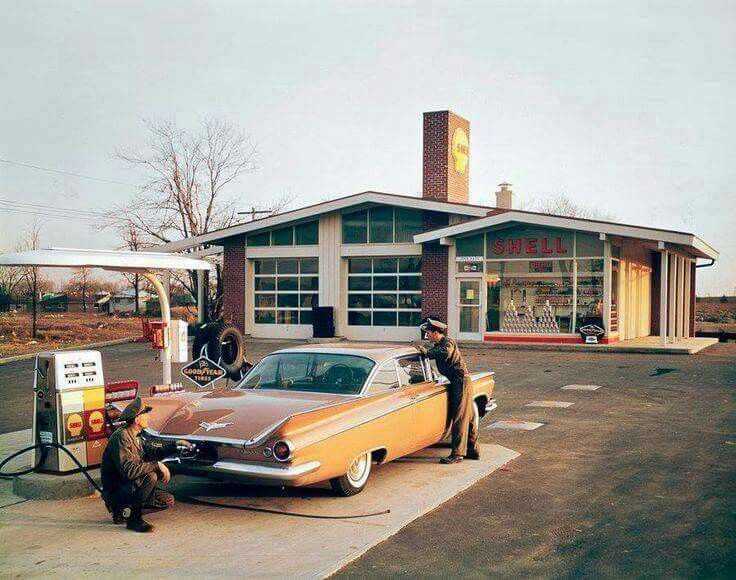
Gas stations used to give you these cardboard calculators to help you figure out your miles per gallon. Now your car does it for you–even “instantaneous” MPG.
A motorist’s biggest expenses are depreciation and repairs (and insurance). But for some reason, a lot of people are obsessed with MPG. I think the gas crisis of the 1970s messed with people’s minds. But even before that, how many miles per gallon your car got was a big topic of conversation.
Constantly figuring your MPG on paper is like people who still manually balance their checkbooks–even though everything is now available online. My mother has been doing this for over 50 years. “The bank might make a mistake.” I asked her, have you ever found an error (that was the bank’s fault?) “No.” She keeps doing it anyway.
My new thing is “Everything has to be re-evaluated and justified.” There’s no reason to keep doing something just because “That’s the way we’ve always done it.” I’m trying out new clothes, new habits, new experiences, new points of view. Every moment is a new moment, the past has burned away, and you have the power in the present moment to start fresh.
https://www.ebay.com/itm/386164179858
https://www.ebay.com/itm/385996462913
LikeLiked by 1 person
I actually don’t “balance” my checkbook, in the old fashioned way, but I check all checking debits and “adds” for accuracy (I trust the computer can add and subtract correctly). The answer is “yes”, I’ve actually found entires that were “off” and never in my favor, and maybe every couple of years, some small, some larger than expected. The last time I found one, I went into the bank with my receipt and statement, and the bank branch manager, who corrected it, said: “…boy, nobody checks this stuff any more, not like this.” Just when you think everything is so easy to do, some retailer figures out how to add more of a debit onto your bill after you’ve walked out. If all those on-line and smart phone banking services worked perfectly and were an aid to money management, half the millennials I know wouldn’t be walking around getting overdraft fees all the time! Or there wouldn’t be all those “no overdraft fee” bank accounts available and being marketed to the money management bereft!
LikeLiked by 1 person
I remember those cardboard calculators, always thought that they were cool.
I have not balanced a checkbook with a paper statement for years, and truthfully, feel a little guilty about it. Such is the fruit of being raised by Germans.
You make a good point about dropping old things and trying new ones. But with all of the change being forced on me in so many parts of life, I find some comfort in old familiar routines.
LikeLike
This post made me smile JP. I’ve mentioned before that I keep track of my mileage, so I can see how many miles I go each year. Each trip out in the car, I update my list. I also keep track of when I fill up – for me, about once a month in nice weather. But …
When I had the Regal with its many quirks, suddenly the gas gauge stopped working. It always registered “full” – sigh. I dealt with that quirk for several years, using a little book to record my mileage when I filled up, just as you use and which I kept in the glove box. So, I’ve gone to the same mechanic now for about 25 years and when I went there originally to ask about a “fix” for my horn with the mushy horn pad that the recall didn’t fix, (to eliminate the need to use a fuse puller to pull the fuse out when I wasn’t driving it), I said “could you fix my gas gauge at the same time so I don’t have to keep track of my miles on the odometer to know when I need a fill-up?” The then-manager, who has since passed away, was great and always nice to me. He said “you don’t want to pay to have the instrument panel taken off and torn apart just to keep track of your gas tank – just keep writing it down and keep track of it that way. Sometimes we would tear it apart and it still won’t work.” So that’s what I did, always ensuring I had at least a half-tank of gas. A minor inconvenience for a car that had a lot more serious quirks, recalls, etc. than that one.
LikeLiked by 1 person
I had a car that the gas gauge would go to “full” in wet weather. Fortunately, it had a straight filler pipe and I could run a wooden stick down it to check the fuel level.
LikeLiked by 1 person
Hmm – well, I had to resort to the mileage log, but I had a VW Bug that sometimes would not start in wet weather … a heavy rain or snow and I was outta luck and wore out my welcome on my auto club insurance and they cancelled me. The Bug was buggy literally, a lemon from day #1, having slid down the driveway after leaking red fluid in the driveway and ending up in the middle of the street the day I brought it home brand new from the dealership.
LikeLiked by 2 people
I read this post to my husband, who has kept track of the same things for most of his vehicles. These days he writes the odometer reading and the miles since the last fill up (which the car tells him) on the gas receipt. Then he transfers that to a spreadsheet where he can calculate all the other things he tracks. He likes the spreadsheet because then he can create graphs!
Like you, he uses this information as a confirmation that everything is running okay or that something needs to be fixed. In years gone by, when he did most of his own repair work, the data was important.
LikeLiked by 2 people
Ooh, I never thought about transferring the data to a spreadsheet. I like it! Both current cars are recent enough acquisitions that I could do this without too much effort. My periodically recurring OCD thanks you!!
LikeLiked by 1 person
Once you know how to use Excel, it’s hard not to find uses for it! I’m currently tracking my sub-$20.00 champagne reviews and quality on Excel; much to the chagrin of my also retired friend who I share champagne with (and who was in finance). I also track my fedora ownership by style and color!
LikeLiked by 1 person
I don’t remember if I have always done this or if I started in the ’90s when I had an Aerostar with a gas gauge that worked when it felt like it. The gauge definitely did not work at first when I got the ’65 Chrysler, and with slightly too small tires, the odometer was off, so I had to add 7% to the miles travelled to correct for that.
I am curious if your modern cars that calculate the milage do so accurately? I note that figure as well as my calculated one for each tank. The ’95 Olds 98 was dead on accurate. The ’96 Olds 98 was consistently high by exactly 10% and my ’04 LeSabre is always 1-4 mpg too high, but with no discernible pattern.
LikeLiked by 1 person
I need to start checking this. I glance at the calculated figure but it goes away when I zero out the trip odometer, which I do before I fill. Perhaps I need to wait to zero it out until after my hand calculations.
LikeLike
And I’ll bet the figures on your Chrysler are grim! The ones on my 68 Newport certainly were.
LikeLike
I certainly wouldn’t want to drive it every day. Between Aug 14 & Aug 24 I did the Back to the Bricks cruise in Flint, A day at the Woodward Cruise and 6 days on the Old US-27 Tour. 1613 miles and 12.5 mpg. The best I have seen was 15, that was a long steady highway drive with basically no city at either end.
The good news is I have it tuned to run happy on 89 octane and don’t need premium.
LikeLiked by 1 person
I used to do this, and probably still have some of the notebooks somewhere. It was mostly pointless, particularly during the years where I was tracking the mileage of a diesel VW Rabbit (since the answer nearly always was that I could drive another 400 miles or so before needing to get fuel). But I have to say that this was one of those habits that vanished once kids came on the scene. The chaos introduced by two little people tossed into life at a relative point (we didn’t have kids until our mid-30s) simply wiped the slate clean so far as ability to tend to things like habitual record-keeping. At least that’s my excuse.
Ironically, I started the practice up again only for the car originally purchased for one of those two little people when he hit driving age. The 40-plus (at that time) year old Volvo with it’s eternally wonky electrical system necessitated keeping track of mileage so as not to miss buying gas; ’cause lord knows the fuel gauge gave nothing but meaningless info. The kid took quite well to the practice (he’s subsequently become a professional mathematician, go figure) and now that the car’s become essentially mine, and I’ve probably (probably) fixed the fuel gauge so that it’s mostly (huh?) reliable, I continue to do it. For that car only.
I’m surprised about your experience re. the Fit’s mileage. The one we have here (which is now being driven by the kid who used to drive the Volvo) seems to reliably get in the high 30s and I’ve had it up to the mid-to-low 40s on highway trips. Fuel economy is one of the most stellar features of that car.
LikeLiked by 1 person
I had one kid (who was the thriftiest of my 3) who could get the Fit right up to its EPA highway number of 37, but I never accomplished that. My mileage on highway trips (usually 32-33) was mighty unimpressive for the noise level and lack of legroom I got in the bargain. I always kept tire pressure up to 35-36 psi and did plugs/wires/air filter from time to time, but it didn’t help. I doubt that my other son, who has the car now, tracks mileage.
LikeLike
I used to keep track of gas mileage on my first car, maybe even my second one. But I had a friend who kept it his whole life until he died in his late 70’s. His widow got a big laugh when she told mourners that at least she will no longer have to track gas purchases and mileage. Some new cars do it for you on the dashboard.
LikeLiked by 1 person
Yup, both of my cars now do it for me. But I can’t quit. I wonder if there is a support group.
LikeLiked by 1 person
I wouldn’t have a clue what my mileage is – I don’t even know what is considered good mileage but then we are litres here in Canada? I guess I’ll find out when I (eventually) car shop. But it seems many of your readers (males and female) do record, so you’re not alone in your habit. My car OCD habit is I don’t pump gas – I avoid self serves, and will drive miles out of my way to find a gas station where they do it for you, which I admit is getting harder to find. although I don’t fill up as often as I used to. This habit stems from my childhood, when the smell of gas/diesel on the farm (the gas tank was in the driveway next to the garage, surely a safety issue now) to fill up the tractors used to make me feel sick/nauseated. I also admit to balancing my chequebook occasionally, although not as often. I toss all the debit slips into a pile and then match them up maybe every couple of weeks. Not sure why I do that, but yes I have occasionally found mistakes. Once they debited someone’s rent cheque for $700 from my account which was from someone who lived two hundred miles away because the account number was mis-read? Not sure that would happen now with everything so automated.
LikeLiked by 1 person
That’s funny, I LOVED the smell of gas when I was a kid. But then I didn’t live next to it.
LikeLike
I used to do this. Stopped by 2005. A change in mileage used to warn me about potential engine trouble. But at some point I realized it wasn’t doing that for me anymore, and I stopped.
LikeLiked by 1 person
I guess I must still be doing it for me. Whether that’s a good thing or a bad thing, I’m not sure.
LikeLike
Interesting… definitely not something I’ve done. I have thought about writing down walking stats. There was a lady who did this so she would know when to buy new gym shoes.
LikeLiked by 1 person
Walking stats – there’s something I don’t even think about! 🥱
LikeLiked by 1 person
I wanted to compare your habit to mine of catching the odometer every time it hits an interesting number (ex. 123456 is a gem), but the better comparison is my mother-in-law’s hand ledger. She tracks the checks she writes and the cash she spends in a long handwritten list with similar detail to what you’ve got going with your fuel usage. Then she proudly presents her pages to her CPA every April, convinced the information is critical to her return. Her CPA is a good sport and doesn’t push back. I’ve never had the heart to tell my mother-in-law her ledgers play no role whatsoever in the final numbers.
LikeLiked by 1 person
Your MIL’s habit was another that my mother attempted to pass down to me. For several years I maintained a small ledger book where monthly expenses were recorded. But I never made the leap to writing out where my cash goes.
LikeLiked by 1 person