A Happy 100th Birthday to Sweet Georgia Brown

For the past few years, we have looked back at the top songs from a century past. We have seen novelty songs (like “Yes, We Have No Bananas” from 1923) and semi-classical pieces (Gershwin’s “Rhapsody In Blue”, 1924). Well, 2025 is now on its waning side, so your author had better get busy and find something worth remembering from 1925. And so we have.
It is tough to pick a “top song” from a given year from that bygone era. Some sources try, but popularity of songs from the 1920’s is a tough one to figure. There were sheet music sales, because lots of people played music on their own pianos. Then there were piano rolls for those who liked their pianos to play themselves. By the 1920’s, phonograph records were big business and all the popular songs were on them, by what seemed like a bazillion different performers. Radio was in its infancy, but hundreds of bands toured the country playing the songs of the day. This is a long way of saying that trying to pick the No. 1 song from any year before WWII is folly.
A contender for the title is Sweet Georgia Brown. This has become an old standard played by jazz performers from the beginning until today, so let’s have a listen to a few noteworthy versions. We should point out that there are few really definitive renditions of this one. Instead, it is a song that has lived on through recordings by artists as disparate as Louis Armstrong and The Beatles. But seeing as how we focus here on vintage jazz, let’s listen to a small sample.
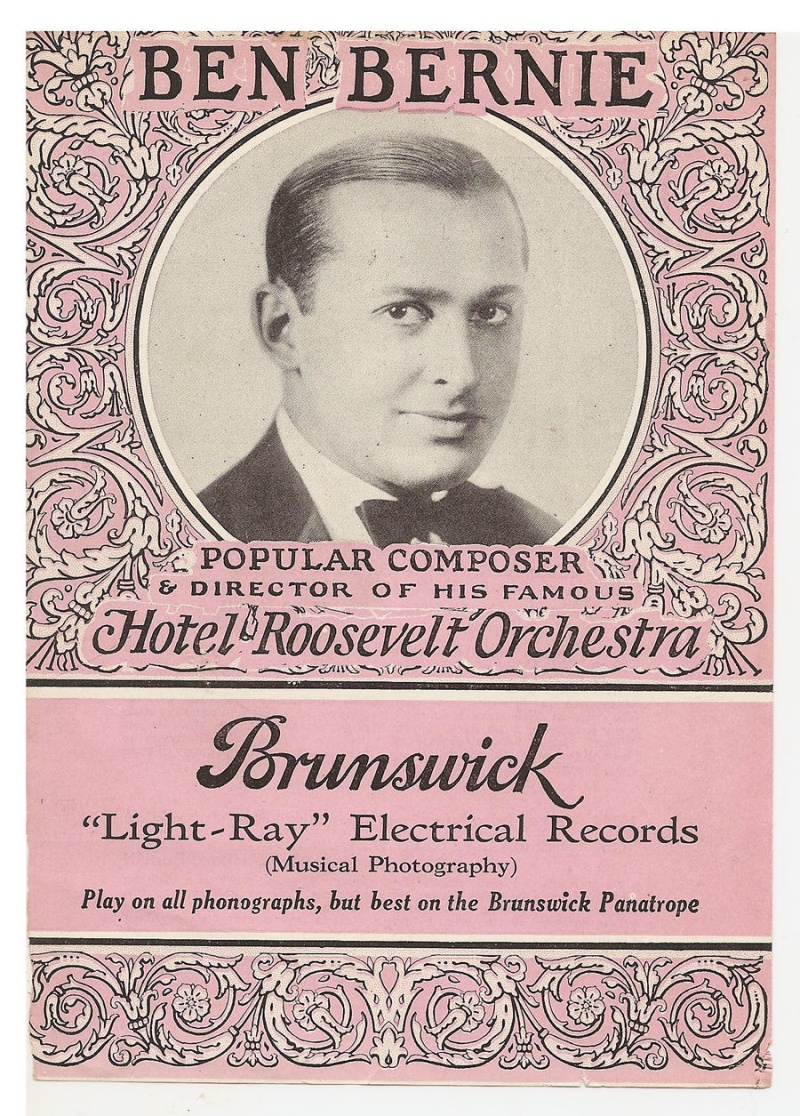
The song was written by bandleader Ben Bernie and Maceo Pinkard and was first recorded as an instrumental version by Bernie’s Hotel Roosevelt Orchestra on March 19, 1925, possibly before the lyrics were added by Kenneth Casey. Bernie was an early radio star and was known for his on-air expression “Yowsah, yowsah, yowsah!”
The record was made at the tail end of the acoustic recording era, which was soon eclipsed by electric recording technology (which we covered here). But that did not matter to the record-buying public because the tune shot to the top of the sales charts, and was as popular as any song introduced that year.
Did you know that there were genuine sound movie shorts as early as 1925? I didn’t either, but we have one here. That year Bernie and his band were captured on an experimental PhonoFilm, a short-lived format pioneered by Lee DeForest, inventor of the vacuum tube . This film, with an electrically/optically recorded sound track, has better sound than the original record, which can be heard here, and it is also a more spirited performance. It is fun to watch the boys get into the rhythm of jazz from before the swing era – something we can only imagine by listening to the record.
The Benny Goodman Quartet recorded the song in October of 1938. For some reason, this tune has found much more favor with smaller, looser jazz groups than with arrangers for the big swing bands that ruled during the 1930’s and 1940’s. Lionel Hampton (vibes), Teddy Wilson (piano) and Dave Tough (drums) accompanied Goodman on this cheerful version.
After WWII the song came blazing back in a novelty version that probably became the most famous version of them all. This is such an enduring recording that we cannot just skip over it, although we covered it in depth here quite a few years ago. This novelty record by Brother Bones & His Shadows hit the charts in the later months of 1948 and stayed there into 1949. You will recognize it as the theme which the Harlem Globetrotters adopted in 1952 and has kept ever since, though with some modernization in recent years.
Here is another (and more traditional) jazz version from around the same time. The great Canadian pianist Oscar Peterson put his own trio to work on the piece very early in Peterson’s long and prolific career. The online videos I found date this as being from 1947, but a Peterson discography at jazzdisco.org says that it was recorded March 1, 1949 in Montreal for RCA. Unless it has missed an earlier version, I will put my money on the discography. And this date makes more sense, after the Brother Bones record had made such a splash in dusting off the old tune. As always, Peterson’s mad keyboard skills are a listener’s delight.
You have probably been wondering about the lack of vocal versions thus far for a song that has lyrics. Let us address that now, and here is a good one. Ella Fitzgerald put her unmistakable stamp on the tune, backed by the Marty Paich band on a 1966 album. Ella was still in fine voice when she turned up the heat on the old song.
Lest you think that this century-old song died off with all of the performers noted so far, it is still a good option for jazz groups today. This last sample is one that is new to me. This 2021 live performance was by the German guitar player Joscho Stephan and his quintet. Stephan follows the “gypsy” style of jazz guitar, long ago popularized by Django Reinhardt – someone I really need to profile here – and does a really nice job of it. This piece is longer than the rest, but is a fun way to close out our brief celebration of this century-old song and is sure to bring a smile to all but the most sour personalities.
This is what I love about vintage jazz – even a single basic song can come in a million different flavors, most of them quite good. I also love how a little ditty from a century ago can continue to live and breathe through multiple generations and still be fresh. Georgia Brown is as sweet today as she ever was.
 J. P.'s Blog
Good music outlasts us all!
LikeLiked by 1 person
Indeed it does!
LikeLiked by 1 person
Great musical story! I’ll say the same thing that you note about vintage jazz in reference to almost any popular music. During COVID, I became a part of a Zoom-based group that met monthly to discuss music, each member presenting on some piece they chose. My regular presentation was to take something like Sweet Georgia Brown (I recall doing this same thing with various versions of Casey Jones over time) and trace it through popular culture. Usually starting in the late 19th century to the present. (Sadly, that group broke up once the culture took a turn against virtual meetings and did the throw out the baby with the bath water thing that all too often happens.)
Your PhonoFilm clip is a terrific reminder that technology takes so many twists and turns before settling down on one solution — usually that championed by some producer with deeper pockets than everyone else wins the day whether or not it’s technically “the best” solution. That’s definitely the story with automotive technology, and it was also true with motion picture technology…from the development of actual movie cameras and projectors to color to sound. Looking at the various breadcrumbs left along the way (or some may say road kills on the road to market domination) is fascinating.
Those PhonoFilms are largely forgotten, but it may be interesting to some to know that another source of content for those (although I really love Ben Bernie!) were the Max and Dave Fleischer studios. The same folks who later gave us Betty Boop and Popeye (among other things). Early Betty Boop shorts featured Ko-Ko the Clown (memorably as voiced by Cab Calloway in the Fleischer-produced St. James Infirmary Blues cartoon), and Ko-Ko got his start in the Out of the Inkwell shorts…which were made as PhonoFilms in the mid-1920s.
This is also where the “follow the bouncing ball” thing started. In the linked clip, the music is no where near as good as Sweet Georgia Brown, but then again, as a piece of a cinema program that was likely playing to an audience that included a bunch of guys who had just returned from World War One a half-dozen years before, it was probably pretty well-received.
LikeLiked by 1 person
As I got into this, I thought the PhonoFilm thing really deserved its own story, but decided that I had best try to ignore that squirrel and stay on task! I loved the Fleisher piece. I knew about that series they did with jazz performers in the early 1930s, which I believe were called Screen Songs. I know the Mills Brothers and the Boswell Sisters sang on a couple of them, in addition to Cab Calloway.
If you really want to fall into a rabbit hole, you ought to click on that link to my older piece on the Brother Bones record. That features a long-forgotten instrument called a Novachord, which I had never heard of before I started researching that record.
LikeLike
Rabbit hole gladly fallen into!
Much to say there, but I’ll just leave it at the fact that 163 vacuum tubes must have produced a wonderful smell (I always loved the smell of our old tube TVs, stereos and radios), and a tremendous amount of heat once fully warmed up. Great stuff!
LikeLiked by 1 person
I know, right? I remember loving the orange glow from the tubes when I would look into the backs of old televisions, through the little holes in the fiberboard back panel. I’ll bet a Novachord would have been a sight to see, all warmed up in a dark room with the lights off!
LikeLiked by 1 person
We recently fostered a dog for our local rescue. The dog’s name was Georgia. Couldn’t get this song out of my head the entire time we took care of her!
LikeLiked by 1 person
Haha, I can only imagine! I am sure I would have done the very same thing.
LikeLike
I played the first version, and kept thinking, “I’ve heard this before.” But I couldn’t quite place it. Then you mentioned the version used by the Harlem Globetrotters, and it clicked! Thank you.
On another note, the 1978 disco single by Chic, “Dance, Dance, Dance,” uses the refrain, “yowsah, yowsah, yowsah” repeatedly. I remember Casey Kasem of American Top 40 solemnly telling us the origin of that phrase, which otherwise made no sense to most teenagers in 1978.
LikeLiked by 2 people
I think everyone has heard that late 1940’s record, though most people don’t know that they have.
I had remembered that something from the 1970’s had recycled the “yowsah, yowsah, yowsah”, but I had forgotten what it was. Thanks for filling in this hole.
LikeLiked by 1 person
I think “yowsah, yowsah, yowsah” was also used in the movie They Shoot Horses Don’t They, which I’ve never actually see but heard about from my mother.
You briefly mentioned The Beatles doing a version. That was pre-fame, when they backed up singer Tony Sheridan. Later Sheridan went back in the studio to record new lyrics related to his now-famous backing group. “In Liverpool she’d even dare to criticize The Beatles’ hair,” and such.
LikeLiked by 2 people
That’s interesting info on the Beatles’ version – I had stumbled across that factoid somewhere, but didn’t follow the thread. As for the movie, I have not seen that one either, so cannot say. Thanks for this info!
LikeLike
Well, that was fun – I couldn’t stop jigging the whole time I listened to the clips. It stands to reason, but I never thought about “other” versions of SGB. The one and only for me (of course) is Brother Bones. From the first word of your post I kept thinking, “wait for it…, wait for it…”, until you finally mentioned the Harlem Globetrotters. My dad took me to see them several times in my childhood, and I’m trying to remember what they called that kickoff circle dance at half-court while SGP was playing. Listening to it again, the man can really whistle! His backup sounds like a whole lot of tap dancers. As for the other versions, the first one is wonderful. I kept waiting for the bandleader to play that violin (fiddle?) instead of waving the instrument and bow all over the place. Enjoyed the last version too – serious guitar and trumpet skills there!
LikeLiked by 1 person
Okay I admit it, I went down the rabbit hole J P. Not only did I answer my own question by reading my own comment from your previous post (“Magic Circle!”) but I got to listen to the Novachord Screen Gems theme, which made the whole journey worthwhile. Rabbit hole indeed!
LikeLiked by 1 person
I am quite sure that I irritate the Mrs. when we are watching some old movie and I pipe up “I’ll bet that’s a Novachord!” after some random sound effect.
LikeLiked by 1 person
This made me LOL.
LikeLiked by 1 person
I almost skipped over Brother Bones with nothing more than a link. I was trying to go another direction and knew that it would hijack things if I put it in. But in the last 24 hours I decided to put it in. That record is the 800 pound gorilla of SJB recordings, and it just didn’t seem right to leave it out. And besides, it really holds up well, I think.
LikeLiked by 1 person
Great Friday entry, and I had to laugh when I saw Maceo Pinkard, ’cause the first thing I though of was jazz man Maceo Parker!
LikeLiked by 1 person
Yes, it very much is two different people!
LikeLike
Now “Sweet Georgia Brown” is a song I am familiar with JP – it was part of the Red Garter Band’s repertoire back when my fellow newspaper staff members and I used to go to Bimbo’s nearly every Friday night for beer, pizza and sing-a-longs back in the day. We had the words with the little red bouncing ball on a big screen, but we also had a sing-a-long song sheet, but I think I’d memorized all those old-time songs by the time our gang disbanded when we went on to different schools to finish our degrees. I had to laugh here because the Christmas dinner faux pas I mentioned in your recent post, after Christmas dinner, that guy took me to see the Harlem Globetrotters – last date.
LikeLiked by 1 person
Haha, that is a funny tie-in! And yes, this is a song almost everyone has been exposed to.
LikeLiked by 1 person
Yes, it was a funny tie-in and even before you mentioned it being the Globetrotters’ theme song, I remembered hearing it that night.
LikeLiked by 1 person
Interesting background for a famous song. I vote for the Benny Goodman version. I had totally forgotten about the Harlem globetrotters using it as their theme song.
LikeLiked by 1 person
There are no wrong answers here. 😁
LikeLiked by 1 person
I liked this version so much I sat for a few hours with my sax (when I could play decently) and transcribed the solo:
https://www.youtube.com/watch?v=ZJ0B_9H1JtA
LikeLiked by 1 person
This would be a tough one to play!
LikeLike