Count Basie, 1937-38 Edition – A Big Band That Played No-Excuses Jazz

Is music played by a big band actually jazz? This is an interesting question. The “big band” in music is usually defined as a group of somewhere around 14-17 musicians, more or less, including trumpets, trombones, saxophones and rhythm. Jazz is music that is more-or-less free form improvisation within some kind of larger structure, whether it be chord progressions of a well-known song or something else.
People who are into sporty cars are fond of saying that the answer is always Miata – the Mazda 2-seat roadster that is renowned for its high fun-to-drive factor. I will co-opt this idea and say that in the world of both big band music and jazz music, the answer is always Count Basie. Because when Count Basie led one of those big bands, it was always in that part of a Venn diagram where big band and jazz overlapped.
William Basie was born 1904 in Red Bank, NJ. He got piano lessons from his mother and, a little later, from teachers his mother paid. While still a teen, Basie ended up in Harlem and rubbed elbows with many top jazz musicians. This got him jobs playing for a variety of traveling vaudeville acts. His Harlem years even brought him under the wing of the great keyboardist Fats Waller, who was working in a theater accompanying silent films and taught the not-yet Count some things.

Basie was playing with a burlesque show that went bust in Kansas City, and it was there that he developed his musical style as he made his living in that wide open, everything-is-legal town. This led to gigs with Walter Page’s Blue Devils in 1928 and the better-known Bennie Moten band in 1929. When Moten died in 1935, Basie tried to keep that band together but could not. But out of its ashes came a 9-man group called The Barons of Rhythm. When a radio announcer thought Basie’s name needed some pizzaz, he became Count Basie.
One night in 1936, promoter John Hammond (fresh off his success making Benny Goodman a household name, heard a radio broadcast from Kansas City’s Reno Club. The band knocked him out, and he made tracks for KC to find out more about this guy calling himself “Count Basie”. Hammond quickly decided that this guy was the real thing, and he urged Basie to upsize the group and head for Chicago and then New York. Hammond had worked out a deal with Columbia Records but, for reasons that still are not clear, Basie signed a terrible 3-year, flat fee deal with Decca. Very early in this blog, I featured one cut from a 1936 session where Hammond got Basie and some of his guys into a studio before they got to New York and recorded a few discs under the pseudonym of “Smith-Jones, Inc.”
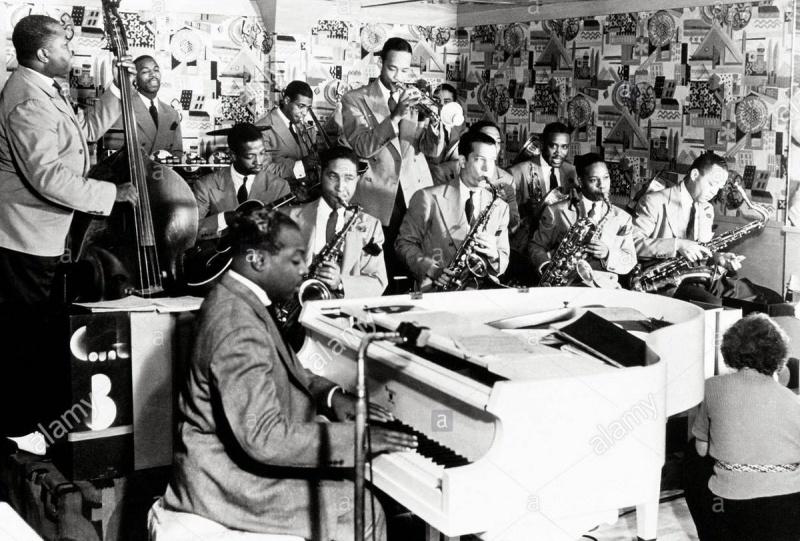
As bad as the new arrangement was for the band, Basie hit Decca’s New York studio in early 1937. Over that 3-year stretch, that early Basie band turned shellac into gold as it went from an unknown outfit from out west that was rough around the edges to one of the top bands in the competitive New York ballroom scene.
It was a terrible job to pick the cream of this crop, but I eventually settled on 4 examples (two each from 1937 and 1938) to show how this band was unlike any other of that time. Most of the fanfare of this era goes to tunes like “One O’Clock Jump”, “Jumpin’ At The Woodside” and “Swingin’ The Blues”. But as great as those records are, I like the following examples as a way to showcase this band’s truly unique qualities.
Topsy (June 7, 1937) is from the 3rd of 4 1937 sessions. It is a great example of a Basie “head arrangement”. While most other bands relied on arrangers who wrote out the music (leaving space for solos), Basie and the band concocted music by stringing together a series of memorized riffs that both separated and worked behind multiple soloists getting their turns at the mic. It has been argued that “big band music” isn’t strictly jazz because it’s too structured. But Basie managed to do jazz with a big band unlike anyone else.
The muted trumpet of Buck Clayton starts off in front of the minor-key riff, then he hands off to baritone sax player, Jack Washington. Then listen for Basie’s piano solo, with his sparse, percussive piano style that melded into part of one of the best rhythm sections of all time. That section consisted of Jo Jones keeping time with a light touch on cymbals, something that would become universal soon, but was rare in 1937. Walter Page slapping the bass and Freddy Green’s rhythm guitar strumming every beat provided more motive force. The last solo is by tenor sax man, Herschel Evans before the band riffs its way to the end.
Next is Boogie Woogie (New York, March 26, 1937). Nobody found more ways to incorporate blues into a big, swinging band than The Count. This piece combines a “boogie woogie” beat (8 beats to each measure, or bar) and manages to adapt it to a blues structure. A fixture of the Basie Band, who also came by way of the Blue Devils, was singer Jimmy Rushing. Called “Mr. Five by Five” for his short, stout stature, Rushing’s strength was singing the blues – which he does here in his inimitable way. The rest of this record, before and after Rushing, is alternating sections of Basie’s piano and the band, as they swing from start to finish.
Not appearing on any records was Basie’s original female singer – Billie Holiday. The problem was that by the time Basie signed with Decca, Holiday was already under contract with Brunswick Records, which would not allow her on another label. I count it as a great loss that none of her work with the band was ever preserved.
Blue And Sentimental (June 6, 1938). I chose this one because it shows how this band could handle a languid ballad on one of the rare occasions it did so. This piece features the gorgeously sumptuous tone of Herschel Evans, one of Basie’s two tenor sax players. Herschel’s playing is backed by the band playing oh-so-quietly behind him. Other solos are by Basie himself, in a performance that points towards the spare style that would mark his playing into old age. The seldom-heard Ed Lewis brings his muted trumpet to the mic before the record’s next highlight.
That highlight was Lester Young. Young was Basie’s other tenor sax man. In fact, Basie may have been the first band to feature two tenor saxes, who played in highly different styles. Where Evans played in a slightly rasping style with a lot of vibrato, Young played high and smooth. Here, Young plays the clarinet instead of his usual sax, and gives a performance every bit as beautiful as that of Evans.
Today’s last offering is “Doggin’ Around” (June 6, 1938). This record, coincidentally issued on the flip side of “Blue And Sentimental”, might be the most fun ever captured on recording equipment. The Count starts off with an intro that channels Fat’s Waller’s Harlem stride piano style then the band jumps into an energetic riff that pits the saxes against the growling brass. Then we are treated to a relay race as one crack soloist gets his turn and hands off to the next. First up is alto sax man Earl Warren, who tags in Herschel Evans on the tenor, who passes to Buck Clayton on his trumpet, who is followed by Jack Washington on the baritone sax.
Then comes Basie, in a solo that goes from Basie’s economical style to some Waller-style stride (where the left hand beats out a rhythm while the right tinkles out the showy stuff) and back again. It was said that Basie could make a single note swing, which is how he finishes that solo – plinking a single note over and over in a perfect rhythm. The record finishes with Lester Young, this time on his signature tenor sax. Young (nicknamed “Prez”, for president of the tenor saxophone) never played fireworks, even on a hot piece like this. Instead, his playing was cool and controlled while everyone rollicked around him. Just as it would compliment a later generation of musicians to say “they were really rocking”, for music from this era it was swinging. And there is no doubt that these guys were swinging from start to finish, and with uncommon ease.
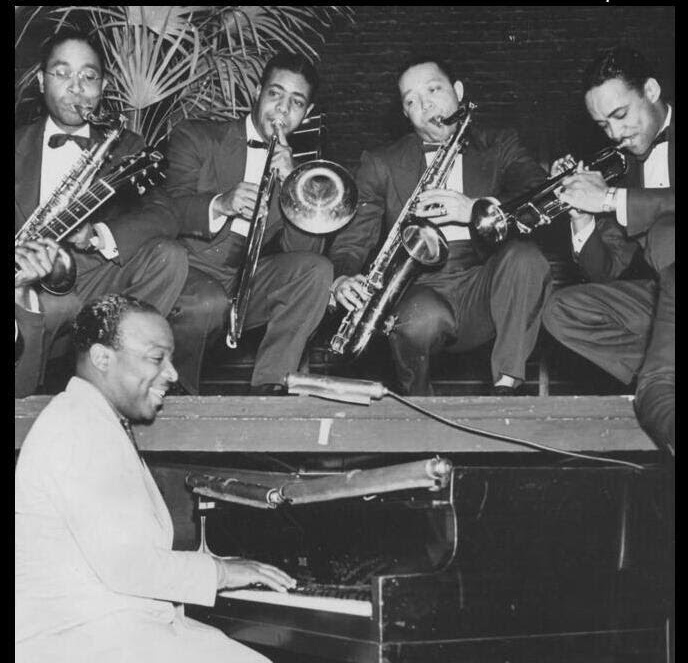
This early edition of the Basie Band is special, mainly because of the stellar soloists. Although the band would mature into the early 1940’s, it would do so without the two great, battling tenor sax men. Sadly, Herschel Evans died of heart failure in early 1939 at the age of 29. And Lester Young would depart in late 1940 – accounts differ whether it was planned or whether the always-quirky Lester was fired for refusing to play on a Friday the 13th. On the other hand, there was rhythm guitar man Freddie Green, remained a fixture in Basie’s band right up until Basie’s death in 1984.
So while later Basie bands were always great, none of them could match the youthful enthusiasm of a bunch of players whose skills and hard work landed them in the spotlight for the first time. And although other big bands of the day were more polished or had bigger popular followings, none of them could match this Basie outfit for playing honest-to-goodness jazz.
Read More Count Basie’s only recording session of 1936
Read More on Count Basie’s pioneering use of the organ in jazz
 J. P.'s Blog
I’ve always been a Basie fan, but knew little about his history till I read your story. Real good essay. I saw Basie and his band in 1965. They were on tour with Sinatra, backing Sinatra up, so to speak. It was a great show.
LikeLiked by 1 person
That association (including three albums) with Sinatra in the 60’s was a real financial boon to Basie and his band. I saw his band three times – once in the late 70’s and twice in the early 80’s. I could see the Count’s physical decline each time – the last time (probably 1983 or so) he came on stage in a motorized scooter, then slid onto his piano bench. But the music was great every time.
LikeLiked by 1 person
There’s a hunger in ‘first albums’ that often gets lost once musicians have a bit of security. I don’t think the comparison works 1:1 with the group you’re talking about — personnel changes often contribute tonal shifts in a band’s offerings — but I think it’s there regardless.
LikeLiked by 1 person
I agree completely. And I think there was some special chemistry with that first group. Basie’s band was heavily reliant on top soloists all the way through the 1940’s, and so the flavor of those bands changed as the soloists did – it was especially true with changing tenor sax players, who were always the keystones of those bands.
LikeLiked by 1 person
With so many soloists available to someone, I certainly agree that has an effect on the sound when there’s churn there.
That also helps keep enthusiasm in the band, or could.
LikeLiked by 1 person
A great look at the Count during a very important few years. I’m a long time Count fan, and to this day still listen to his late, swinging version of April in Paris every couple of months. Let’s not forget his widespread appeal: Blazing Saddles anyone?
LikeLiked by 1 person
His late-years success was amazing. Especially how he kept a big band going as a paying proposition longer than anyone else, except for maybe Guy Lombardo. And a Basie estate band continues to tour over 40 after his death.
I got introduced to him through his 70s albums, and then I went to these. Frankly, I wasn’t in love with this early stuff for awhile, but came around a few years later.
LikeLike
That’s some fancy piano playing – all those years of lessons from Mom and a professional teacher sure paid off. JP, I did not know that jazz would normally involve a large back-up band, but as you know I am new to jazz only through reading your posts. I was impressed with the quality of the 78 rpm records considering they would have been recorded almost 90 years ago.
LikeLiked by 1 person
Yes, by the mid-late 30s, recording quality had gotten reasonably good.
The big band format was really successful from the late 20s through WWII, but very few could shoulder the expense of keeping one going after that. Basie was one of the few exceptions, and even he gave up for about 18 months in 1949-50.
LikeLiked by 1 person
Pretty amazing as to sound quality. When you think of how bands travel together now, by private plane, or by bus when on tour, I can imagine it was pretty expensive, even then, transporting that many band members to each gig without the amenities they have now.
LikeLiked by 1 person
I love the soloing, especially the muted trumpet and the clarinet in “Blue and Sentimental”. I saw a clarinetist perform in New Orleans once that gave me a whole new appreciation for the instrument. He was a sweaty mess by the time he was done but man did he pull out some solo music. Interesting to hear Basie play with just one hand most of the time. Maybe it was all about concentrating on the rhythm. I can almost seem him, head down, focused on the fingers.
LikeLiked by 1 person
Count Basie played lots of notes in his youth, and as he got older he became the most economical of players. And it was even showing up in these records.
I read that Lester Young’s clarinet was a gift from Benny Goodman. It was stolen at some point fairly soon after these records and he didn’t get another until the end of his career.
LikeLiked by 1 person