Louis Armstrong – The Rise Of A Singing Star
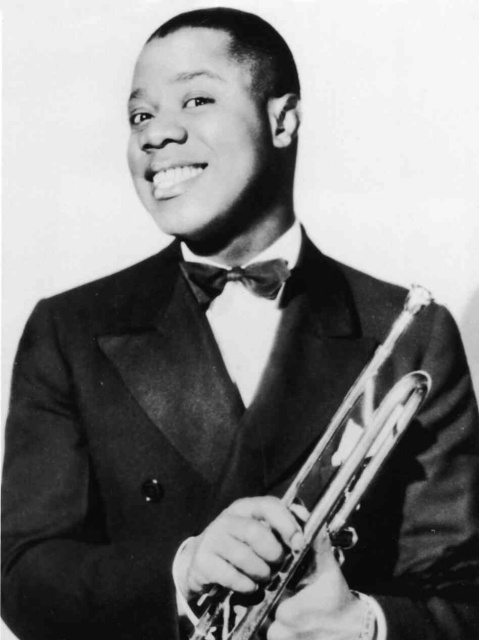
If you had been asked in the early days of jazz to pick the least likely singing voice to reach the top levels of popularity and stardom, you might well have picked almost anyone not named Louis Armstrong. But as things turned out, Armstrong made it happen. It was not enough that he became a ground-breaking trumpet player who influenced almost every jazz instrumentalist who came after him. Armstrong also took a voice that most would have considered a curse and turned it into something that would keep the fans coming to him for five decades.
Some time back, Louis Armstrong the trumpet player was featured here. At that time, I recognized that Louis Armstrong the vocalist was an entirely different thing which needed to be considered on its own. Well, today is that day.
To briefly review, Armstrong was born into a life of grinding poverty by a mother who was a New Orleans prostitute. He was taken in by another family but found himself consigned to the “colored waifs home” after he was caught firing a gun. His growing abilities on the cornet saved him, and soon he was playing for the band of New Orleans musician Joe “King” Oliver. Louis followed the Oliver band to Chicago, and then struck out on his own.
Many of us heard Armstrong singing as an old man – his 1967 recording of What A Wonderful World has become a worldwide favorite. And for we younger boomers, it was hard to escape hearing his version of “Hello Dolly”. But I wondered – did he always sound like that? That question can be answered by our first sample – which is the very first time Louis Armstrong sang on a record.
In February of 1926, Armstrong was in a Chicago recording studio with his original Hot Five. The other members were fellow New Orleans alums Kid Ory (trombone), Johnny St. Cyr (banjo), and Johnny Dodds (clarinet) as well as Louis’ then-wife Lil Armstrong (piano). This was only the group’s third recording session, and Louis was talked into singing duties on a new novelty tune called “The Heebie Jeebies”.
Several sources have claimed that during that session, the sheet with the song’s lyrics fell to the floor and that Armstrong was forced to improvise. That story may or may not be true. What is clear is that from the very beginning, Armstrong’s vocals were unlike those of anyone else. First was that voice – even at age 25 or 26 he sounded like a frog in the process of swallowing gravel. And it was marvelous. Then there was his ability to change or complement the melody note by note as he sang, much in the way he constructed solos on his horn. And from this point on, a song’s published lyrics were no more than suggestions for any song Armstrong chose to sing.
Within a very few years, Armstrong had accomplished something remarkable: He was able to take a voice that had an extremely limited range of pitches and tones and make it one of the most emotive in the history of jazz or pop music, as the following two cuts will show.
In 1929, Armstrong found himself in the ensemble of an off-Broadway all-black musical review called “Hot Chocolates”. Fats Waller and lyricist Andy Razaf were responsible for the music, and one of the songs was “Black And Blue”. According to a Razaf biographer (1), it was demanded that Razaf write a comedic song about how hard life was for a black person. Razaf (and Waller) wrote the song, but it was anything but comedic.
Armstrong did not sing the song in the show, but did record it in 1929. This record is an early example of the way Armstrong could infuse a song with emotion – in this case, great sadness and melancholy. Really, the lyrics to this song conjure a kind of raw pain, and Armstrong’s treatment makes it real, even after nearly a hundred years.
A second example of the emotional impact of Armstrong’s singing comes from a record that has become problematic for modern sensibilities. This 1931 recording of “When It’s Sleepy Time Down South” was Armstrong’s first recording of a song that would become something of a theme song for him over the course of many years. Louis was a child of the deep south from the turn of the twentieth century, and he certainly experienced the worse that time and place had to offer. But where “Black and Blue” aimed a harsh light at those realities, this song ignores them.
Later recordings made much-needed changes to the lyrics , and it would be easy to not feature this record at all – except for the fact that it is one of the most beautiful and lyrical performances Armstrong ever committed to wax.
This performance is also interesting because the entire first chorus of the song has the band in the background as Louis and his piano man, Charley Alexander, carry on a conversation about “goin’ back home”. Then the tempo slows and Louis sings as sweetly as ever he did. The final time through is Armstrong back on his trumpet, playing at his loveliest. Perhaps this song affected Armstrong so deeply because it made him sentimental for a kind of southern life that he never knew in his own gritty surroundings.
The final selection shows Louis Armstrong at his most joyous. This clip is from a filmed 1933 performance in Denmark during a multi-year tour of Europe that was reportedly made necessary to avoid repercussions from breaking a contract with a mob-controlled club in New York. This film was the first time Armstrong was captured in that medium, and this performance of “Dinah” shows Armstrong’s legendary stage presence.
This up-tempo version starts off with a band that sounds like it is straight out of 1927 instead of right on the cusp of the swing era. But once Louis steps up to the mic, everything changes. Armstrong never completely abandons the song lyrics, but neither does he follow them for this song that was well-known in its day. Or the melody, for that matter. The song didn’t really matter, because Louis had the ability to just sing Louis. And that vocal method was all about constructing a vocal solo much as he would with his horn, with some lyrics and some of his trademark “scat” singing where nonsense syllables took the place of words. This is one of the rare performances where I much prefer his vocal work to his horn playing. The trumpet solo is not bad, but it is nothing compared to the animated vocal that simply bursts from the singer’s one-of-a-kind personality.
It has been said by many a jazz critic that everything in jazz traces back to Louis Armstrong, and this was just as true for his unique singing abilities as for his mastery over his horn. It is safe to assume that nobody in 1926 ever suspected that the kid with the terrible voice would soon move from doing novelty tunes to becoming a geniune singing sensation. That he kept delivering the goods through those rocky vocal cords for generation after generation would have surprised those folks even more.
(1) Barry Singer, author of “Black and Blue: The Life and Lyrics of Andy Razaf, as quoted in a February 8, 1989 article in the New York Times by Stephen Holden.


I was always a fan of Armstrong when I was a kid, mostly as a pop star, but didn’t understand his role in the jazz pantheon until the Ken Burns Jazz series drove me back to the twenties to listen to his cuts with the Hot Fives and Hot Sevens. Truly stunning and I went out and bought those CD’s in pretty rapid succession. Listened to West End Blues daily for a pretty long time!
LikeLiked by 1 person
I was much like you in this way. And even then, my appreciation of the quality of Armstrong’s vocal work came to me even later.
LikeLike
Funny, I’d always assumed that was his voice in his older years but he sounded like that when he was young too!
LikeLiked by 1 person
I have never read anything about a childhood vocal injury, but you kind of have to wonder.
LikeLike
I loved Louis Armstrong! Dixieland music wasn’t my favorite (I lean more toward the mainstream Big Band music), but it was a close second. But I noticed the passing of time in the 1990s, when an MTV news person referred to him as “Louis” instead of “Louie” — the news person had never heard anyone say his name. Oh, well: his music is still with us.
LikeLiked by 1 person
I understood that he always referred to himself as “Louis” and that “Louie” was a nickname that others gave him. His musical style is funny in that you can’t really identify different “periods” or “eras” from his career – he kind of played/sang one thing and in one way, which seems to have been able to mesh with multiple musical styles through the decades.
LikeLike
Funny you’re posting about a song called “The Heebie Jeebies” so close to Halloween, renowned for giving us “the heebie jeebies”. Well JP I can’t say I knew much about Louis Armstrong until I read this post and I only really know his music from the song “Hello Dolly”.
LikeLiked by 1 person
You made me look up the origins of the term “heebie-jeebies”. It seems that term came from cartoonist Billy DeBeck, whose daily newspaper cartoon Barney Google became hugely popular after around 1922. The Armstrong song (which became a big hit in its day) probably followed that term’s popularity from the comic strip.
LikeLiked by 1 person
That’s interesting – I know I’ve been saying the phrase for years. I have heard of the cartoon Barney Google but not the cartoonist’s name you mentioned.
LikeLiked by 1 person
Armstrong sure did make it happen!
LikeLiked by 1 person
And for a long time!
LikeLiked by 1 person
J.P., you must be channeling the jazz gods! Opened the NYT Arts & Leisure / Ideas and Personalities section today, to find a full page on Louis Armstrong, covering six of his best songs, pursuant to a Broadway show on his trials and tribulations, called: “A Wonderful World”. Their pick of songs vital to the show: West End Blues, What Did I Do To Be So Black and Blue, Heebie Jeebies, I’ll Be Glad When You’re Dead You Rascal You, Hello Dolly, and of course, What a Wonderful World. Article has a great picture of him on a French train in 1955 as well, which makes him look less like a happy-go-lucky guy and more like Miles Davis!
LikeLiked by 1 person
Haha, and they even picked 2 of my 4 songs!
LikeLike
If you want to hear a little story from me about Louis Armstrong, here it is:
When I was real little (around age 4), I got an LP record, Walt Disney’s Merriest Songs. They were given out by Gulf stations. The LP had musical selections from various Disney animated movies like Pinocchio, Snow White, Mary Poppins, etc. I listened to this record over and over. But there was this one song that creeped me out–“I Wan’na Be Like You” from The Jungle Book. Something about the tune and the voice seemed really spooky and weird.
Later on, I heard music sung and played by Louis Armstrong, and liked it–Dinah, Stardust, Wonderful World, West End Blues, etc. For some reason, I assumed the Jungle Book song I remembered was sung by Armstrong. (I must point out that Armstrong’s voice has a certain earthy, kind of “creepy” quality that I actually like). Years later I found out that it was actually Louis Prima (not Armstrong) who sang the Jungle Book song! If you listen to it now, Prima does sound a little like Armstrong (at least to me).
I’ve always found movies, cartoons, and music from the ’30s-’60s to be appealing, cozy, and sometimes a little creepy (a paradox). What they all have in common is one thing–CHARM! It is this elusive quality that today’s entertainment so tragically lacks. I won’t watch anything Disney puts out now–doesn’t appeal to me at all. And of course everything today has to be PC, which is really tiring and unfunny.
I used to think that my childhood was rather typical, routine; nothing special about it–growing up white, middle class, and living in the suburbs of New Jersey. But from a global perspective, my background is rather rare and exotic. And I was lucky enough to be exposed to a lot of this older stuff which made an impression on me. I feel that today’s children are missing out on something valuable because they’re consuming all this modern stuff which has a whole different vibe to it.
So that’s my story–I’d be interested in hearing what you think of it.
LikeLiked by 1 person
I was another who was drawn to things of earlier generations.
The song that creeped you out was sung by Louis Prima – honestly, I was never much of a fan of his. I can understand how a young kid could think Armstrong might have done that song. My big takeaway from the Jungle Book was Phil Harris and his voicing of Baloo the bear. I wrote about Harris here (https://jpcavanaugh.com/2021/10/29/phil-harris-more-than-just-your-above-average-bear/). He kind of re-wrote the book on how animated cartoons were voiced/performed. Harris’ Bear Necessities was my favorite song from that movie.
LikeLike
I was also curious about why his voice sounded like that but I couldn’t find any really reliable (in my opinion) sources of information. I just like his sound. I also like how those older songs have the long musical intros.
LikeLiked by 1 person
In those days the musicians were often given more prominence than the singers. Besides Armstrong, I’m having trouble coming up with another singer from the 20s that people today would know, at least before Bing Crosby hit the scene late in that decade.
LikeLiked by 1 person