Wherein A Musical Question Is Asked In Different Ways: How High The Moon?

It seems that most jazz standards can trace their lineage back to a well-known recording of a Tin Pan Alley song from the 1920’s. Others began with a well-known recording of an original work by a particular “name” musician. Today we examine a less-common occurrence – a jazz standard that began as a forgettable song that only seemed to be rescued by another piece based on it, but that shared nothing more than the basic chord patterns.
A song that asks a question would be a natural for the TV game show, Jeopardy. If we were playing Jeopardy, the answer might be “238,855 miles”. But we are not playing Jeopardy, but listening to jazz, so we will just stick with the musical question “How High The Moon”.
The song is one that has been recorded innumerable times by countless performers, and is an indisputable part of the jazz canon. I always struggle with how many musical selections to include in a piece like this – brevity is to be prized, but then rabbit holes can be awfully fun. I have decided to approach this like a meal, with an appetizer, a three-dish main course and a dessert. So, let’s dig in, shall we?
“How High The Moon” was written by Morgan Lewis (music) and Nancy Hamilton (lyrics) for a Broadway musical review called Two For The Show. It ran for a total of 124 performances before sinking into the abyss of history. The song generated a small handful of recordings but none of them made any kind of a splash at all.
The first recorded version (our appetizer) appears to have been by Benny Goodman and his band. Goodman recorded it on February 7, 1940 on the Columbia label. This blog has not been shy about trumpeting (or perhaps clarinetting?) Goodman’s many merits, but those accolades were not based on this record. Goodman was “The King of Swing” whose 1930’s recordings introduced big band swing to a wide audience and whose music still holds up today. By 1940, Goodman had settled into patterns of success and was surrounded by dozens of other highly capable bands who vied for the affections of the music-loving public.
Unfortunately, there is not much about this record that would give a first-time Goodman listener any hint of the man’s talents. The recording is certainly not a bad one, but comes across instead as a very conventional take on an uninspired tune. Most listeners must have agreed, because it is easily one of the most obscure records from a period when Goodman was anything but obscure. The record certainly did not inspire any other top bands to take a whirl at it. Other than a couple of third-tier bands (Mitchell Ayers, anyone?), “How High” seemed to sink below the surface pretty quickly, where it largely remained until 1946.
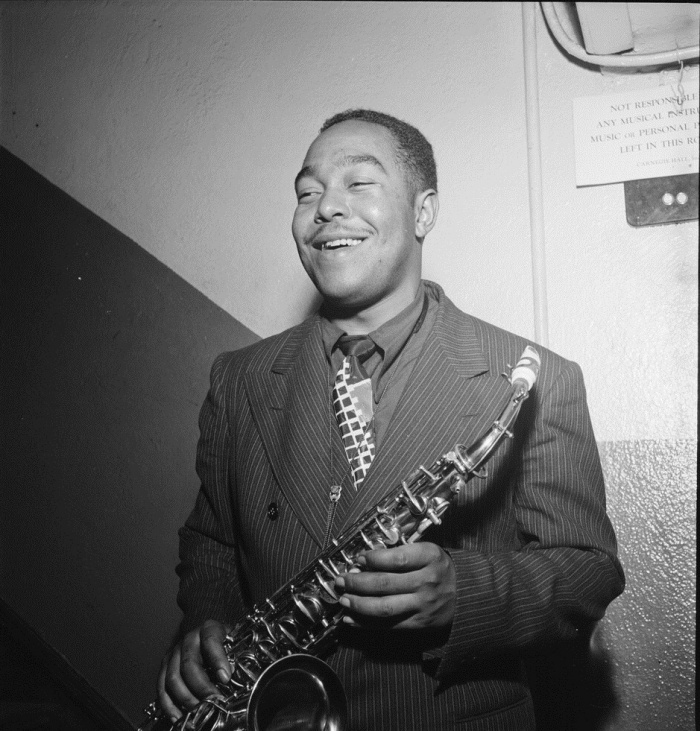
But the song was not forgotten completely. Charlie Parker was one of the founding fathers of the early postwar “bebop” movement in jazz, which approached music in a way that was anything but conventional in the final years of the big band era. Parker took the chord structure of “How High The Moon” and wrote a piece called “Ornithology”, most likely a play on his nickname of “Bird”.
This kind of song is called a “contrafact”, which describes a new song written on the chord pattern of an earlier one. Parker recorded the piece on March 28, 1946 on the Dial label, and it became an early bebop standard. One other thing it seemed to have done was to spark an interest in the original tune, because How High The Moon suddenly came to the attention of many jazz players, and has seen plenty of action in the decades since.
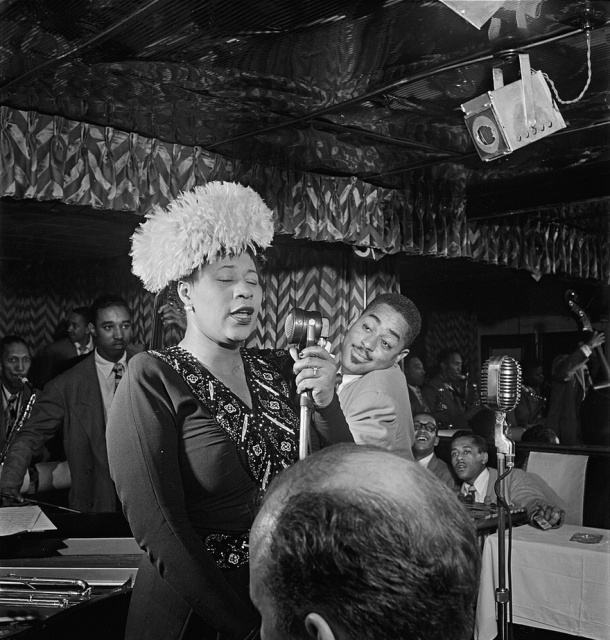
Ella Fitzgerald spent mid 1947 touring with another of bebop’s founders, Dizzy Gillespie. Ella was certainly aware of “Ornithology”. Although it had no words and was thus not terribly suitable for a singer, the original song certainly did and Ella put it to wax on December 20, 1947 for Decca. She was backed by a small orchestra which included renowned bassist (and Ella’s husband) Ray Brown.
Ella Fitzgerald was clearly influenced by Charlie Parker’s “Ornithology”, as is shown by her scat-singing inclusion of lines from both the theme and the solos from that performance. And, or that matter, phrases from multiple other records. In her inimitable fashion, Ella added some additional lyrics which have become part of the song’s legacy. This song would remain part of Ella’s repertoire for the rest of her life.

It was out of sheer coincidence that Stan Kenton’s band was New York’s RKO-Pathe studio the very next day (December 21, 1947) and recorded the very same song. This record features June Christy singing, backed by the band doing a Neal Hefti arrangement. Stan Kenton was known for heavy, hard-punching music that was both loud and full of dischord. Neal Hefti (who wrote lots of material for Count Basie in the 1950’s) turned this into one of the least “Kenton-y” Kenton records of them all, with a solid swing and a (relatively) relaxed treatment of the melody. It was released in June, 1948 on the Capitol label, and saw some modest success on the popularity charts of the day.
This record, along with Fitzgerald’s, give us a rare opportunity to compare the stylings of two talented jazz singers, each unaware of the way the other approached the song. June Christy’s vocal has become nearly as iconic in jazz circles as is Fitzgerald’s – Christy .is not known for scat singing, and was certainly unaware of Ella’s take on this piece, which shows how popular scat singing was for a short time. Also, Christy’s treatment is remembered for the way she improvised in small ways with the melody itself – subtle licks that have been unconsciously copied in multiple later recordings by other singers and players.
These three records of 1946-47 put “How High The Moon” on the map, and jazz recordings of the song became quite common in the years after. This would be a great stopping place, but for one other record that is impossible to ignore.

January 4, 1951 marked the completion of record on the Capitol label, this time by the married couple of Les Paul & Mary Ford. Les Paul is, of course, famous for the many guitars that have carried his name in the decades since. Paul is not remembered so much as a jazz player (though he certainly was) as for his early work on multi-track recording technology, as well as the guitars he designed and built. This was not his first go with the song – his instrumental jazz group was one of the few to record it before 1946. But it was this 1951 record that everyone remembers.
This version of “How High The Moon” was said to have contained twelve guitar parts and twelve vocal tracks, all of which were performed by the husband and wife pair. This record crossed over onto the R&B charts, and has been sort of adopted by fans of early rock and roll. Because of Paul’s reputation with the guitar, this probably the most familiar take on the song to modern audiences.
I will admit to a fairly stiff bias against pop music of the early 1950’s, a time when music seemed unsure of where it was going. Swing was dying, bop never really took off commercially and rock & roll was still just over the horizon. Paul & Ford’s interpretation sort of keeps one foot in the older tradition while stepping into something new. I have never been a fan of Ford’s vocals, which I consider a bit plodding. However, Les Paul’s sparkling guitar work makes up for it.
Most readers will probably have a favorite from among these, and there is sure to be disagreement. But it is fair to say that these four recordings between 1946 and 1951 have probably influenced virtually every subsequent performance of “How High The Moon”. And there should not be much disagreement that this is a good thing.
 J. P.'s Blog
That’s a classic, I remember the winter I had to get up at 5am every day the Ella version was one of the songs I woke up to. Not entirely appropriate for 5am, -30 degrees and icicles inside my apartment window. Still a great version.
And no, I dont like the Kenton version, keep trying 😉
LikeLiked by 1 person
That Ella record would wake a guy up, that’s for sure! And rats, I thought I might at least get you to a neutral position on this Kenton record. 🙂
LikeLike
Amazing it was covered that much. Unfortunately the Les Paul version is uppermost in my mind, altho it was mostly a gimmick track done to show the sound of multi-tracking. I’m aware of the Charlie Parker version, but think mostly of the women singers when it think of this.
This happens to be a song I confuse, unless I’m actually listening to it, with East of the Sun (West of the Moon), another song with a million people covering it. It’s a very long list on the Wiki. Written for a college show for the Triangle Club at Princeton, and covered by a ton of jazz and popular artists. Worth a listen as well….
LikeLiked by 1 person
I find it amazing that the song died away almost completely within the first 4-5 years, and then got reinvigorated so thoroughly. I am sure there are other examples of something like this, but none is coming to my mind right now.
I agree on the Les Paul version – it was a big hit in 1951, but that is not saying much because lots of forgettable records were popular at the time. It is a lot more memorable for its technical creation than for its music.
I know East Of The Sun from the version Frank Sinatra sang with the Tommy Dorsey band in the early 40’s. I know it has lived on, but I have not seen it reprised nearly as frequently as How High The Moon. I wonder what other song titles get into the realm of space geography? 🙂
LikeLike
I like the original version best – it sounds like something I could dance to without being completely worn out after just one song…
LikeLiked by 1 person
I am not sure when jazz changed from music for dancing to into music for listening to but it was probably right around this time. I recall reading once that some time in the 1950’s, band leader Count Basie marveled that nobody danced to the music anymore. He recalled that there had been a time when everyone was dancing to the band, and now they just sat and listened. I guess I am one of the “sit and listen”-ers.
LikeLike
A friend has been upgrading my dancing skills so that I can do a decent two step. Getting up and dancing around the room rather than just listening to the
music has been a lot of fun.
LikeLiked by 1 person
I liked the Charlie Parker version – snappy and toe-tapping and he played a mean sax. I might be the only one of your followers who never heard of, nor listened to this song before.
LikeLiked by 2 people
Parker did indeed play a mean sax. It should not surprise me that you have not heard of the song. It helps me to meet (personally and online) people from the real world (and who are under age 90) who have not been listening to music like this for decades. I suspect you are probably in the majority.
LikeLiked by 1 person
My parents listened to country western music, but only the old-time CW stars like Hank Williams Sr., Hank Snow and Patsy Cline. My father would put albums on the stereo spindle every Sunday, flip them over when they finished and it took all day. Also they liked Jim Reeves. I grew up listening to those singers and probably could still sing along to those tunes. On another note, I don’t know if you are a Beatles fan, but I watched a documentary on the making of this latest and very last Beatles song (“Now and Then”) that John wrote and includes John and George in the song, in part due to AI. I will send it in a separate comment in case the link would cause this comment to go to your SPAM filter. I am old enough to remember the excitement of the Beatles coming to North America in ’64.
LikeLiked by 1 person
I am barely old enough to remember what a phenomenon The Beatles were at the outset. I remember a babysitter bringing her record player and her new Beatles album to our house in probably 1964. Country is probably the one genre I have less exposure to than any other. I need to do something about that sometime.
LikeLiked by 1 person
Yes 1964 was the year they became so big over here. I knew I was a bit older than you – I was eight in 1964. If you do unearth some old Country Western songs/artists, you should try to pick the old-time stars first.
LikeLiked by 1 person
Here is the link to the 12 1/2-minute documentary. It’s amazing how they did this when you think about it. I think as a music lover, though it is not your usual genre of music, you will enjoy the video:
LikeLiked by 1 person
New song on me as well, J P. I liked Ella Fitzgerald’s version… at least, for the first minute. Then her added lyrics kicked in and I almost laughed. “How High the Moon is the name of this song”? “… though the words may be wrong…”? “… does it touch the stars…”? Feels like filler just to keep the song going. Having said that, I need to listen to better examples of her beautiful voice and singing style. It won’t surprise me if you point me to a post you’ve already written. Finally, this post felt like a day in a college course called Jazz 101. I’m not sure I would’ve made the obvious connection between the several versions of the song without your guiding hand (er, keyboard). Maybe you should’ve been a professor? 🙂
LikeLiked by 2 people
Well for sure JP could be a professor Dave – a side gig when he retires from his second career. Jazz studies – music appreciation perhaps? I’ve learned a lot about jazz, a genre I’ve never listened to before now in these posts.
LikeLiked by 2 people
I wrote about Ella at least once before, here: https://jpcavanaugh.com/2020/01/17/ella-fitzgerald-lucky-so-and-so-1946/ . It is a slower blues number, so it gives you a better idea of her range when compared to this fast one.
Haha, one of my Econ professors told me he thought I should get a PhD in Economics. At the time, the last thing I wanted to do was go to school longer, then spend my life teaching. In hindsight, a cushy tenure gig at a state university somewhere and maybe an outlet writing op ed pieces for various publications might have been a good life. Oh well. And as I think about it, early in my law career I was told that I came across kind of professor-ish when doing a jury trial, and that it was pretty effective. I guess maybe I am a professor at heart. 🙂
LikeLiked by 1 person
Fascinating and entertaining as always. I also figured out that if I averaged around 8.5 miles a day, I could have walked to the moon by now. Oddly, the older I get, the more doable it becomes.
LikeLiked by 1 person
But wouldn’t it be terrible to walk to the moon, then not have enough time or energy to get back! That thought keeps me in my recliner. 🙂
LikeLike
Oops I forgot to log in for the comment I sent.
LikeLiked by 1 person
I forget more things every year.
LikeLiked by 1 person
I wanted to like Ella Fitzgerald more than I did. The straight opening is solid, the funny patter is sort of amusing & the scat singing is well done (but maybe goes on too long?) but I’m not sure the 3 styles work together to make 1 good song.
So, I remain team Les. 🙂 I will admit that their recording is better if you are aware of the multi track gimmick, but I think it stands pretty well on it’s own.
LikeLiked by 1 person
All reasonable points. I think I am on the fence between Ella and Stan/June. My son pointed out another version on YouTube – Gene Krupa’s band from about 1946 playing a Gerry Mulligan arrangement of the song.
LikeLike
I like the Krupa version a lot.
LikeLiked by 1 person
I keep forgetting how good his early postwar band was.
LikeLike