Miff Mole – The Jazz Trombone Is (Re)Born In New York
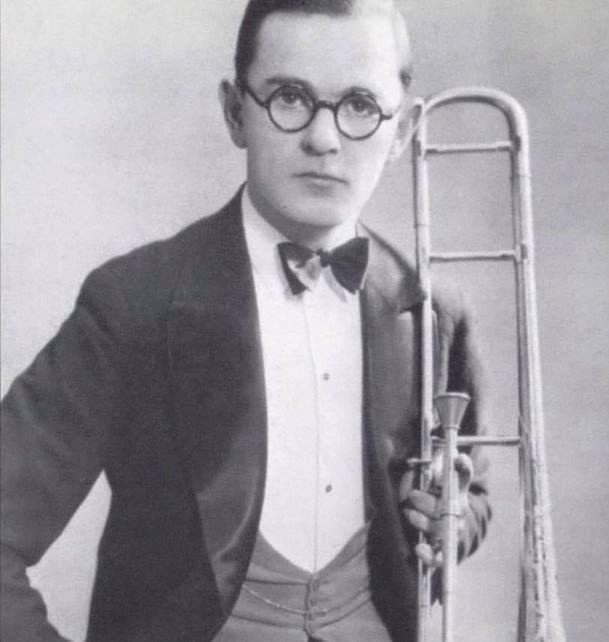
The slide trombone is an under-appreciateed instrument in jazz. Any fan of the music will have no trouble coming up with a top-10 list of most influential trumpeters, or saxmen or even drummers. But a list of top-10 influential trombonists would be a chore.
And among those influential trombone men, one of the early greats on that horn is routinely overlooked by jazz writers and is largely forgotten today. Fortunately, my specialty is shining the spotlight on forgotten jazz players. And today, Miff Mole gets his turn.
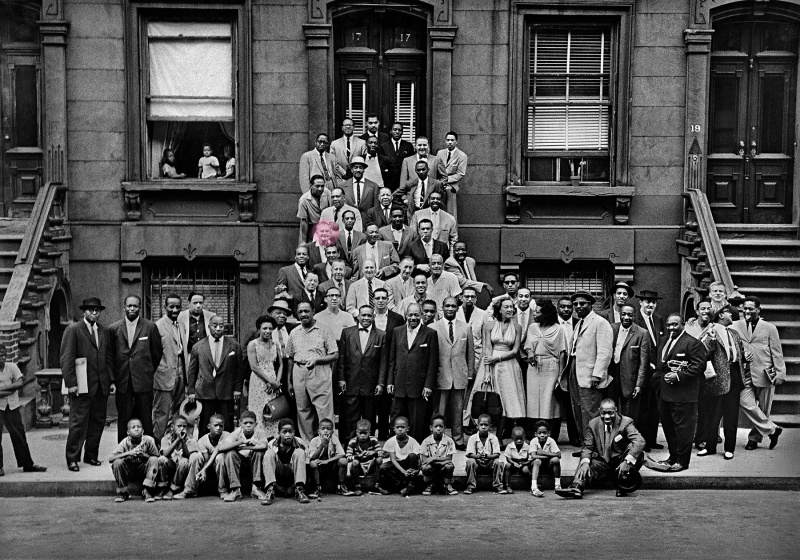
In the summer of 1958, a photographer for Esquire Magazine put out a call for jazz players to assemble at a particular location in Harlem on August 12th for something of a family picture. The photo has become famous because of the number who showed. Longtime reader/commenter Andy Umbo reminded me of a good documentary on that event (which I watched here, and you should too). At the end of the doc, the camera panned across the photo and put names to all of the participants. That was when I first noticed that an aged Miff Mole was there for that famous photograph.
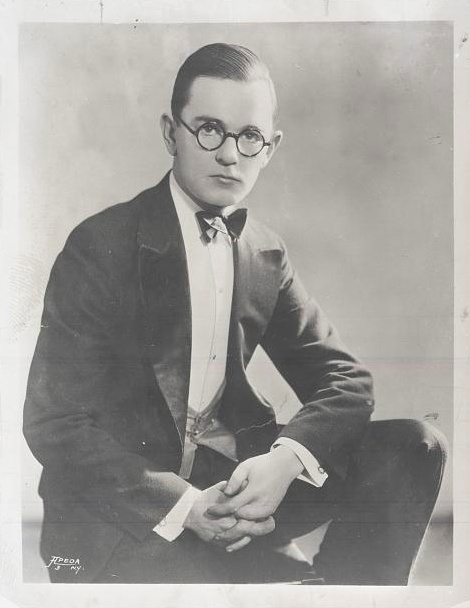
Irving Milford “Miff” Mole was born March 11, 1898 in Greenwich Point, Long Island in New York. After studying both piano and violin as a kid, he switched to the trombone by the age of 15 and was soon playing professionally in New York-area bands. In 1922 he joined “The Original Memphis Five”, a hot jazz outfit whose fame went far beyond its New York home.
Before Miff Mole, the jazz trombone was played in a “tailgate” style, named for the guy who played off the tailgate of the wagon in a New Orleans parade. A tailgate trombone was was there to add some texture behind the “real” jazz instruments – trumpet and clarinet. Any (brief) solo t-bone time was reserved for guttural growls and that slurring that trombonists call a “glissando”. Miff Mole is widely recognized as the guy who moved the trombone off the tailgate and into the front rank of jazz solo instruments.
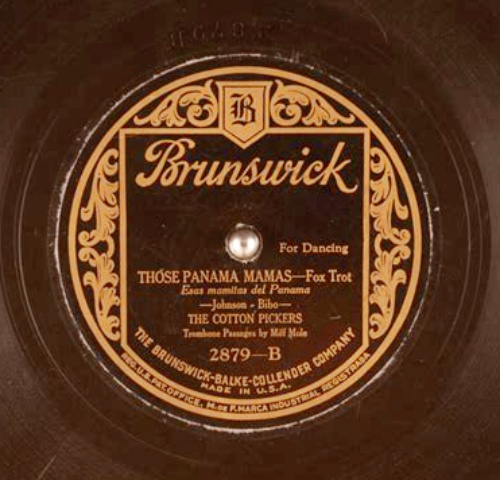
An example of this sound is on “Those Panama Mamas”, by The Cotton Pickers1 from April 9, 1925. This record was my own introduction to Mole, a disc I randomly picked up in the late 1970’s during an early immersion into 1920’s jazz. Mole was well enough known by 1925 that he was singled out for label credit.
This record is a great sample of New York jazz in the last days before acoustic recording was replaced by electrical microphones. “Those Panama Mamas” is also a great example of the music of the mid 1920’s, which was populated by many passable musicians, but few stars. Along with trumpeter Phil Napoleon, Mole really stands out. His solo (at about 1:53) shows off his high technical abilities and his ability to compose a coherent solo. Unfortunately, this record also sets the pattern for how to listen to Miff Mole, because his playing usually came only in short (but very fine) bursts.2
It was around this time that Mole joined the orbit of trumpeter Red Nichols. Among white New York players of the time, Nichols was probably second only to the great Bix Beiderbecke in popularity, and he and Mole made a slew of records under a dizzying number of names.3 Like this next one – “Hurricane” by Red & Miff’s Stompers from November 10, 1926.4
This is a fascinating record for a couple of reasons. First, this may be the first jazz performance captured on an Edison Diamond Disc that I have ever featured here. You may note that sound quality is, though still acoustically recorded, significantly better than on the conventional Brunswick disc above.5 The Edison disc’s unique design also permitted finer grooves, which allowed a recording to last for up to about four and a half minutes – something almost unheard of in recorded jazz recorded in the 1920’s.
The upside of a four-plus minute record is that we get one of the longest Mole solos I have heard, with this one starting at the 3:20 mark and running for nearly 30 seconds. Almost nobody at the time could mimic Mole’s clean slide work, and many believed that he had to be playing a valve trombone for that kind of precision. But no, Miff Mole was just that good on the slide.6
There are very few examples of Mole taking the lead and being the featured performer on a record, even (especially?) those recorded under his own name. This one, “Slippin’ Around” by Red & Miff’s Stompers from October 12, 1927, is the rare exception.7 So many leaders hog the spotlight on records under their name, but Miff Mole was never one of them. This may be the only record giving Mole extended time in the spotlight in this, the era of his greatest fame.
This electrical recording captures the warmth and nuance of Miff’s tone, as well as his ability to play at a more relaxed pace. It is the mark of a great jazz soloist when, at the end of a performance, the listener is left wishing it was longer. This record fills that bill for me because Mole’s work on it is something I can listen to multiple times in a row.
(Note: if footnotes do not appear while in WP Reader (as they did not for me) they are included in the web version of this pice, available here.
[Note: if footnotes do not appear in WP Reader (as they do not for the author), they can be accessed on the web version of this piece: https://jpcavanaugh.com/2026/09/18/miff-mole-the-jazz-trombone-comes-to-new-york/#more-21051 ]
I am the first to confess that I have listened but to a drop of Mole’s extensive recorded output. But in the several hours I have devoted to Miff’s records, my favorite is the one I have saved for last. If you only listen to one of today’s musical selections, this should be the one: “Feeling No Pain” by Red & Miff’s Stompers, from the same October 12, 1927 session.8 I’ll bet anyone a package of french burnt peanuts that you cannot listen to this record without some serious toe tapping. Just don’t ask why all of the photos in the video involve Harry Houdini, because I have no idea.
This record is a great example of the apex of New York’s downtown jazz scene from the late 20’s, which reached its full flower right before the onset of the swing era, the next great epoch of jazz. And Miff’s solo at 1:40 is a joy.
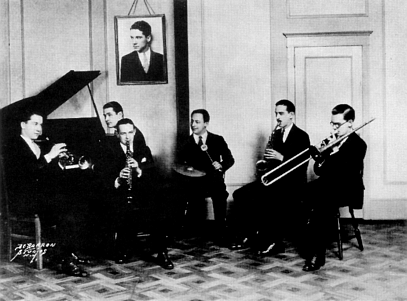
So, if Mole was such a great trombone player, how come almost nobody today has ever heard of him? Honestly, it may be because Jack Teagarden came to New York in 1928. The young Texan was every bit as good on technique as Mole, and boasted a newer, smoother sound that matched up better with changing musical styles. From that point on, Teagarden waxed while Mole began to wane.
Mole and Nichols continued to make a slew of records up until about 1930, but there was a depression on and Mole took a studio job with NBC Radio (through 1938). He played in the Paul Whiteman band in 1938-40 and even did a year with Benny Goodman in 1942-43.9 He later found refuge in the Dixieland movement and played regularly in Chicago into the early 1950’s. But after that, things were a grim series of health problems and musical inactivity, and even stories of people seeing Miff selling things from a pushcart somewhere in New York.
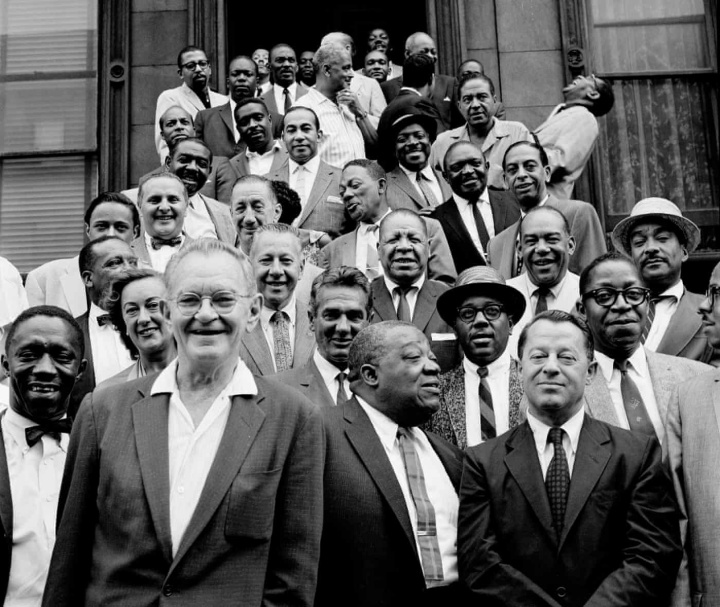
Showing up for the Esquire photo in the summer of 1958 made some people remember his contributions, and he almost had a last act. He was on the program for the 1960 Newport Jazz Festival, but Saturday night riots that got out of control there led to Mole and most of the rest of the program being scrubbed. Festival promoters put him on a bus back to New York and that was that.10
Mole’s health continued to deteriorate until he died penniless of a cerebral hemorrhage in New York on April 29, 1961 at the age of 63. As a curious pair of bookends, Mole was the third-oldest man in the Esquire photo11 and was also the third man in the photo to die (following Lester Young in 1959 and bassist Oscar Pettiford in 1960).
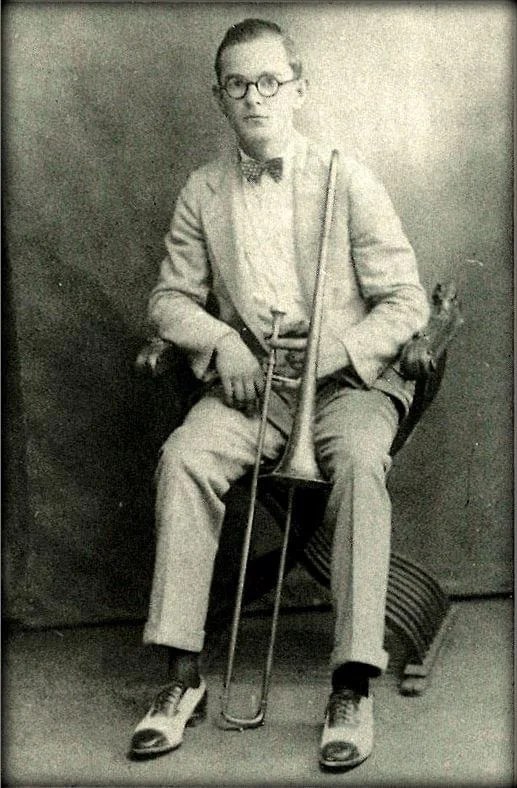
Miff Mole got no mention in the 1994 documentary about that Great Day in Harlem, and it is an open question if the makers of the documentary knew much of anything about him. But had they spent some looking into his life, they would have learned that bandleader Tommy Dorsey (no slouch on the trombone himself) once described Mole as the Babe Ruth of the trombone. We may be getting to the place where few remember much about Babe Ruth (OK, the greatest baseball player of his era), but then we cannot watch Ruth play baseball in 2026. We can, however, still listen to Miff Mole a full century after he was showing the jazz world what a skinny guy with glasses could do with a trombone.
[Note: if footnotes do not appear in WP Reader (as they do not for the author), they can be accessed on the web version of this piece: https://jpcavanaugh.com/2026/09/18/miff-mole-the-jazz-trombone-comes-to-new-york/#more-21051 ]
- The Cotton Pickers of this record is a generic ensemble name used by Brunswick Records at the time, and is almost certainly a version of The Original Memphis Five, led by trumpeter Phil Napolean. In addition to Mole, the group included Chuck Miller (clarinet), Frankie Trumbauer (sax), Rube Bloom (piano), John Cali (banjo), Joe Tarto (tuba), Harry Lottman (drums). This is a completely different band from “McKinney’s Cotton Pickers”, a black band from Detroit which we previously featured here. ↩︎
- Mole was noted in a March 27, 1926 edition of The Billboard as the author of a method book called “100 Hot Trombone Breaks” and was described as “[W]ithout doubt the best ‘hot’ trombone in the country. . . .” ↩︎
- This was the norm in that era, often because of the economics of making records. Musicians got paid on the day they made the recording, and that was it. The more records you made, the more money you made. And because record companies did not like sharing artists even then, groups often used different names when recording for different labels. ↩︎
- Personnel – Red Nichols (trumpet), Miff Mole (trombone), Jimmy Dorsey (clarinet, alto sax), Alfie Evans (alto sax), Arthur Schutt (piano), Joe Tarto (tuba), Vic Berton (drums) ↩︎
- We featured the Edison Diamond Disc some time back (here). Briefly, its improved sound quality came from its vertical-cut groove (in which the sound information was stored on the bottom of the groove instead of the sides) and its use of a permanent diamond stylus instead of the cheap steel needles that were (theoretically) good for only a single play. Edison did not include jazz titles in its catalog until late in the company’s run. The recording used here was almost certainly made by an Edison disc being played on an Edison phonograph, which was the only device that could properly play these discs. ↩︎
- For those wanting a deeper dive, Mole and the band did three takes of Hurricane in the Edison studios that day (the record featured above is Take A). There is a video analysis that plays Mole’s solos on each of the three takes and gives an analysis on how he got more adventurous with each. (Video here). ↩︎
- Personnel – Red Nichols (trumpet), Miff Mole (trombone), Fud Livingston (clarinet, alto sax), Lennie Hayton (piano), Carl Kress (guitar), Jack Hansen (tuba), Vic Berton (drums) ↩︎
- Same personnel as “Slippin’ Around”, above. ↩︎
- There is a color filmed performance by the Benny Goodman band of 1943 where a 45-year-old Miff Mole is one of the trombone players (here). ↩︎
- The sad story of Mole’s cancellation by the promotors of the Newport festival in 1960 and much more is found in this fabulous 2018 piece by Steve Cerra at Jazz Profiles. ↩︎
- Only stride piano players Lucky Roberts (born 1887) and James P. Johnson (born 1894) were older than Mole. ↩︎


I’d never heard of him. Thanks for all the info. By the way, are you familiar with Ray Anderson? He’s a really good trombone player. He’s still with us.
LikeLiked by 1 person
Ray Anderson is not one I am familiar with, but then I tend towards musicians who died decades ago. I will have to check him out. I have a soft spot for the trombone, having played one in high school.
LikeLiked by 1 person
Thanks for giving some love to Miff Mole! And you are absolutely correct that Jack Teagarden (another favorite of mine), slid right in (pun intended) to become the “go to” trombone guy when people thought about jazz trombone. His “Texas Roadhouse drawler” style really took hold. Mole used to get much more airplay on jazz stations when I was younger, with jazz DJ’s who considered themselves more curators than disc spinners, having much respect for his early trombone accomplishments. Glen Miller and Tommy Dorsey with their big band smooth dance stylings also took much of the later thunder when people thought about trombone.
Anyone fascinated by the “Great Day in Harlem” photo might want to track down a copy of the book: Art Kane, Harlem 1958, 60th Anniversary Edition. A comprehensive look at the photo, and it has short bios with a small picture of all represented, including our man Miff.
Moles sad “fade to black” demise is all too common for many in the arts: music, photography, painting, etc. Those that haven’t gained on-going fame or interest, or managed to put something away for the lean years, or even found academic positions (as a lot of jazz players have), are sort of doomed to a meager existence until the final measure. I’ve heard a lot of people in the arts say they are “unemployable” in anything else, even worse in today wildly inexplicable and targeted on-line job application processes; so, so easy to go off the rails.
I’m a big fan of the trombone, and actually know a few players that don’t even seem to want to keep it up; sometimes it seems like the people that play it don’t give it much respect? I also know there’s certainly a bunch of new players, but it’s tough to keep up with it all! A great example of the sweet sound of the trombone by a modern group is the Maniacal 4’s wonderful version of Wichita Lineman, worth a listen to see what your missing not deep diving into the ‘bone!
https://www.youtube.com/watch?v=Mx5c-6SV3Hk&list=RDMx5c-6SV3Hk&start_radio=1
LikeLiked by 1 person
It seems that Miff worked fairly regularly up into the early 50s, but after his stint with Goodman (1942-43) most of it was in dixieland, which has kind of become an ugly stepchild of the jazz movement for modern listeners. I know that I have never really worked up much enthusiasm for it, but maybe I should try harder. I read that he had some hip surgery in the mid 40s and that things did not go well for him after that due to unnamed complications. There is also really little written about his personal life, but it seems that he had a wife and daughter at some point (at least according to Find A Grave.com).
That BG stint must have been kind of tough for Mole – Goodman’s was never a trombonists band, but was instead a showcase for Benny’s clarinet. Some bands like Stan Kenton and Woody Herman could be a pretty good place to be if you played trombone, but I don’t think Miff’s background and style would have fit in with either of them. When you think of it, Miff was already 30 in 1928 and thus in the old-timer category once the swing era got going, let alone anything after the war.
I loved the clip from the Maniacal 4! I played trombone in high school, but started on it late and never really got good at sight reading. I was told that I got a pretty nice tone out of it, though. I will repay you with a 1953 piece from Woody Herman, “Four Others” which was a showcase for his trombone section. ( https://www.youtube.com/watch?v=eUZ6P01wPo4&list=RDeUZ6P01wPo4&start_radio=1 )
LikeLike
The Woody Herman piece is great, and very upbeat. Fun to hear the trombones featured! I’m with you when it comes to dixieland: not my favorite sub-group of jazz (or in that era, jass). I’ll tell you what I’ve found tho: early, early recorded dixieland seems to have a slightly different “warp and woof” and sophistication than later offerings. My dislike of dixieland comes from my limited exposure to the 60’s and 70’s dixieland “pop” albums early in my listening career; with those musicians in red and white striped shirts and jackets, handle-bar mustaches, suspenders, and bowler hats; playing in those theme bars with peanut shells all over the floor. Kind of corny and simple versions. My later experience deep dive listening to early works usually played by a piano player (often referred to as a ‘professor’), in the “comfort salons” of New Orleans can be an entirely different thing!
LikeLiked by 1 person
I hear you! Straw hats too! 😄
LikeLike
https://www.youtube.com/shorts/XJczvs4iKvU
LikeLiked by 1 person
I have one ODJB disc, and it is interesting to me for what they were historically, but I can’t really call myself a fan. I recall reading that LaRocca was a real jerk.
LikeLike
…but amazingly different from what was served up to me as “dixieland” back in the 70’s…
LikeLiked by 1 person
Wow – your post today is a real treat. I’ve played trombone for almost 60 years and don’t recall ever hearing about Miff Mole previously. The trombone is a wonderfully versatile instrument when played skillfully, but dealing with the “imprecision” of handling the slide lends an added level of complexity (compared to pushing down a valve or a key to get the note that you want).
I’ve played with some pretty good trombonists over the years, and it’s clear that Miff Mole was exceptionally talented. In the spirit of full disclosure, I am and always have been a real hacker when it comes to trombone playing, but someone has to play the background parts while the better instrumentalists do their solos.
LikeLiked by 1 person
Thanks! I have nothing but respect for someone who has kept up with playing over the long haul. I played a trombone in my last 2 years of high school because I wanted to get out of the choir and into the band where all my friends were. One friend (a trombone guy) told me it was easy, so I picked it. I did not find it as easy as he had led me to believe! I wasn’t good enough to be into music in college and never made time for it. I eventually sold my horn (a King 2B) and that was that.
Glad you found something new to enjoy. I have enjoyed my recent (moderately) deep dive into Miff’s work.
LikeLike
Excellent article, J. P.! And terrific “video” choices.
LikeLiked by 1 person
Thanks! I am happy when one of these old music posts finds someone who enjoys it!
LikeLiked by 1 person
You’re right about toe-tapping songs JP. They do have that effect don’t they? The songs are all very upbeat. I didn’t recognize him in the original group picture but later in the post, when you zoomed in more, I could see that he had different glasses. I was starting to think that Miff Mole’s eyeglasses were a trademark to him similar to Buddy Holly’s glasses were to him.
LikeLiked by 1 person
I have seen a couple of photos that are supposed to be him without glasses, but I can’t tell if it really is.
LikeLiked by 1 person
The tribute band, Jeff’s Stampers, has long been overlooked as well.
LikeLiked by 1 person
🤣
LikeLiked by 1 person
“Feeling No Pain” is a hoot. I can’t dance the fox trot very well but even if I could, that song would wear my feet out! Any idea what instrument solos at about 1:20 (following the clarinet)? It’s like a bass-y trombone – love the tone. And yes to your description of Mole; not someone I’d guess plays jazz music.
LikeLiked by 1 person
Isn’t it though? You have me confused on the thing at 1:20, all I here is a few of the same note by Red Nichols’ cornet before the piano/guitar. Which is one of the cleanest piano passages I have heard from this era of muddy piano playing. And I love that fat, resonant rhythm guitar behind the piano.
LikeLiked by 1 person
On second listen, I think that excerpt is a bass saxophone solo. Not just bass-y but sassy!
LikeLiked by 1 person
I love the trombone. Great selections. I’d heard of Mole and it’s sad how so many greats die penniless. 🤣😎🙃
LikeLiked by 1 person
So true, and glad you liked the samples! I think that if you were a jazz musician, the 20s was a great time to learn and grow but a bad time to peak because that style of music just kind of died after about 1929-30.
LikeLiked by 1 person