Culture Clash – A Hoosier Meets An (The?) Idaho Spud
As a Hoosier (someone from Indiana, for the four people in the world who might not know this) of Irish descent, your author is a boy who loves his potatoes. Mashed, baked, fried, sliced, shredded, julienned, by themselves or in a salad or a casserole, I could eat a potato (or three) as part of every meal. But until recently, I was unaware that my beloved potato has been imitated in candy form – The Idaho Spud.
I recently shared a test of two different varieties of my favorite candy, French Burnt Peanuts. One sample was a gift from family, who had ordered them online from the Idaho Candy Company. Along with the peanut treat, my gift included an example of that company’s signature product, the Idaho Spud. If you are from the Pacific Northwest, you are probably aware that the Idaho Spud has been a thing for a long time. Until recently, I was with the rest of the country (world?) who had no idea that such a thing existed.
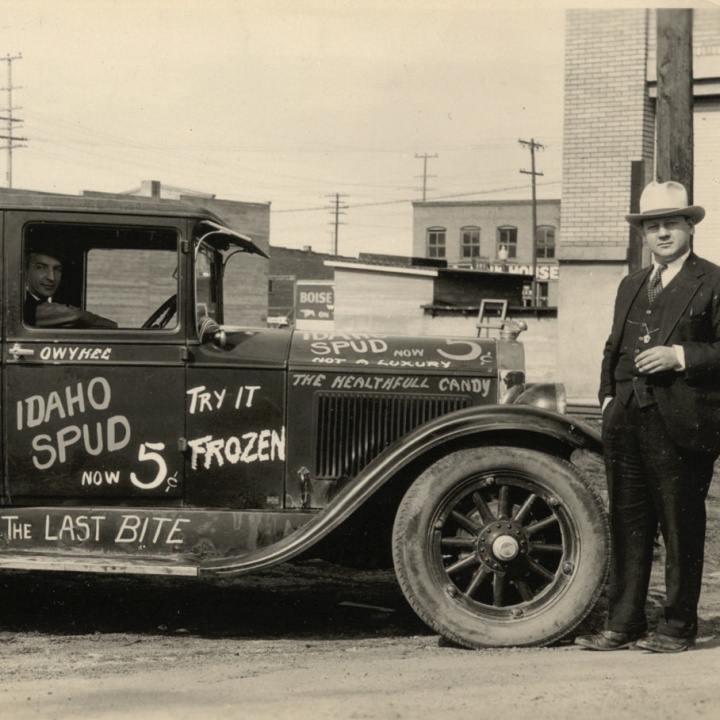
Thomas Ovard (“T.O.”) Smith started making chocolate candy in his Boise, Idaho garage in 1901. Successful door-to-door sales led to the construction of a larger scale candy-making operation in 1909. The chocolate products were branded as Owyhee in a burst of local pride over a local river and an Idaho county of that name. Although a little research shows that Boise is actually in Ada County, which is one county to the north of Owyhee County. Perhaps someone local to that area can clear up this mystery.
It was before 1920 that the company introduced a new product, a candy bar called the Idaho Spud. Sources differ – Company materials say the bar was introduced in 1913 while our friends at Wiki cite a source that dates the bar to 1918. In either case, the Idaho Spud has been with us (or at least some of us) for well over a century.
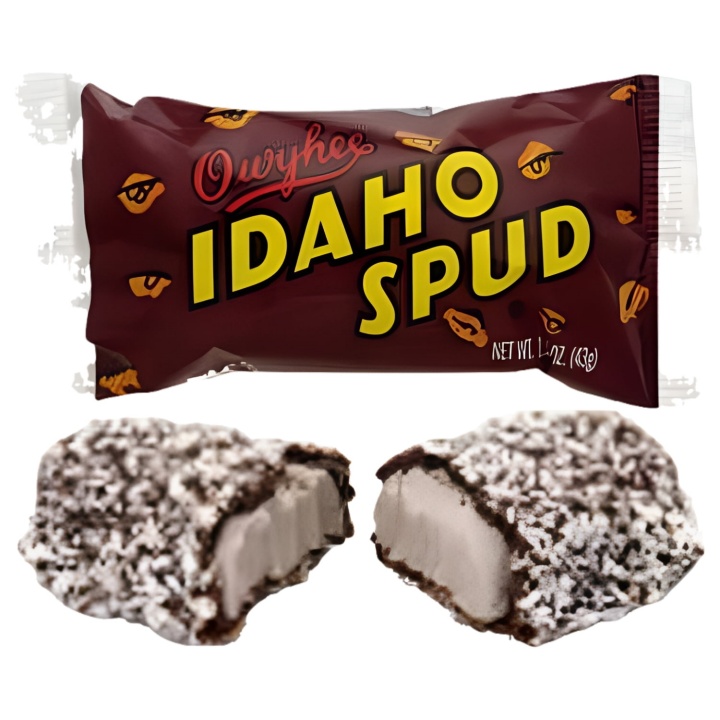
So, you might ask – What, exactly, is an Idaho Spud? First off, no actual potatoes were harmed in the making of these candy bars. Not that the versatile potato would be out of bounds as an ingredient in a sweet treat – I am aware of at least one old recipe for homemade doughnuts that calls for mashed potatoes to be mixed into the dough. Basically, the Spud is a cocoa-flavored marshmallow center coated with dark chocolate and covered with coconut sprinkles. Yes, there is simply nothing like it in my corner of the world.
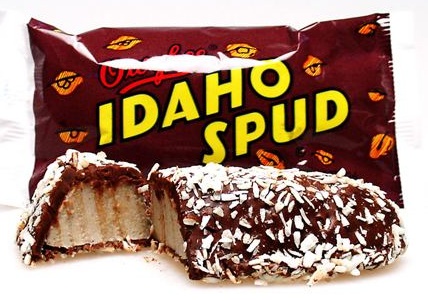
I knew from the moment that I received my little Spud that I would be writing about the experience, so I saved it until I was good and ready. It is a small bar, and a lightweight one at that – only 1.5 ounces. I was happy to see that the covering was dark chocolate. Let us just put this on the table – anything made with dark chocolate is better than anything made with milk chocolate. So the Spud had this going for it before I even took a taste.
I will confess to some trepidation before I opened the package. I have not traditionally been a big fan of candy with either coconut or marshmallow. I do not dislike either of those things, but they are not in my top ten candy ingredients either. The first bite was intriguing. I was trying to place the flavor I was getting from the marshmallow and had to look up that it was cocoa. It is a light, delicate cocoa flavor and not at all unpleasant. The consistency was soft and almost creamy, but not so creamy that it would run. It is held together by the dark chocolate outer shell and the flecks of coconut sprinkled around the chocolate surface add a bit of texture and a slight accent for the bar’s flavor.
I will also confess that I cannot decide whether I am a fan or not. A second (or third) taste test is called for, and I was sadly limited to a single bar. It was a unique mixture of flavors and textures that was completely new to me. I can easily believe that additional samples could make me at least a moderate fan – after all, look at how popular the thing is in its own region. In the spirit of full disclosure, I will add that I shared a bite with Marianne, who promptly pronounced it as awful and asked for no more. Which shows either that she has a poorly developed sense of taste or far more discriminating standards than those of her husband.
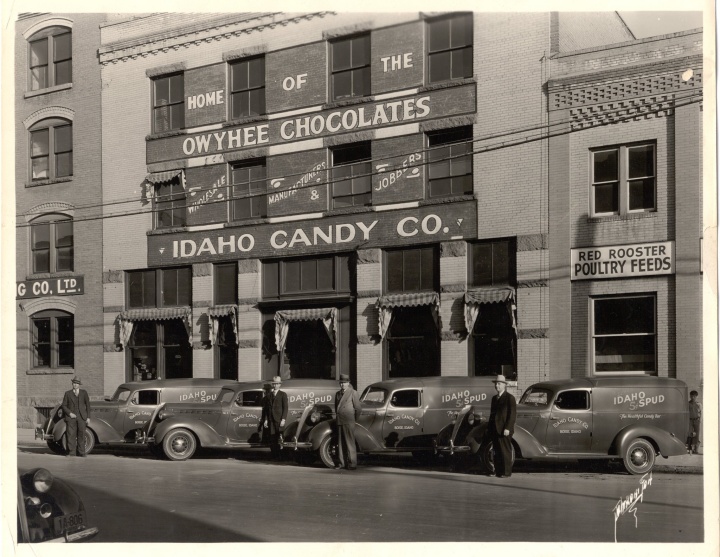
I was pleased to discover that the company has not been gobbled up by Big Candy, but is now under only the fourth family’s ownership in its century-and-a-quarter history. In addition to the Idaho Spud, they offer some other old time products, including the Old Faithful bar (vanilla marshmallow covered in peanuts and chocolate, 1925) and the Cherry Cocktail (a maraschino cherry center covered with peanuts and chocolate, 1926). This company also seems to have been the birthplace of the Chicken Dinner candy bar, the now-discontinued depression-era treat. A modern addition is Huckleberry Gems, which are packaged as two pieces of huckleberry-flavored marshmallow covered in chocolate.
Perhaps I will need to order some more Idaho Spuds. We are all about fairness here, and a venerable regional candy bar deserves a fair shake. The company’s website offers a 10% discount if I subscribe to a monthly shipment, but this might be more of a commitment than is wise for me to make. Unless after further taste tests the Idaho Spud becomes as favored as the real potatoes that I crave. Which might or might not be a good thing for me.


Completely unknown to me and I’ve never even seen one!
LikeLiked by 2 people
It appears that I am ahead of you by only one single experience! Research says that it has been fairly popular in its home region for a long time.
LikeLike
I’d be interested in trying one if a coconut-free version was available. Or if the coconut was replaced with potato flakes.
LikeLiked by 2 people
Now you have me wondering about actual potatoes used in candy. I wonder if it has ever been a thing anywhere.
LikeLike
I’m usually a bit hinkey on candies based on marshmallows (or marshmallows in general), but I’d give this one a try. Mostly because it’s modeled after a potato, named “Spud”, and has those charming little potatoes wearing eyeglasses on the package. Sure…potatoes…eyes…glasses! Makes sense.
The photo of the company car from the 1920s is fascinating. “Not a Luxury” (alright…) and “Healthful” are excellent declarations. I also wonder about the “Try It Frozen” suggestion. I’d guess that this was kind of a reach at that time given the fact that relatively few consumers actually had home freezers at the time (hence the struggle Clarence Birdseye had in bringing his frozen fish and peas successfully to market for much of the 1920s). Maybe it was more of a winter-time suggestion when customers could just leave the treats out on the porch. I hear it gets pretty cold in Idaho in the winter.
LikeLiked by 2 people
I was thinking about that freezer thing myself, and you are probably right. Although, people had iceboxes, so could you put a little candy bar on top of the ice block? If I were to get more of these I would definitely put one in the freezer to try it that way.
LikeLike
Hi. I’d never heard of this product. I have a feeling I wouldn’t swoon over it. But, maybe I’m wrong!
LikeLiked by 2 people
I am kind of amazed at how many regional things still exist. I will confess that these have not displaced Goldenberg Peanut Chews in the circle of my favorite candies. 😛
LikeLiked by 1 person
The coconut would immediately put me off. Can’t stand it at all, not even the slightest bit. The rest sounds intriguing though.
Goldenberg Peanut Chews are top-notch. Necco Skybars as well.
LikeLiked by 2 people
I don’t think I’ve tried a Skybar – is that one regional too?
LikeLike
Yes, it’s really a New England candy. Though I’ve seen them in Cracker Barrel stores in Ohio NC, VA, etc.
LikeLiked by 1 person
Yes! It’s another product from the New England Confectionery Company…NECCO. Home of course of Necco Wafers; the only confection that confuses candy with antacid with office supply. Most of NECCO’s treats (which are still available here in New England, and nowhere else since the rest of the world had managed to move on) that are not chalk-based (Necco Wafers and Sweethearts) are marshmallow-based.
Well, except for the Clark Bar…which I loved. But I’m ok with coconut.
NECCO operated in Cambridge, MA right up until its closing somewhere in the 2010’s.
LikeLiked by 3 people
I was not aware that some remnant of NECCO was still around. My father loved the rolls of wafers. The all-chocolate ones were pretty good.
And is the Clark Bar now extinct?
LikeLike
NECCO also had a plant in Pewaukee Wisconsin, originally a Stark Candy plant, purchased by NECCO in 1988 because Stark was making wafers and “conversation” candy hearts virtually indistinguishable from NECCO’s own products. Stark had been running the plant since 1959, and after the 1988 NECCO purchase, it was run until 2008 and then closed. The Wisconsin plant also made the regional favorite Candy Raisins, a sort of gummy ginger confection. I had a buddy who moved to Portland Oregon, could not find Candy Raisins anywhere, and used to have me send him a bag every once and a while! Our convoluted candy history!
LikeLiked by 2 people
Put the Twin Bing on your Regional Candy Bucket List!
LikeLiked by 2 people
Ooh, I looked it up, and it sounds quite good!
LikeLike
This is a new product for me JP, but many years ago friends of the family passed through Idaho while on vacation. They brought back souvenirs from their stay which included individual solid chocolate potatoes. They were not life-sized, but a generous size, wrapped in foil which resembled the skin of a potato, but inside, it was shaped, eyes and all, just like a potato. Mr. and Mrs. Potato Head would have had a field day!
LikeLiked by 2 people
I laughed at your last sentence – what kind of day other than a field day would be more appropriate for Mr and Mrs Potato Head?! 🤣
LikeLiked by 1 person
Ha ha – well I was punny-funny and didn’t realize it!
LikeLiked by 1 person
I’ve never heard of or seen these before now but if I were given one I would try it. Apropos of nothing, your remark about mashed potatoes in a doughnut recipe just made me picture my Grandma’s potato bread and potato pancakes.
LikeLiked by 2 people
Oooh, potato pancakes are another favorite!!
LikeLiked by 1 person
To answer the question about Clark Bars – although I defer to JP in all candy-related knowledge – yes, they’re still around. Plus, I was confusing them with Zagnut in my earlier aside about being “ok with coconut”.
Necco wafers, Clark Bars and Zagnut Bars were all NECCO brands for a while and all at that time (the 1980s and 90s?) were made in Massachusetts; either at NECCO’s factory in Cambridge (at one time the “largest candy factory in the world”) or another plant in nearby Revere, MA. Clark Bars and Zagnuts were invented by a company, named Clark, in Pittsburgh in the early part of the 20th century before they were bought by Necco. When Necco started to dissolve in the 2000s, Clark production and rights moved to a company back in PA (this time, Altoona…which despite my belief otherwise, is apparently a real place and not just a word used in Warner Brothers cartoons), where they’re still made. Zagnuts went to Hershey (the company and city).
And Necco wafers are now made by a company called “Spangler” that also makes the Valentine “conversation” hearts.
The NECCO factory building is still in Cambridge (it’s on the national register, so tearing it down is thankfully difficult). It’s now owned by Novartis, the pharmaceutical company. They repainted the old water tower – which used to look like a roll of wafers – to have large pictures of DNA molecules on it. Not quite the same. Oh well.
The good news about all of this, and to bring it all back together with the original article, is that as these big historic candy companies like Necco (and Wrigley and Beechnut, etc.) folded, their brands have in many cases been taken up by smaller companies which still make a bunch of these old brands. It’s kind of nice to live in a world where one can still get “Idaho Spuds” and (more to the point) some version of Burnt Peanuts.
LikeLiked by 2 people
Thanks for this update!
LikeLike
NECCO must have loved painting those towers! Here’s the Pewaukee Plant. I forgot they made those candy cigarettes as well!
https://www.facebook.com/groups/237316961284593/posts/243718313977791/
LikeLiked by 3 people
I have not heard of them either! I totally agree about the merits of dark chocolate.
LikeLiked by 1 person
I have been informed that my daughter in law is a member of the Milk Chocolate club, and that I am misinformed. It is good to have someone else on my team!
LikeLike
Perhaps you should do a post that explains cocoa solids and how much goes into Milk Chocolate vs Darker Chocolates. Also the amount of sugar. Personally I think the darker the chocolate the better… One of the final acts I hope to perform before I leave this earth is to host a “Death by Chocolate” party…
LikeLiked by 2 people
You’re right about dark chocolate vs milk.
It does seem that further investigation is warranted. Having shared some of your small sample set, additional data points are required.
Hope that helps with the justification. 😀
LikeLiked by 2 people
Absolutely!
LikeLiked by 1 person
I never liked coconut myself, but like you I think dark chocolate rules. After your review I may have to try one If I ever get to Idaho. 🤣😎🙃
LikeLiked by 2 people
My son (who, along with his wife was the source of my gift) reports back that after eating just one he was on the fence. The second made him mildly positive and the third he found delicious enough to plan for a follow up purchase. So I think your Idaho trip should have 3 Spuds for you to get a fair sampling. 😛
LikeLiked by 1 person
If he was on the fence, why did he eat the second one? There’s a lot of candy to choose from without going back to ones you don’t like. 🤣😎🙃
LikeLiked by 1 person
Well, I suppose it was because he ordered a box of them – and it’s best to be sure you don’t like them if you’re going to throw them out. 🤔
LikeLiked by 1 person
The Spud brings to mind Cherry Mash, which takes a similar approach in ingredients and look. I’ve tried neither, even though they probably beckoned from the shelves of the candy aisle when I was a kid. For some reason rectangle “bars” had a more appetizing look. I was onboard with your description of the Spud until you described the marshmallow filling. Would you liken it to Marshmallow Fluff? If so, I’ll pass. I prefer my marshmallow filling to be the consistency of a marshmallow. Example: See’s Candy makes a product called a Scotchmallow (chocolate-covered marshmallow with a layer of caramel). They are wonderful, and taste exactly like a chocolate-covered marshmallow should.
LikeLiked by 1 person
I am kind of ambivalent about marshmallow, but can acknowledge that the description has a bit of range in texture and flavor. This bar’s center was thicker than marshmallow fluff (something I don’t really crave either).
That Scotchmallow sounds very interesting.
LikeLiked by 1 person
Reader comments suggest a post on coconut candies is in order, J P. How can someone not appreciate coconut as an ingredient in candy? I can’t begin to count the number of Mounds (and Almond Joys) I consumed when I was a kid!
LikeLiked by 1 person
Anything to satisfy the demands of public opinion!
LikeLiked by 1 person
I like those chocolate coconut macaroons so I might like it, but a marshmallow filling- just no – it’s like a non-ingredient filler. I had to google what was in a chicken dinner candy bar – nuts for protein which was needed in the Depression.
LikeLiked by 1 person
I’ve never heard of this candy. Hum.
LikeLiked by 2 people
I’m amazed that so many obscure candies still exist!
LikeLiked by 1 person
This is the first time I’ve ever heard of this candy. The company apparently does not distribute them in south-central Pennsylvania. They sound tasty – particularly since I’ve always loved marshmallow filling.
LikeLiked by 2 people
Yes, I think they are restricted to the northwestern part of the country. You can always get them online like my kids did. 😛
LikeLiked by 1 person
I’m tempted, but I have to overcome the aversion to buying food through the mail.
LikeLiked by 1 person