The Stuka
When you are a kid, ever summer becomes consumed by something. For me, the summer of 1970 was ruled by internal combustion. Kid scale internal combustion, that is. I may not have been old enough for the real thing, but a “gas”-powered toy made by the Cox Manufacturing Company briefly provided both my highest and lowest points of that summer – and all on the same day.
At that time, my best friend was Tim, who lived down the street. It took a pretty strong friendship to survive going to different schools, but but that was the kind we had. None of Tim’s friends from St. Charles lived nearby. My public school friends did, but they always took a back seat whenever Tim and I got together.
Tim’s grandparents were loaded (the money kind, not the liquor kind) so Tim was often the first one in the neighborhood with the cool toys. One day he presented his latest – The Shrike!
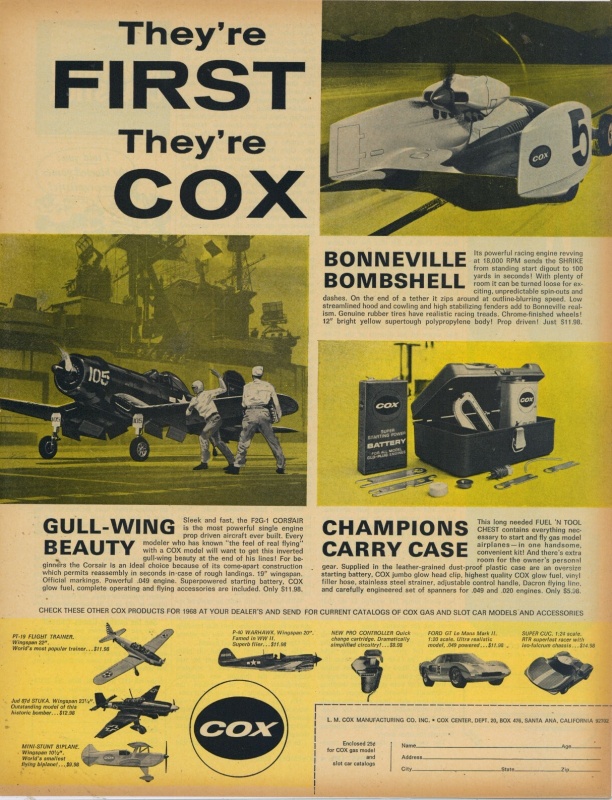
The Cox Manufacturing Company had spent the 20 years after WWII becoming a leading maker of hobby cars, and planes powered by tiny internal combustion “gas” engines. We called it gas, but it was actually Cox “glow fuel”, which research reveals was a concoction of methanol, nitromethane and oil. I am sure it was perfectly safe.
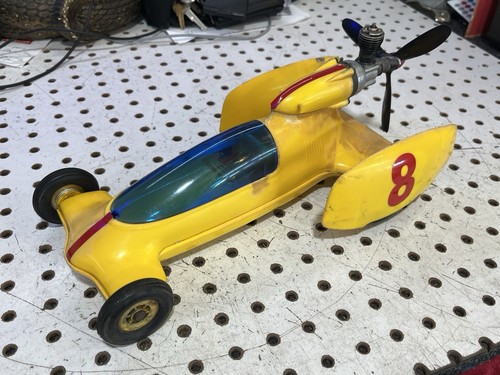
The Shrike was a curious hybrid of car and airplane. It was a car because it had 4 wheels and traveled on the ground. It was like a plane because it was powered by a propeller. I found pictures of later models that put a big guard around the propeller, but in my day we didn’t need such trivialities. The primary safety feature was the good sense to keep our fingers away from the spinning propeller.
And it was fast! (How fast? Check out this guy’s video where he lets his vintage Shrike loose in a parking lot at about the 1:15 mark.) Our quiet suburban street saw very little traffic, so it was the perfect place for our scale model land speed record attempts. We didn’t have access to enough asphalt to do a big circle on a guide string, so Tim’s Shrike was kept on a straight-ahead course by a long string fastened to the ground at each end, which ran through an eyelet on the front of the car.
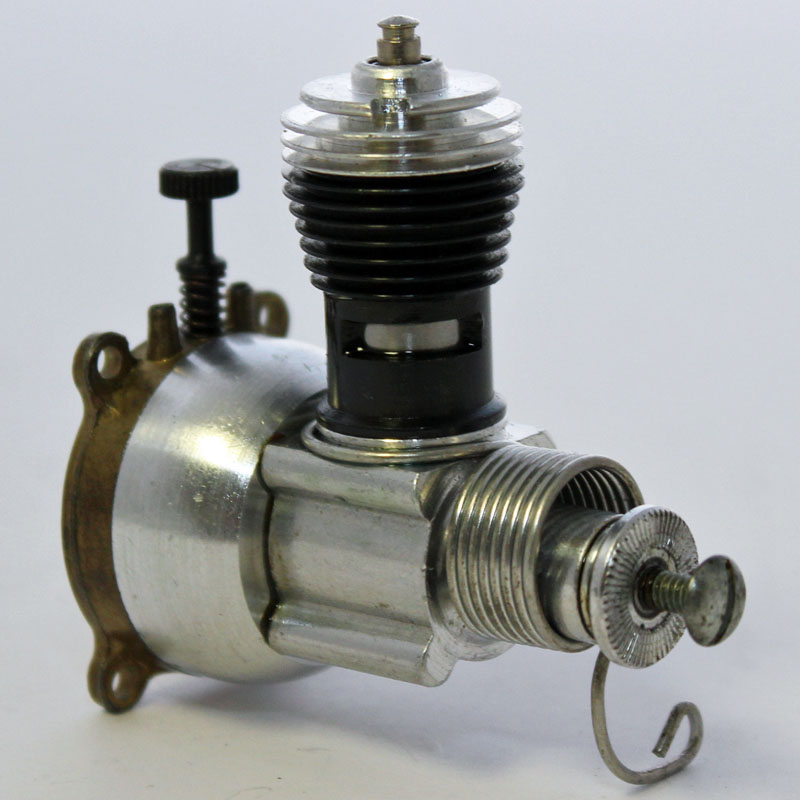
Tim was generous at taking turns, giving me the chance to learn how it worked. There was a little clear tube on the can of fuel that was squeezed onto a nipple that protruded from the tiny fuel tank. How could you tell when it was full? When fuel started pouring out of second of the two filler tubes, of course. I can still smell the raw fuel and feel the spilled excess that would coat my fingers. Then there was a battery pack with wires that clipped onto the top of the engine. This got a glow plug hot enough for the teeny engine to fire. Two or three tries at winding the plastic propeller backwards against a spring would explode into the sound of a insect-scale leaf blower and the thing was ready to roll like mad.

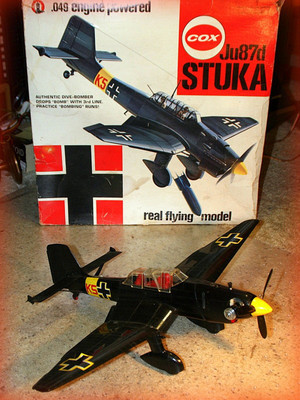
My birthday is at the end of June, so right at peak summer for a kid. Cox offered series of gas-powered airplanes, but the one that caught my eye was the jet-black German Stuka. Why did an American kid want a Nazi dive bomber for his 11th birthday? All I can say is that I was (and still am) a sucker for its aggressive look, mostly courtesy of those bent wings.
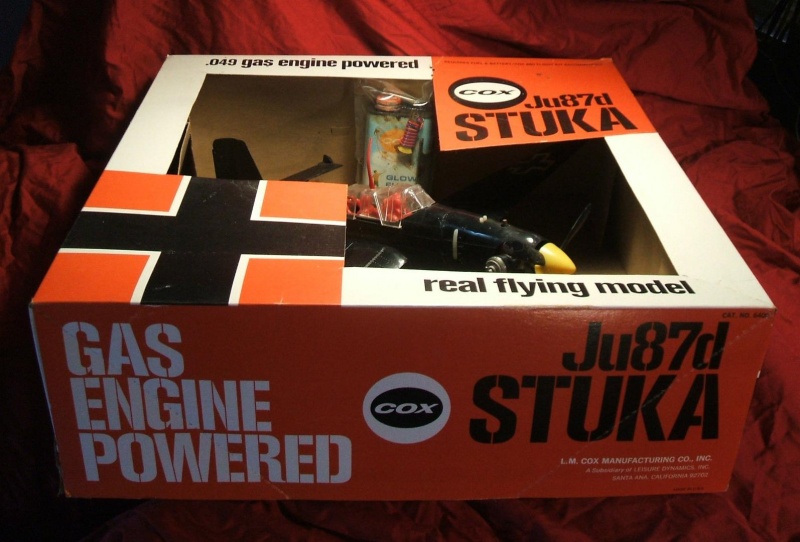
I am sure that my hints to my father as a gift idea were none too subtle, but a successful life all came together as I unwrapped a gleaming new Stuka on the big day. These were called “guide string” planes, and were designed to fly in a big circle, controlled by strings that operated the ailerons on the tail for climbing and keeping level.
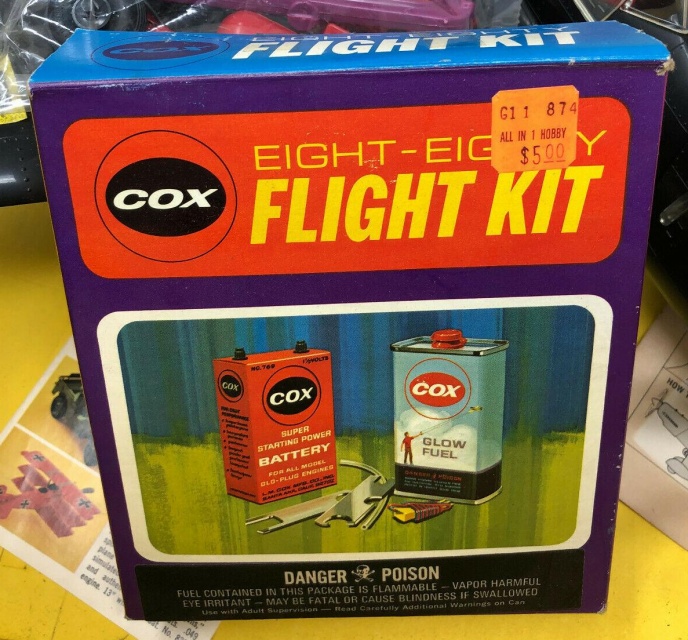
By then, I was an expert at the work of a ground crew. I had the little .49 cubic inch engine fueled and ready. And I was quite sure that I could quickly get the hang of the flying part. But Dad said not so fast. (I think the actual phrase used was “hold your horses”, which Dad said a lot, despite neither of us ever spending time around actual horses).
I did indeed hold my horses so that Dad could show me how to do it. This plan made a certain amount of sense. First, Dad had been schooled as a mechanical engineer, so he knew how such things worked. But more importantly, my father was an actual licensed pilot. And not one of those guys who would take a dinky little Cesena out on an occasional sunny Saturday afternoon, but an accomplished pilot with ratings on his license just short of the one needed for flying passenger jets. Who better to give me flying lessons in the front yard?
And so we were ready. The Stuka was at the end of its string, Dad was confidently holding the control handle and I was ready to spin the propeller to bring my gleaming new airplane to life and give it a taste of sky.
The engine started, I pulled it tight against the string and then let it go. I watched in ecstasy as the Stuka climbed sharply aloft. My ecstasy turned to alarm as the craft went into an aerodynamic stall and plummeted towards the grass. The alarm made the full circuit to horror as I saw one of the Stuka’s wings snap in two upon impact. My prized birthday present had lasted something like 4 seconds in actual flight. It’s first, last, and only.
I have no memory of anything else that day. I’m sure that my father felt bad and that he sincerely apologized. But I was 11 and had gone all too quickly from desperately wanting that Stuka to actually having it to being left with it in 2 unusable pieces. As much as I thought I might be owed a replacement from the guy who had broken it, no replacement was forthcoming. Something was said about this plane being too advanced for someone my age (which was probably not untrue), and that was the end of that.
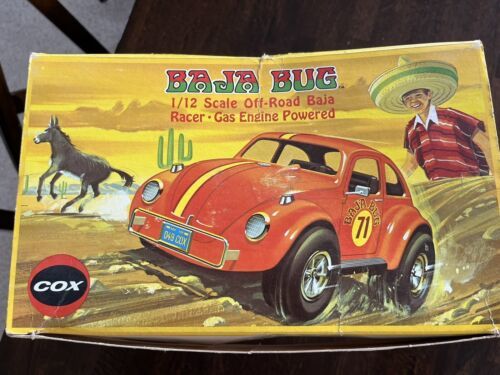
I think it was the next Christmas that my father got me another Cox vehicle – the Baja Bug. This should have been one of my favorite presents ever. I always loved cars more than planes, and this car’s reduction gearing and big, super-soft tires made it perfect for traversing the bumpy lawns of my suburban habitat. But by the time the weather warmed, 1970’s Summer Of Internal Combustion was over and the Baja Bug did not get a lot of use.
In adult hindsight, I know that even if the Stuka had not crashed on its maiden flight, I would not have had many opportunities to fly it. And if I am going to be brutally honest, I almost certainly would have crashed it and broken it just as quickly and as badly as my father did. I also have to acknowledge that it wasn’t so much the actual Stuka that I was in love with, but the idealized version of how I imagined my life to be with it. But as much as I wanted to live the brochure-version of life, actual life (even with a Stuka in one piece) would have been pretty much just like it was both before and after that crash.
My early life (and even sometimes later life) involved a long series of infatuations with things, almost all of which turned to either boredom or disappointment after obtaining that latest object of desire. This is something that I eventually figured out (much to the chagrin of our system of consumerist consumption) and have usually been able to understand that my life after getting some desired item will almost certainly be exactly what it was before. I have to admit, though, that for a few minutes in the summer of 1970, life with that Stuka was everything I thought it would be.
Thanks to my blogging friend Ted Shideler, who recently shared some childhood memories of toy disasters (here) and (here) that brought this one out of some forgotten place in my brain and gave me the impetus to share it.
Thanks also to those kids who never grew up and have kept their old Cox cars and planes going, and whose pictures and videos have reminded me of what fun these were.
 J. P.'s Blog
This was great! Sad, but great. The feeling of anticipation only for things to turn into disaster in a matter of seconds; I can obviously relate.
LikeLiked by 1 person
Thanks! I can’t believe the kinds of stuff my generation of kids was allowed to do on our own.
LikeLiked by 1 person
By the time I rolled around my grandpa was into air hogs. A slightly more modern equivalent? I’d write about them but we never had any disasters. Used to take them to New Haven to fly with dad and cousins.
LikeLiked by 1 person
What a cool toy.
I’m surprised your dad didn’t claim it was hit by anti-aircraft guns.
LikeLiked by 1 person
Haha, that would have been good, but I wouldn’t have bought it. Or maybe “Here’s how we treat a dirty Nazi airplane! Score one for the Americans!” 🙂
LikeLiked by 1 person
I opted to skip the jingoist interpretation; but I can’t deny I flirted with that one too. 😆
LikeLiked by 1 person
I had one Cox engine powered car as a tweener, and openly admit to not being able to start very easily nor being able to keep it running for any length of time. A total frustration. After half a summer of trying to have fun with it, it just got thrown on the pile of stuff I wasn’t interested in messing with any more. My one fond memory of it was spending an afternoon buckling down and trying to make it work, while the cute girl next door who was my age, and laying out trying to get a tan, wandered over wearing what was for the era, a very skimpy bikini; pitching in to help me trying to make sense of the instructions and operations manual. Viva la Summer!
BTW, your Stuka experience has been duplicated many times over in the recent years with the interest in affordable radio controlled drones. About ten years ago, I knew a bunch of people that wanted to try the drone experience, and purchased radio controlled drones in the couple of hundred dollar range; only to immediately fly them into the top of 40 foot high trees, where they got lodged never to fall out of, and never to be returned. Ditto for flying them into the middle of rivers or right into Lake Michigan and lost! It’s good to know your childhood experience has continued on to be reproduced with modern technology!
LikeLiked by 1 person
I had not thought about the modern drone disasters, but I can imagine the pain of someone flying a new drone out over Lake Michigan, only to have it lost at sea.
I think these were the kind of thing that you needed a friend to do it with. I think that is what made the experiences so memorable for me.
LikeLike
Hi. I’d like to own a full-scale Baja Bug. It’s cool!
LikeLiked by 1 person
It really kind of is!
LikeLiked by 1 person
Wow. Your Stuka story parallels my P51 Mustang story almost exactly. Including the part where my dad (who had no pilot’s license, but still professed expertise) crashed the thing on its maiden flight, after about 15 seconds. In my case, that flight took place on my elementary school’s asphalt playground (because, back then playgrounds were hard paved surfaces similar to parking lots) since we didn’t have a sufficiently large yard front or back to accommodate the Cox’s circular flight.
The Mustang had a feature where the wing was held onto the body of the plane with rubber bands. Supposedly this would mean that in the event of the unavoidable crash the wing would pop off, avoiding the issue that your Stuka had. I can report that “solution” only partially worked. When dad crashed it, the wing popped off for sure, but it also broke in half. There was some other damage…which gave me unexpected (by me) opportunity to try to master the finder points of gluing and splinting plastic parts. I did not master those skills, as the thing never worked well after its first 15 seconds of flight. Over the summer, I cracked it up – generally in less than 15 seconds per flight – several more times. Once I broke the propeller…which then gave me the chance to learn as a 10 year old how to order replacement parts from the manufacturer (I should note that my dad made me pay for all subsequent replacement parts on my own).
Ultimately, I managed to break the plastic bits on the cowl which held the engine onto the plane. Hence, more gluing….and you can imagine how that turned out. I did love starting that little engine though…and eventually just mounted it to a block of wood so that I could run it without the plane. I harbored fantasies of building a new plane around the Mustang’s motor…but that never happened as I got much more interested in things like cameras (that didn’t usually wind up in pieces scattered on the ground). I still have that engine on my shelf. The rest of the Mustang lies in (many) pieces in some box in the basement.
I’d imagine that some kids (just not you and me) did manage to learn how to fly these things. They’re probably making the big bucks now flying things made by Airbus and Boeing that manage to fly in straight lines without strings.
LikeLiked by 1 person
Your Mustang and my Stuka would have made for an epic dogfight. Although one where each plane does its best to crash on its own before the other one can. 🙂
I remember asking Dad about gluing the wing back together, but he convinced me that it would never hold. After hearing about your success, maybe he was just ready to be done with this father-son episode. I can’t blame him. And neither he nor I thought of ordering a new wing.
After writing this (and reading your comment) I can still feel how my fingers would hurt, raw from Cox fuel, then mangled by the sharp propeller edges as I made multiple attempts to start the thing.
LikeLike
This article inspired me to research what became of the Cox company, and lo and behold they eventually became part of the Estes Corporation. Estes being the company responsible for an even more dangerous “toy”…model rockets! If I recall correctly, my Cox model plane was considered by my parents to be a bit of a consolation prize/present for me given that giving me live explosives was a bridge too far for them; because I REALLY wanted model rockets. I continued to lust after model rockets for most of my life, only getting partial satisfaction once my own boys joined scouting (briefly), where the local troop had an annual “rocket day”. I was the dad who was clearly having a better time at those things than were any of the kids.
Looks like Cox is now run by something called “Model Engine Corporation of America”…which sells replacement and service parts for all of the Cox engines. Although it does seem that you need to perhaps mix your own fuel nowadays. If I were looking for a new hobby, this could now well be at the top of the list.
LikeLiked by 1 person
Jeff, I built and launched a bunch of Estes Rockets in my youth, a literal and figurative “blast”. The engines were considered so volatile, that they could not be sold in my city or county; and I had to take an “inter-county” bus to a mall the next county over, where a hobby shop there would sell me the engines! My construction methods were so poor, that most of the time, on launch, the thrust would tear one or more of the fins off, resulting in some pretty wild trajectories!
LikeLiked by 2 people
I was never bitten by the model rocket bug. IIRC, my friend Tim also got a few of those, but we were never allowed to shoot them off.
I am kind of amazed that these old Cox engines have 1) lasted so long and 2) have so much parts support. Now you have me wanting to see if the Baja Bug is still in the basement.
LikeLike
Drones have sure come a long way in recent years! My husband just had to have one and though he has never taken it out of the ‘limited height and distance’ mode, it is fun to see what our land looks like from a different perspective.
LikeLiked by 1 person
I never understood the drone thing at first, but I do now. That would indeed be interesting.
LikeLike
The adult neighbor down the street flew these planes as a hobby but IIRC his choice of powerplant was a Testor (yes, the glue people). I wonder if the Testor engines were simply rebadged Coxes (Coxen?).
LikeLiked by 1 person
Good question. I saw nothing about Testors either way in what little research I did.
LikeLike
That big propellor reminded me of those little flying planes you could get as a kid, where you wound up an elastic and let it loose to turn the prop. Did it fly? Don’t recall now, maybe they were just roll on the floor toys. I think they were made of balsa wood. Which nobody knows what it really is, anyway. Fake wood I imagine.
My toy of choice as a kid was my Big Bruiser tow truck, which moved considerably slower than your Stuka.
LikeLiked by 1 person
I think those little balsa planes with the rubber band power would fly short distances if you launched them by hand. They certainly didn’t have enough power for a take-off from the ground.
Aahh, but I’ll bet your Big Bruiser could take a severe impact and keep doing its job!
LikeLike
I don’t think I’ve ever seen kids flying planes as sophisticated as this one back in my day – it was more like those lightweight balsa airplanes, just a step above the kites made with balsa wood that all us kids used to fly. Now I see kids at Council Point Park with remote controlled cars whizzing around the parking lot and drones that often crash in the trees. I think you would have been even more disappointed if it had been you that had been flying the plane on its maiden flight and it crashed and was damaged, but I’m sorry your dad deemed you too young to get another one.
LikeLiked by 1 person
That would have made for an interesting life re-do – me crashing the plane and my father walking away, wondering why he hadn’t insisted on showing me how to do it. As a dad myself, I can see both sides.
LikeLiked by 1 person
It worked out for the best … I think if you broke it, you might have been labeled as careless. It’s an interesting point of view now seeing it from the other side.
LikeLiked by 1 person
I enjoyed reading this even though it was a bit sad. I could imagine every bit of it and I could imagine myself as the dad, as well.
LikeLiked by 1 person
Yes, my own turn at fatherhood gave me a new appreciation for Dad’s dilemma.
LikeLiked by 1 person
I knew someone who was into the really large R/C planes, and one of his mottos was “Takeoffs are optional, Landings are mandatory”
LikeLiked by 1 person
Love it! When I got my own pilot’s license decades ago, my instructor defined a good landing as one you could walk away from. So I guess this story involved a good landing after all. 😛
LikeLike
“After the turn of the Seventies, in the clear blue skies over Indianny,
You could hear JP’s plane and its buzzing sound, then a big ol’ thud when it hit the ground.”
I’m pretty sure the remaining Royal Guardsmen aren’t going to come after me.
LikeLiked by 1 person
I came back for the comments. Dad and I did the model rocket thing once in his acre-sized backyard. It shot straight into a tree and was shot down for recovery.
I hadn’t considered that drones are the modern equivalent. I have the cheapest pro-level drone on the market and I’ve flown it on some epic journeys! Did smack it into a tree once right in front of my face, but it did no lasting damage.
LikeLiked by 1 person
I figured that I knew nothing about rockets, and that any one I might try to launch would either burn itself up on the ground or launch itself into something, destroying both itself and whatever it might hit.
LikeLike
I built a crashed about a dozen of those planes. We rebuilt and just kept going. Those things were so much fun. Thanks for the story and memories. 🤣😎🙃
LikeLiked by 1 person
Now I feel like a slacker for not trying to fix it!
LikeLiked by 1 person
Don’t. I’m a bonifide geek. You probably had a normal childhood. 🤣😎🙃
LikeLiked by 1 person
I don’t remember ever having one of these. We did have slot cars – Aurora/AFX – with small motors that had to be cleaned regularly, and treated with special lubricant (that today would be classified as a hazardous substance!). My friends and I spent hours racing those cars, and regularly cleaning the engines and reassembling the chassis and body as though we were the local NASCAR pit crew. Good times!
LikeLiked by 1 person
I had a set of these too, and loved it! I got it out when my kids were young and we had great fun, until the aged original transformer would heat up and the cars would slow to a crawl. I imagine I could probably buy a new one, but have never seriously looked into it.
LikeLike
This is a late comment, but this just “popped” on my feed!
https://www.youtube.com/watch?v=6FyQ-WlM9ms
LikeLiked by 1 person
That was great!!
LikeLike
A neighbor recently invited me into his garage and told me to look up. Suspended from the ceiling were 30 or 40 RC airplanes of various shapes and sizes. It’s the most impressive collection I’ve ever seen, and proof that some of us keep the kid inside of us forever. I never graduated past balsa wood gliders but I certainly remember Cox. I also remember “hobby shops” as the staple retail of our youth. I’m sure my kids would have no idea what I mean by that phrase, but there was no better place for a pre-teen to hang out.
LikeLiked by 1 person
Yes, I used to love going into hobby shops. When I was in my 20s I knew a guy who worked for one. His job was building models that the store could sell to people who didn’t have the time or skills to build their own. I couldn’t believe it was a real job, but it was. At least until the place went out of business in the early 90s.
LikeLiked by 1 person