Breaking Up With My Mechanic (Or Looking For Mr. Goodwrench)
In my world, finding a good auto mechanic is almost as big of a deal as finding a spouse. In both cases, it is (or at least should be) a “till death do you part” kind of relationship. I am a child of divorce and really hate breakups – of all kinds. Breaking up with a mechanic is bad – mainly because you have to find another one. Living the single life is not an option when it comes to keeping your car running. A good mechanic is a necessity.
Sadly, the one I have been using for several years has become part of a relationship I simply can no longer abide. A relationship with a mechanic requires trust, and since this particular shop seems to have changed hands a few years ago, things have been deteriorating on that front.
Once upon a time, I was younger, thinner and less affluent than I am now. It also helped that I loved cars, and so it was natural that I would tackle most of my own repair jobs when they became necessary. I watched older guys make car repairs, and then my friends and I did simple jobs on each others’ cars, making rookie mistakes and learning along the way. I slowly built up a moderate supply of tools, a decent jack and safety stands, and even a good pair of coveralls to keep the grease (and rust) off my clothes.
There has always been a boundary line for more complex jobs that I have been unwilling to cross. As age and financial abilities (and the complexity of my cars) have increased, that boundary has moved closer and closer to me and I have been willing to pass off more and more work to professional mechanics. I have one big problem, however, that many folks do not. I am still pretty decent at diagnosing problems and need a mechanic who will listen to me and explain things at a higher level than is necessary for most customers.
What is a good mechinc? He (it is virtually always a “he”, though I am certainly open to the alternitive) will fix what needs to be fixed and not fix what doesn’t need to be fixed. He will also understand the sliding scale of cars, from a “good car” which requires high-standard repairs and a less expensive older car that needs to be safe and relatively reliable, but which does not need every part to operate as new. Finally, their rates must be reasonable.
For quite a few years I had a really good mechanic who fit all of these qualifications. But then he took over a larger shop and his overhead jumped substantially. That, along with his location in an affluent area, led to his rates creeping higher and higher. This might have also been his way of dissuading me from bringing older cars in, which can be more difficult to work on and mess up the flow of work in a busy shop. I eventually found a replacement nearby and it was a great thing for several years. But then there were changes in the people there and things started to go sideways.
The first time I started to have doubts was a couple of years ago. My daughter called me from the other side of my city. “My car is making a funny noise.” I made time to check out the situation, and found an alternator that was absolutely screaming in agony. I am afflicted by a condition called “mechanical sympathy”, and when I hear a mechanism that is loudly protesting, it really bothers me. It was after my mechanic’s closing time, so I swapped keys with my kid and drove her car to my house, hoping that the poor alternator would hold itself together for the rest of the ride. Hold together it did. So much so, that when I went to start the car the next morning it would not start. My theory was that the alternator had gotten so hot that it had welded itself together after I shut the car off.
After a tow-in, the mechanic called me. “Bad news. I think it broke a timing belt and this engine is toast.” When I explained that we had done the timing belt service at a Honda Dealer relatively recently and that I really believed that it was a seized alternator, they checked again. “You were right – the alternator seized and the engine seems OK.” “Yes, I know” was the reply that I crammed back down my throat before it came out.
My current mechanic-needing car is a 19 year old Mazda. I own it for driving to and from work. It doesn’t look great, but it starts every day and blows both hot and cold air out of the vents, so it does everything I need it to do. When I first got the car, I got a starter put in it – from a different shop, but that’s a different story. About a month ago the car refused to start at my job. It was a weekend, and rather than towing it to the place that put in the starter, I opted to to to my usual mechanic. I suspected that the rebuilt starter might have quit. Although I was not as sure about this as I was about my daughter’s alternator.
They replaced the starter, then called later to say they found another problem – a fuse to the starter. Which left me wondering if I needed a new starter after all. They also recommended another $2k of work for the rear suspension, including new shocks. I declined that work, and everything seemed fine. Until the day I hit a big pothole and broke a part that holds one of the rear shocks in place. My research indicated that this is a fairly common issue on these cars, and the broken part is readily available.
The problem? My shop called me and told me that the car was too rusty underneath to safely repair. I wanted to ask how the rust advanced so quickly in the month since they wanted me to replace these very same rear shocks. The car was safe enough to spend $2k last month but not now? I know that cars rust in Indiana, but they don’t rust that fast. The shop’s claim was not adding up, and I figured that 1) they were looking for some revenue a month ago and/or 2) that they were busy enough now that nobody wanted to deal with rusty fasteners underneath.
This is a problem with many mechanics – they get used to dealing with newer cars. I have found that when I have an old beater, I have better luck with mechanics whose customer base is mostly old beaters. I went to such a place, and was in and out with new struts for $600. And this was after I told them in advance that my prior shop wouldn’t do the job, claiming that the car was unsafe because of the rust.
I understand that a car can become unsafe because of rusted parts of its structure, and I have no doubt that this fate will befall my trusty little Mazda at some point. But to my eye, the car is not there yet, and apparently shop number 2 agrees. So, I think it is time to say goodbye to Shop No. 1. Maybe I have found one in Shop No. 2, although they are not in a very convenient location. As middle aged people say when discussing dating, “The good ones are out there.” Hopefully I will find one of them again.
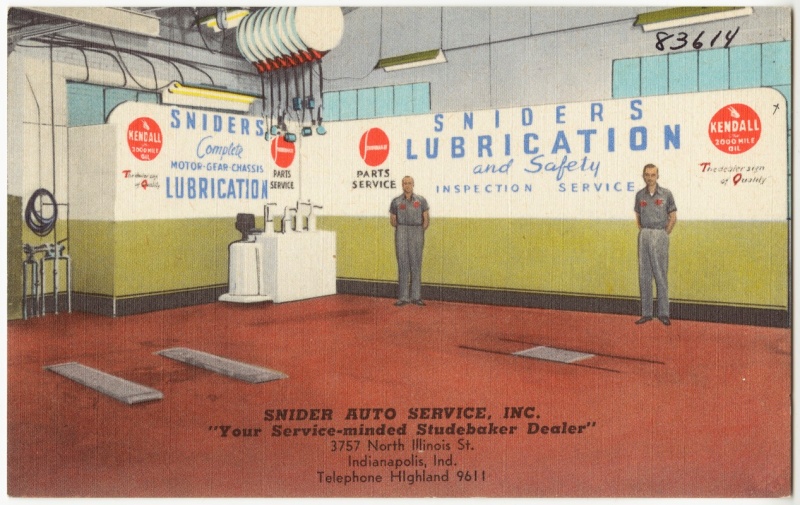
Lede photo – vintage postcard that featured the service department of a long-ago Studebaker dealer in Indianapolis, Indiana.
 J. P.'s Blog
Totally agree. Gone are the days I could get my car fixed for parts and a six pack. I’ve gone through many mechanics. I leave when they start saying, “We did your oil change, but we found these other things. ” 🤣😎🙃
LikeLiked by 1 person
I don’t even mind them finding other things, so long as they add “This one ought to be addressed now, but these other three things are just to keep an eye on to see if they become a problem.”
LikeLiked by 1 person
This is a prescient post, since I’m about to take my 250k mile shitbox on a 200 mile round trip for county home photos. Hoping I don’t need to find a mechanic on the way!
LikeLiked by 1 person
Ooooh, I hope you don’t too!
LikeLiked by 1 person
Sorry, I learned a long time ago, that the dealerships my best bet. I learned this because I was a relatively early adopter of Toyotas; I haven’t driven anything American since 1975 (and have financed an enjoyable lifetime by not having to pay for American car repairs). My local “trusted” independent mechanics couldn’t make “hide nor hair” out of what was going on under the hood of a Toyota, and after a couple of botched repairs I learned my lesson and went to the dealership. Go to the people that know your particular car! Japanese car dealerships did NOT have the same program going on as American dealerships, and were much more service oriented, PROVIDED, and this is important, I went to a dealership that was what I referred to as a “true believer” i.e. one that was a stand alone Toyota dealership from the early days with no relationship to an American car dealership (which were usually ‘late’ adopters of Japanese cars because they finally saw the light, were losing money, and also dragging their American car dealer behavior hi-jinks into the mix). You can, or course, get a bad dealership, or one that “goes bad” (happened to my Toyota dealer that was bought out after about 30 years, and the bad behavior started immediately; most of the old staff left as well).
It’s important to know as well, that the few indie mechanics I know of, or have heard of here, have shop rates that are not much different than the dealerships. Liability insurance, and all the other expenses associated with running a business have driven rates up everywhere, and no different for the small shop. Dealerships also have regional adjudication departments. Something not done to your liking, or botched, you have a path to hopefully get satisfaction. Even a good dealer will work with you. My service writer at my Toyota dealer in north suburban Indianapolis guided me to an indie shop to make a repair on my exhaust they couldn’t touch (they were not allowed to weld and would have had to replace the whole part at five times the cost). You also build a relationship with familiarity. I’ve never tried to save a couple of bucks on oil changes by going somewhere other than the dealer, so they see me and I’m in the computer. God forbid I’m going to lay on the ground and change my own oil! I’ve never bought into the idea that having my “man card” punched is based on me doing car repairs myself. I’ll help you restore a Jag XKE, but I’m not doing maintenance on my daily driver.
BTW, my brother, a long time Mazda driver, now driving a Hyundai, will tell you that Mazdas are notorious for underbody rust and especially “tear outs” of the metal around McPherson strut and shock towers! He’s had to get rid of cars that needed new metal welded into spots to make the suspension system “safe” (and which the dealership won’t do). This is the lesson that not all asian cars have the same dependability or build quality. Somehow Subaru has gotten dependable (when they never used to be in the 80’s), but Toyota and Honda are the benchmark. Mazda, Nissan, Mitsubishi, Izusu, maybe not so much…
LikeLiked by 2 people
The first-generation Ford Escapes – based on a Mazda platform – also have issues with underbody rust. It’s not uncommon to see those still on the road around here, but with rust on the quarter panels around the wheel opening. In many cases, once the rust has reached that point, repairs are too expensive compared to the value of the vehicle.
LikeLiked by 1 person
GB, both my younger sister and brother bought Mazda built Ford Escorts, and they were amazing for dependability and quality. They kept them for a long time, both loved the small Escort wagons (why doesn’t anyone make that format today?). You’d think Ford would have learned something by working with Mazda?
LikeLiked by 2 people
It seemed that for awhile, preventing rust was a priority in new cars, but some never got the memo.
LikeLike
I think you are right about dealers – IF – you are driving newer or middle age cars. But with older cars, name-brand parts are expensive and flat-rate mechanics don’t often take the time to properly diagnose things. My new car is under warranty and goes to the dealer, but not my older cars.
Oh I know that some cars are better than others and that Mazdas suffer more from rust from some others. But mine isn’t there, at least not yet!
LikeLike
This is a real issue…fortunately, the service department of the Honda dealer from which I purchased my current Civic seems good. But the car has been reliable so far (137,000 miles), so one could say that the service department really hasn’t yet been put to the test.
Another issue is finding a mechanic who will work on classic cars. Most just aren’t interested, even though domestic cars from the 1960s and early 1970s are supposedly quite simple from a mechanical standpoint.
If the problem is with something like an automatic transmission, the real fun starts. The Roto-Hydramatics used on full-size Oldsmobiles from 1961 through 1964 is very troublesome, but the number of people who can work on it are dwinding in number. On Facebook, one owner was told that the best hope was to remove the transmission and send it to a specialist in another state who still works on that transmission!
LikeLiked by 1 person
“Another issue is finding a mechanic who will work on classic cars.”
Put out a few feelers at your local parts store. Not some big box that will sell you 47 different flavors of floor mats but a real parts store. The people that work there (like me) usually know who the old school go-to guys are.
Good luck with the Roto. As you’ve already discovered, you’ll need it.
LikeLiked by 2 people
Yes, a dealer is great for basic stuff on models that are fairly trouble free. But specialty or oddball stuff requires someone who does a lot of it, or at least some.
LikeLiked by 1 person
Yup. A true-er telling of the mechanic story could not be told. This is basically the story of my life with cars. Between relocating to different cities and falling in and out with mechanics, I too am usually not that far away from needing to find a new one. My particular issue is that I generally know what needs to get done (a la the alternator on your daughter’s car) and I’m also usually quite cheap (i.e., broke). So, I genuinely dislike giving someone else money to do what I know that I could do myself under better circumstances. The problem of course are the “circumstances”. Sometimes I just need something fixed and don’t have the time or patience to fight with the thing myself. In those cases, I usually shell out for a professional as much as I hate it. Recently, I paid several thousand for my guy (who has several talented women working in his shop!) to just make new rear struts reappear on my Highlander…a job that I could have handled (and have done before) for about 1/4 of the cost. Well, if you don’t include several pints of blood lost removing rusted hardware, much swearing, and 4 days instead of 2 without use of the vehicle. Yeah, it was much simpler to just give up and pay. This time.
I was going to write a Curbside article about “mechanics of a lifetime” that traced my wanderlust from one mechanic to another as I’ve taken different cars to them. This would run from the Jamaican guy in Maryland in about 1978 who wrecked my parent’s Fiat between the time I dropped it off and went to pick it up later that day (that was a fun phone call to my dad….) to the VW mechanics/cooperative hog farmers who kept my Rabbit on the road (“Yeah, we can fix your clutch, if you insist on not learning how to shift without it…”) some time later. And I still might. Problem was that I got lost down a rabbit hole looking up photos of the old garages where these folks worked over the past 50 years…and well, you know how that goes. Maybe I should get back to that.
LikeLiked by 1 person
I would love to read that series of stories!
I am jealous of your apparently higher levels of inclination and time. Somewhere along the way I decided that I only like working on car jobs that don’t HAVE to be done. When it HAS to be done, I am happy (well, maybe only not unhappy) to hand it off to a pro. At least one who doesn’t charge too much.
LikeLike
I wish I had raised my three sons to be car mechanic, plumber, and handyman. Instead they have expensive degrees, professional white collar careers, and big salaries which are of no value to me personally! I would gladly pay their full rates just to hire someone I could trust!
LikeLiked by 1 person
Haha, I wish I had thought of that plan too!
LikeLike
A very necessary skill to have – firing mechanics that is. I like Jeff’s idea of a Curbside history or mechanics used, good and bad. Go in for an oil change – oh you need new brakes, and we won’t let the car out on the road – it’s unsafe!! Or you need new constant velocity boots. Or shocks and blinker fluid. A new PCV valve. Or always something. Been there, done that.
I have a great shop I use now, but I have to supplement with visits elsewhere or the dealer when something is needed that they cannot do – wheel alignments, or complex electronics. The only challenge will be when their rents continue to skyrocket and they decide to close down.
Cost and convenience of location are important also. Drop off your car and you need a ride to get where you are going, and get back again.
LikeLiked by 1 person
All true! I don’t mind spending money for something that is 1) necessary and 2) done right. But knowing those things takes some experience.
I feel bad for people who have no aptitude for mechanical things (or, these days, electronics) because without it, it’s hard to judge.
LikeLike
I had an issue with a mechanical last year and my car has not felt the same since. Granted my car has 100K on it, but it was fine… UNTIL, as you mentioned, they started telling me things I needed to do. Anyhow, it is hard to find a good trustworthy mechanic. Good luck with your search.
LikeLiked by 1 person
Thanks. I hate that, when you pick up your car and it isn’t right.
LikeLike
Just found out today that the shop I’ve been using for the last 15 years no longer has anyone willing to work on my 2001 Cherokee and 1944 Willys MB 😦
LikeLiked by 1 person
Apparently there are more and more shops that only want easy stuff. I used to think that something like an old Jeep would be simple to work on, but most current mechanics have never seen one so everything is on a long learning curve.
LikeLike