JP’s A to Z Challenge – Y is for Yugo

OK, admit it. You have been waiting for me to get to the letter Y and either resort to a GMC Yukon or else fall flat on my face. Sorry to disappoint, but there is another option. Have you forgotten about the fabulous Yugo?

Anyone around my age remembers the Yugo. When, in 1985, people were griping about how expensive cars had become – why, it was almost impossible to find anything decent for under $7,500. This was when promotor Malcolm Bricklin and the Eastern Bloc Zastava Automobiles came together to bring a new car to American showrooms for $3,990. What could go wrong?
To put this in perspective, a second bargain-basement offering came to these shores that same year. But the Hyundai Excel could not be had for under $4,995 – still a figure that made people shake their heads, wondering how anyone could sell a new car for so little.
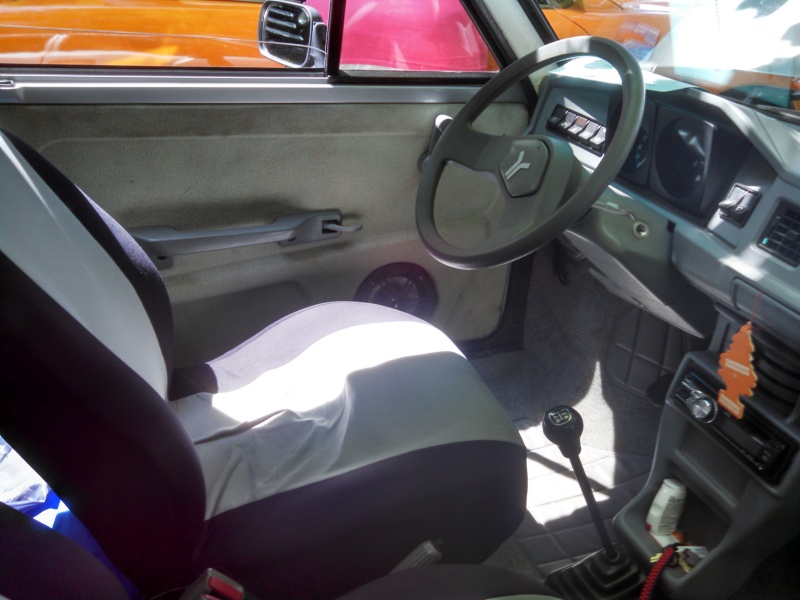
The Yugo soon developed a reputation as a terrible car. People made fun of the crudeness of the thing, an update to an elderly Fiat design. The assembly in a Yugoslavian (now Serbian) auto plant was met with yuks by the American public too. Even in the Yugo’s best year (1987), U.S. sales never hit 50k units. How embarrassing was that for a sub-$4,000 new car? It spent years as the butt of jokes in the movies, where it became gag material in Dragnet (1987) and Die Hard With A Vengeance (1995), to name a couple.

But there were contrarians who loved their Yugos, and claimed that they were simple and robust little cars for those willing to maintain them properly. I knew such a person – a woman who had owned two of them, only reluctantly selling the second one several years after they were no longer imported, when parts became difficult to get.

I would imagine that the owner of this example falls into that small club of Yugophiles. Why else would someone keep one of these on the road into the 2010s? Maybe because it is the sporty GVX trim? Personally, I could see myself becoming a member of this small group of misunderstood souls. Although my Mrs. would almost certainly have none of it.
Photos by the author at the annual Father’s Day car show in Noblesville, Indiana, June 15, 2014
Photo of the Yugo emblem taken by Robert Knight and is found at his Flickr page.
 J. P.'s Blog
I’ve always liked Yugos. A friend of mine in Ecuador had one that was 4×4. I wonder if it would’ve come from the factory that way, or if it had been customized? He swore by it and it did indeed seem sturdy. Was definitely fun to look at and ride around in. I drive a Yaris. Perhaps the modern equivalent, albeit with a better track record for reliability. It’s taken me on multiple 1500 mile plus road trips without a hiccup. Reliably gets 40 mpg. It’s paid for and is a 5 speed manual. I find it amusing it came from the factory without an rpm gauage, in 2009! Anyway, I enjoyed reading this piece!
LikeLiked by 1 person
Thanks Ryan! Yugos never got much popularity in the U.S., and I have always figured that they must have sold better in other parts of the world. On the 4×4 thing, I have no idea.
LikeLike
Wow, there is actually a car that starts with a Y??
LikeLiked by 1 person
Haha, yes. I actually thought of 3 or 4, but this was the only one I had a picture of!
LikeLike
Well, BRAVO! Z… let’s see, there should be FIREWORKS for that one!
LikeLiked by 1 person
Haha, a celebration is in order for sure!
LikeLike
No, I knew you had a plan for Y because you are a person who plans way ahead! Yes, I do remember the Yugo, although I do not remember ever driving or riding in one.
LikeLiked by 1 person
Not many of us ever did. Looking back, I should have walked into a dealer and test driven one, just for the experience.
LikeLiked by 1 person
I knew of one person who bought one brand new in 1988. It lived down to its reputation.
Which brings up another question – are there any truly awful brand-new vehicles offered for sale today?
LikeLiked by 1 person
Good question. There are the 4 cylinder Hyundai/Kia models that often require an engine replacement before 100k miles. Warranty usually covers it, but you know there’s a problem when you have to wait months to get it done. But unlike the Yugo, they are quite nice until that happens.
LikeLike
Ah, the lowly Yugo. Someone I went to college with had one. It was the only car my slug-slow Renault Alliance would outrun.
LikeLiked by 1 person
Maybe because it wasn’t the sporty one like this is? 🙂
LikeLike
Yaris or Yukon might be the only two that some people might have photos of! Next up, Z! I look forward to what you come up with for that letter!
LikeLiked by 1 person
I had hoped to find a Yellow Bird version of the Pontiac Firebird from the late 70s, but no luck. 🙂
LikeLiked by 1 person
I remember hearing about them and hearing people speak disdainfully of them, but I never rode in one.
LikeLiked by 1 person
I think you were like most of the rest of us.
LikeLiked by 1 person
A lemon is a lemon!
LikeLiked by 1 person
Even when it’s silver!
LikeLiked by 1 person
I think this Yugo you’ve pictured here is cute, but then I had an AMC Pacer and this Yugo looks very similar with the “fishbowl” look and lots of window space, especially in the last photo. I did not think you’d falter on the letter “Y” JP. 🙂 Now we all await what you will do for the finale of this series next week.
LikeLiked by 1 person
Yes, the exciting conclusion! 😛
LikeLiked by 1 person
Twenty-six posts, in addition to your regular Friday posts; that deserves a pat on the back!. (Datsun Z series perhaps?)
LikeLiked by 1 person
You will just have to wait like everyone else! 🙂
LikeLiked by 1 person
Ha ha – yes I will! 🙂
LikeLiked by 1 person
The Yugo, as you pointed out, was always the butt of jokes back in the day and that’s literally the only thing I can remember about the car. Probably never even saw one on the road – just TV and movies!
LikeLiked by 1 person
The Yugo proved that too cheap is worse than too expensive. But I would love one now, if only to crash events for owners of vintage European cars. 🙂
LikeLiked by 1 person
HA!
LikeLiked by 1 person
I always liked the profile of the Yugo, it was nice looking with utile features. You can’t say you liked the Volkswagen Rabbit and hated the Yugo, the Yugo actually looked like someone took a Rabbit and made slight and subtle feature changes that made it look a little more “finished”, and maybe a little “sportier”. People might want to do their research, as I believe there were multiple generations of Yugo, and after the initial “quality challenged” ones, some U.S. engineers might have gotten involved and they improved somewhat, and after they stopped importing them to the U.S., they went on in Eastern Europe and South America to be relatively well regarded affordable transportation. If I’m not mistaken, I think they had a thirty-year brand life!
BTW, am I the only one that remembers the slightly absurdist film Drowning Mona, where everyone in town drives a Yugo?
LikeLiked by 1 person
“Many mechanics and even Zastava factory workers agree that the “best” Yugos ever were built between 1988 and early 1991. Quality control was good; high standards were set in terms of plastic quality, seat cloth, and “a well screwed together” interior. Paint and antirust coatings were also well done during that period, evidenced by many cars still showing no signs of rust, tears in the seats, or major engine issues after more than 20 years.[9]
1989 was considered a “golden year” for Yugos because almost 200,000 were built that year, and many can still be seen on the road today. Also, cars were usually branded Yugo instead of Zastava during that period, because the company was taking pride in the (at the time) good sales and reputation established in the export markets, especially in the United States.”
LikeLiked by 1 person
In that era, we Americans were spoiled with cars that (for the most part) would suffer neglect without many complaints. My (limited) understanding of Yugo was that it came with some maintenance requirements that had more serious consequences than we were used to. In that respect, it was kind of like Peugeot in this market. Americans considered them trouble-prone and not very dependable, while for decades they were considered the gold standard for durability in places like Africa.
LikeLike
I already abandoned what I considered “garbage” American cars for Toyotas in 1975. I’m not quite sure I would represent American cars of the 80’s, Yugo introduced in 1985, as cars capable of “suffering neglect”, altho better than the 70’s. What I would say, is that by that time, it was easy to read, and experience, anywhere that Japanese vehicles were available for the asking that were incredibly dependable. My ’77 Corolla, ’87 Tercel, and ’93 Tercel, all made 200,000 miles with literally, and I mean literally, zero repairs other than wear parts like brakes. It’s pretty much agreed upon that the 1986-1997 years, might have been the height of Toyota dependability, even over today! Tossing an Eastern European made car with some early year teething problems, not particularly tested or worked through, might have been pretty hopeful, or arrogant, and likely would end up a disaster.
LikeLiked by 1 person
The Yugo was a great little car. My cousin owned one and it served him well.. 🤣😎🙃
LikeLiked by 1 person
I think it was all about expectations. For those expecting a cheap Honda or Toyota, the car was crude and unreliable. For those going in knowing that it was crude and who were willing to understand it, they were usually pretty happy with the Yugo.
LikeLiked by 1 person