Forgotten Jazz From The 1950’s

Every decade in jazz had a predominant style. New Orleans-style jazz of the early 1920’s morphed into swing (1930’s) which then begat bebop (1940’s). The 1950’s saw jazz kicked off its perch as the predominant style of pop music, as the music fragmented into more styles. The bebop got harder and less inviting to new listeners, while “west coast” jazz promoted a new cool sound.
But there was another strand, one that doesn’t see much interest from modern listeners. What was happening in the 50’s with all those guys who were wet behind the ears in the 1920’s, hitting the big time in the 30’s and maturing into the jazz establishment in the 40’s? There is a lot of good stuff in this group, and I have found 3 very nice examples for your listening pleasure.
There is one more criterion I applied for today’s selections. Top names like Ellington, Basie and Armstrong are well known for their 1950’s output. So today we will look at three artists who, even at the top of their games, never quite cracked into the top two or three names in their style. They did, however, survive into the 1950’s (and beyond) by making some really satisfying records.

Harry James grew up in a family of circus performers and learned how to play the trumpet in a circus band led by his father. By 1937 he had gone from anonymous Trumpet Guy in hotel bands to Benny Goodman’s star trumpet attraction when the Goodman band was at its peak. James left to start his own band in 1938 (which was, incidentally, the first band to hire a young, unknown singer named Sinatra). James struggled financially until he became less focused on jazz and more of a pop band. Still, Harry James was one of the most technically proficient trumpet men of his (or any) era and could handle a wide range of styles. The big band era was well and truly over by 1953, but Harry James kept a band going when many others gave up, and brought it into the era of the LP album.
“Lush Life” was written by Duke Ellington’s collaborator Billy Strayhorn some time in the 1930’s, but was not played by the Ellington band until 1948 – and even then, Ellington failed to get it on a record. It is a beautiful ballad with a complex and sophisticated chord structure that supports lyrics about failed love as experienced in a booze-soaked haze of regret.
It appears that nobody had done the song as an instrumental track when Harry James selected the song in a 1953 recording session. This record shows Harry James at his best, alternating between quiet tenderness in the mellow lower registers of his trumpet and his strong, clear sound where the song hits its emotional peak. The song has gone on to become a great jazz standard, with this version often being ignored. But not today, because it is a lovely rendition of a lovely song. (1)
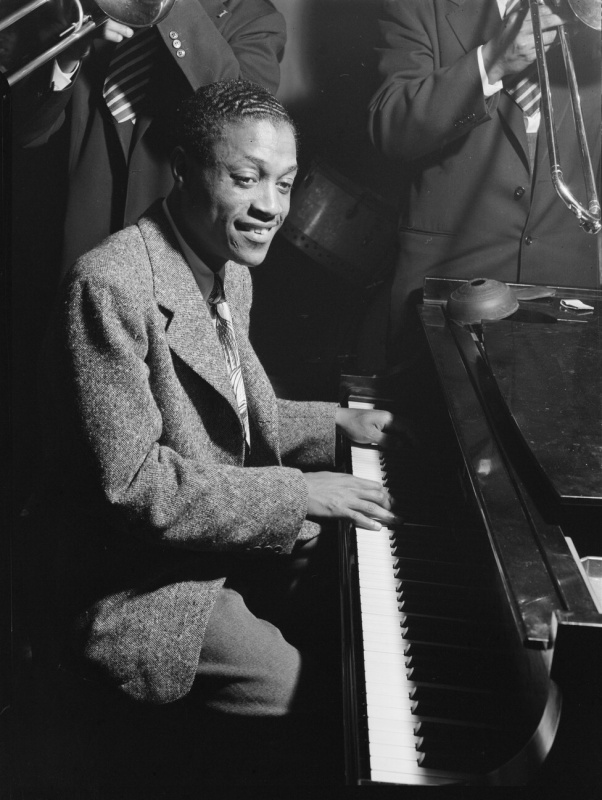
Eddie Heywood was another second generation musician. His father, Eddie Heywood, Sr. had been a jazz piano player in the 1920’s and taught his son to play. Young Heywood found his way into the excellent band of Benny Carter in the 1930’s and then left to form his own outfit. After leading a big band for a short time, Heywood gravitated to leading smaller groups. His career was interrupted by a bout of paralysis of the hands in the late 1940’s, but he recovered and went back to the keyboard.
In 1955-56, Heywood collaborated with Hugo Winterhalter, who led what was essentially the “house orchestra” for RCA Victor records. His “Canadian Sunset” was a big hit from that combination of talented piano man and big, lush commercial orchestra. That same year, Heywood wrote another tune. This one was called “Soft Summer Breeze” and Heywood recorded it as a solo with rhythm for Mercury Records, and that is his contribution featured today.
Heywood’s relaxed style was always pleasing and he adapted it well to a sound that resonated with an adult audience of the 50’s. Although this was not as big of a hit record as “Canadian Sunset” was, it still managed to reach No. 11 on the Billboard charts, which was not bad in a year that was dominated by Elvis Presley and many other early rock and roll performers. Eddie Heywood is one of those artists who almost never comes to the front of my mind when I am looking for something to listen to. But after I stumble on him (for the umpteenth time) I never regret spending some time with his inviting style.
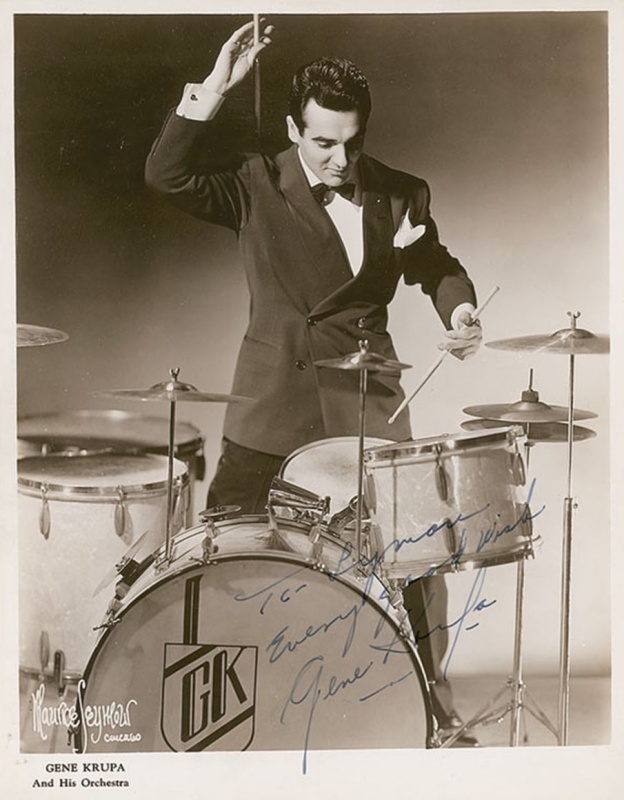
Gene Krupa was another alum from the Benny Goodman outfit of the 1930’s, and was probably the first jazz drummer to become really famous. After toiling in obscurity from the mid 1920’s, he joined Goodman in time for that band’s meteoric rise to the top of the jazz world. He left to form his own band in 1938, and was doing quite well until he was jailed on a marijuana charge in 1943. Upon his release he re-formed his band and continued to play as the big band format lost favor.
This selection is the latest of the three, having been recorded in late 1958 for an album released in early 1959 – Gene Krupa Plays Gerry Mulligan Arrangements. Gerry Mulligan, several years younger than today’s featured artists, was a pioneer in the cool West Coast sound of the late 40’s and early 50’s. Only here, he was responsible for writing the arrangements and leading the band instead of playing his trademark baritone saxophone.
Gene Krupa almost always played with spirit and inspired his bands to play in the same way. This up-tempo version of “How High The Moon” a great example of big band jazz from the latter half of the 1950’s. The tune is usually associated with bebop players, but Mulligan brings it (with a few boppish flourishes) into a fine balance that is both a little cool and a little hot. Notable sidemen on this album include Doc Severinsen (trumpet) and trombonists Kai Winding and Urbie Green.
All three of the artists featured today had long careers. Harry James reformulated his band in 1955 to give it more of a Count Basie flavor, and continued performing and recording right up until less than two weeks before his death at age 67 in 1983. Eddie Heywood suffered from and recovered from a second bout of paralysis, and made several albums through the 1960’s, and even a couple in the early 1980’s before his health declined and led to his death in January of 1989 at age 73. Gene Krupa died at age 64 in 1973, but like Harry James, was actively playing until shortly before he died. Although Krupa did not keep a band going the whole time, he performed and recorded regularly with multiple groups, many of which were led under his name.
Jazz performers come and they go, and most of the time they provide the rest of us with a lifetime output of great music. Each of these three did exactly that. While their names have not been well known for a few decades now, they provide three rich veins of jazz for those looking for things outside of the usual “1950’s jazz” orthodoxy. None of this was cutting edge music, but displayed the talents of three old pros who could still bring their A games to a recording studio long after the tastemakers went off in other directions.
(1) For anyone seeking a really satisfying early vocal version of “Lush Life”, Sarah Vaughn recorded a very good one in 1956.
 J. P.'s Blog
I’m a huge fan of Harry James, and I think he does not get “name checked” enough when people talk about trumpeters! Our local college radio station has had a Sunday morning Big Band radio show that’s been going on for about 40 years (The Dewey show on WMSE for you streamers), and I’ve been happy to hear Harry James played on there every once and a while; otherwise, he’s rarely played on jazz stations and it’s a mystery.
Gene Krupa, of course, was the focus of ongoing arguments between my Dad and me, ad infinitum, about who was better: Gene Krupa or Buddy Rich! I even had “The Original Drum Battle” record on vinyl, recorded in 1952 but not released until 1960. Of course, they were both great, and easy to stream that album if you want to listen to it.
Eddie Heywood has not been familiar to me (although Canadian Sunset is), and I’ll enjoy listening to him going forward.
Funny you should mention Lush Life. I’ve just listened to a tribute album called Lush Life: The Lost Arrangements of Frank Sinatra, by, of all people Seth MacFarlane (yes THAT Seth MacFarlane of Family Guy Fame). He’s taking this seriously, and does a nice job crooning on this (can this guy do everything?)! Apparently these are numbers that Sinatra was working on from the likes of Nelson Riddle and Billy May, that he never released, or didn’t get recorded to his satisfaction. The wiki explains it. I’m not recommending you buy it until you’ve heard it a little on whatever platform you have, but it was given to me as a gift, and since I love big band, and those Linda Ronstadt big band albums as well, this is perfect for me.
https://en.wikipedia.org/wiki/Lush_Life:_The_Lost_Sinatra_Arrangements
LikeLiked by 1 person
I didn’t mention it, but Buddy Rich is the drummer on that Harry James song I featured, so we actually do get both Krupa and Rich on the same day. 🙂
Harry James got a lot more jazz oriented as the 50s progressed, and did some pretty good stuff.
It was only in researching this that I learned that Sinatra had taken a stab at Lush Life but failed to get it across the finish line. That would have been fantastic. And wow, MacFarlane – I had no idea.
LikeLike
JP, although I had heard of this trio of musicians, I really didn’t know their music, since I’m not a jazz afficionado like yourself, however, there were a couple of nostalgic items in this post that hit me. I have not heard the expression “still wet behind the ears” since my parents used it years ago and the couple in the black-and-white photo handling albums also made me think of how they played their cowboy music, the genuine cowboy crooners like Hank Williams, Sr., Hank Snow, Patsy Cline and others.
LikeLiked by 1 person
Linda, you are most certainly correct about “cowboy music” and Western swing. I’ve never been a fan of what the radio stations in modern times consider country & western (can’t listen to it), and I miss when they played legitimate “cowboy” music on the radio, including people like Bob Wills and His Texas Playboys, Spade Cooley, Sons of the Pioneers; and even in modern times, Asleep at the Wheel and Riders in the Sky. I worked with a guy when I was in D.C. that had a Western swing band and it was refreshing to see live. Where are our cowboy bands of the past and present in the media?
LikeLiked by 2 people
I grew up listening to cowboy music Andy – my parents listened to the “real” country and western greats. I admit that I have listened to a few Willie Nelson and Waylon Jennings songs that I’ve enjoyed. The country music stations and concerts today are the young stars only; gone are the sad laments of love gone sour.
LikeLiked by 1 person
And a little twang from Willie and Waylon for you Andy: “Luckenbach, Texas”:
LikeLiked by 1 person
Linda, here’s a Saturday Morning Hit to get you started today! Heard on a local radio program at a college radio station called: The Chicken Shack:
https://www.youtube.com/watch?v=nm22ql2–Fc&list=RDnm22ql2–Fc&start_radio=1
LikeLiked by 2 people
Thank you for passing this song along Andy! You gave me a smile and I got a kick out of the name of the college station, plus the name of the song and the name “Hillbilly Boogie”. 🙂
LikeLiked by 1 person
Linda, you might want to stream “The Chicken Shack” on WMSE on Fridays, between 9am and Noon, central time. Click on the link for info and an example of the vintage country they play! Relive your youth! The DJ even has a segment he calls “Mandatory Jones” each Friday, where he plays three to four vintage George Jones cuts! A hoot!
https://wmse.org/program/the-chickenshack/
LikeLike
I need to dive into old-school country music some time.
LikeLiked by 1 person
I actually heard someone on a PBS show refer to the call and response between Bob Wills and his band as about a jazz oriented as it gets! Lots of “crossover”!
LikeLiked by 1 person
I hope you do JP – I listened to that genre so many times growing up that I began to enjoy those poignant songs.
LikeLiked by 1 person
Great post!! The thing i think about with jazz artists is what it took to make a record back then. Jazz by deffination is not mainstream. Those folks had to not only find their music they had to find their audience as well. Then if somebody thought them good enough they might put forward the cash to make these recordings. It makes me wonder about all those who were lost. 🤣😎🙃
LikeLiked by 1 person
The thing guys like these (especially James and Krupa) had in their favor is that 15-20 years earlier they had been quite popular, so they had less trouble with name recognition and recording options.
LikeLiked by 1 person
Bonus points for an album cover with a convertible on it (a twofer)
LikeLiked by 1 person
And it’s a 1959 Mercury – a convertible that was never very common even then!
LikeLiked by 1 person
I waited for you to identify the Mercury so I wouldn’t make a mistake!
LikeLiked by 1 person
Name recognition does go a long way. 🤣😎🙃
LikeLiked by 1 person
“Lush Life” was a treat. I’ve never heard a trumpet sound so much like a singing voice. You could almost hear the words.
LikeLiked by 1 person
Some called James’ trumpet style schmaltzy, but I think it is really rich (lush, even) on this song.
LikeLiked by 1 person
“Soft Summer Breeze” reminds me of the music from A Charlie Brown Christmas.
LikeLiked by 1 person
Vince Guaraldi was a young jazz pianist in the mid 50s, so it’s not hard to imagine that he was influenced by Heywood.
LikeLiked by 1 person