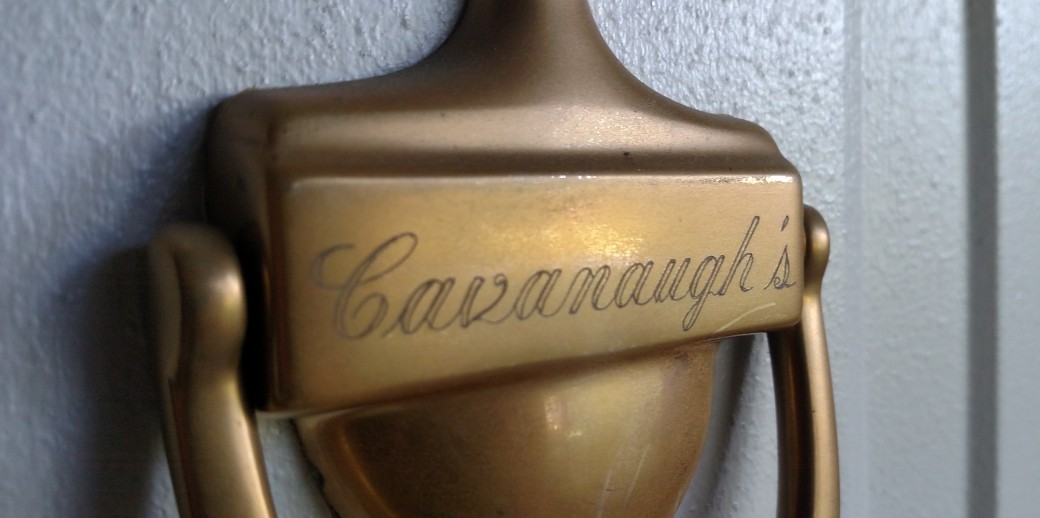
JP’s A to Z Challenge – W is for Wagonaire

We are into the final installments of this challenge, and are now cruising towards the finish line. This means that I have one more chance to get a Studebaker into the lineup. A few weeks ago (R is for R2) we showed a beautifully pristine 1963 Studebaker in one of its more desirable versions. Today we go the opposite direction, with a car that is in pretty sorry condition and was more of a workhorse. But this 1963 Studebaker Wagonaire station wagon was brand new that year and had an interesting party trick – the rear portion of its roof slid open!

As you have figured out by now, I photograph a good number of old cars at shows. There, we usually find lovingly restored examples, or even better, pampered originals that have been kept clean and shiny by a succession of owners. But sometimes, I come across a grizzled old veteran still being used as daily transportation. This is such a car. Even better, this may have been the only one I saw out on the road and followed to its destination – the owner’s home.
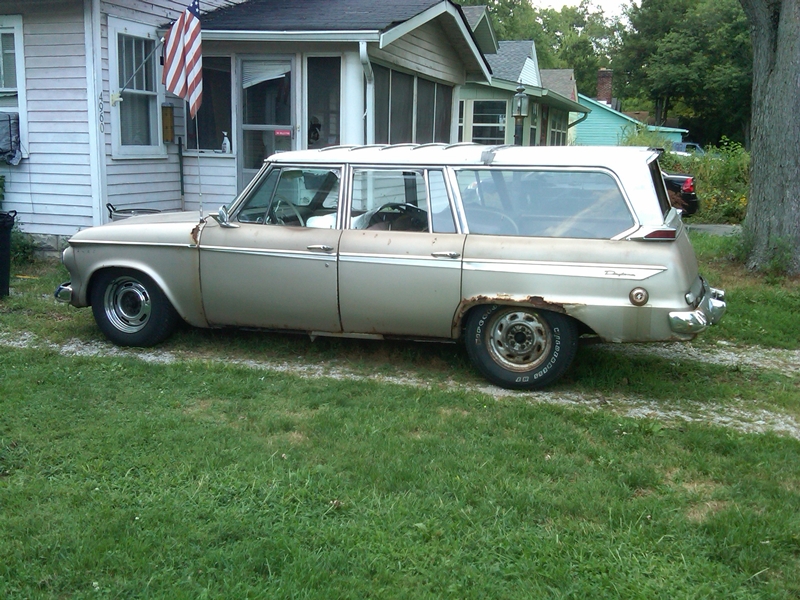
Studebaker was trying to stay alive in 1962, and did so by looking for niches not occupied by the bigger competition (which was almost every other manufacturer of cars by that time). Someone in the company had an “AHA” moment and decided that what the world needed was a sliding-roof station wagon. So they built one.
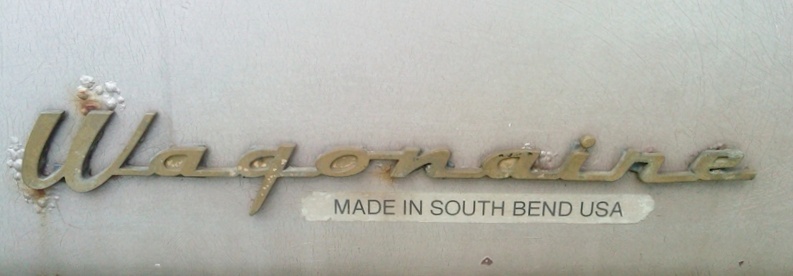
The Wagonaire (Get it? Wagon + aire?) was a solution in search of a problem and did not sell in the numbers the company was anticipating, despite the golden-toned nameplate. Although it did remain in the company’s showrooms through the final 1966 Canadian-built models.
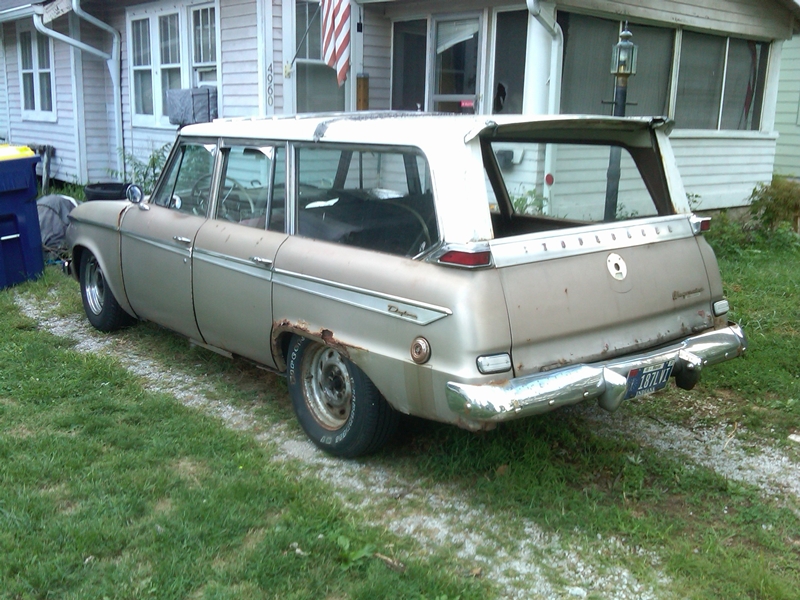
I would have loved to have gotten a shot of the roof open, but the owner kept this one sealed with duct tape. This is because these things were developed on a shoestring and tended to leak when a hard rain would overrun the drainage channels that were not as big as they should have been. Oh well, a person who kept a Studebaker in daily service as late as 2011 is entitled to some allowances.

Let’s have a look at the promotional shot Studebaker used in their sales brochure for 1963. There – that’s much better.

This example was the top-end Daytona trim, which was a quite presentable car in its day.
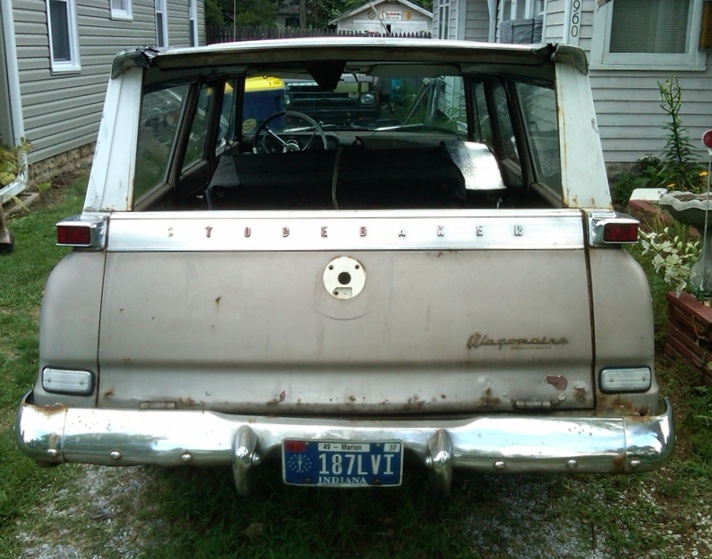
But few things rusted like Studebakers in Indiana, and this poor thing has held out better than most of them. I have never seen it since the day I took these photos and have occasionally wondered what fate eventually befell it. I hope it did not become a parts donor for a nicer car. Or worse, get parked in someone’s back yard or field because “I’m gonna restore it some day.”
Photos by the author, taken October 11, 2011 in the Broadripple neighborhood of Indianapolis, Indiana. This car was previously featured at CurbsideClassic.com.
 J. P.'s Blog
Interesting cars – as most Studebakers are of course.
For European readers there is one for sale in the Netherlands. Not as bad as the example in the article, and also the Daytona version with the V8. Needs some work (interior, gearbox) but almost rust free and good chrome. Pity about the boring color!
https://www.autowereld.nl/studebaker/lark/daytona-wagonaire-sliding-roof-v8-1963-surfwagon-36900620/details.html
LikeLiked by 1 person
This doesn’t look bad all for an original car. Doesn’t your garage have room for another unusual old car with a few needs? 🙂
LikeLike
I love how the nameplate includes “Made In South Bend USA”. There’s a lot of pride in that statement, which is not the way I typically think of South Bend.
LikeLiked by 1 person
I think that decal was added by the owner. As I remember our conversation, he told me that he got tired of answering the “Who made Studebaker?” question.
LikeLiked by 1 person
An interesting combination of inspiration and desperation. Studebaker from 1961 through 1964 was much like AMC after 1976.
AMC, at least, finally hit upon the Eagle, which didn’t save the company, but the basic idea lives on in other vehicles. GM tried to resurrect the Wagonaire idea for a version of the GMC Envoy in the early 2000s. It ultimately helped GM as much as it did Studebaker.
I remember the Matchbox version of the Wagonaire, although it was based on the 1964 model. It featured the plastic hunter and his dog. While Lesney, the manufacturer of Matchbox, was keen on having American vehicles in its line-up – the U.S. was its biggest market in the 1960s – this was a strange choice. Studebakers weren’t that common in England or continental Europe, and weren’t even a common sight in the U.S. by 1964.
LikeLiked by 1 person
I had that Matchbox Wagonaire. I may still have it somewhere. I had neighbors with at least 3 1964 Studebakers in their extended family, so Lesney’s choice seemed more normal to me. 🙂
LikeLiked by 1 person
Maybe the Studebaker in your photo went back to the birthplace in the brochure.
LikeLiked by 1 person
Haha, yes! Now I just need to find that enchanted forest on the outskirts of South Bend where old Studebakers magically become new again. 🎉
LikeLiked by 1 person
Isn’t that Bendix Woods?
Studebaker Tree Sign – Atlas Obscura
Which reminds me that I need to get down there with the drone some day.
LikeLiked by 2 people
Collector’s nostalgia. My husband has many car brochures from years gone by and we have a box or two of Matchbox toys. Thanks for reminding me of these interesting sources from the past!
LikeLiked by 1 person
Haha, happy to be of service!
LikeLiked by 1 person
I seem to remember a few grownups talking about this car but nobody I ever knew or heard of had one. I guess it’s kind of a cool idea but really, I don’t see the point.
LikeLiked by 1 person
I think the Matchbox version was probably the only one kids ever saw. The funny thing is that GM offered a sliding roo on an SUV in the mid/late 00s and it sold in almost the exact numbers that the Studebaker earned 30 years earlier.
LikeLiked by 1 person
That is interesting. It’s possible I saw the Matchbox version.
LikeLiked by 1 person
That was some promo shot wasn’t it? I’ll bet the kids back in the day enjoyed that roof-top window that was made “just for them” too!
LikeLiked by 1 person
There is a great commercial on YouTube for this car, that ran as part of Studebaker’s sponsorship of the Mister Ed show. Complete with the enthusiast kids.
LikeLiked by 1 person
Thanks for the link JP. I always watched the Mister Ed show and likely saw that commercial when it aired. That’s quite a concept for that extra space, a dog and a kid in the back riding along with that ladder for the boat and the “step” to get into the back of the car was very cool. This was likely the first hatchback vehicle?!
LikeLiked by 1 person
Hi. Are any traditional station wagons still being made by anyone?
LikeLiked by 1 person
Every now and then BMW or VW/Audi will bring one out, but I’m not sure of any current ones. Though the Subaru Outback is a kinda-sorta wagon.
LikeLiked by 1 person
It was a truly inspired concept but, as you said, it was a solution looking for a problem.
You know I have seen many pictures of these over the years but haven’t until now realized how pathetically small its tail lights are. Using the word “afterthought” almost seems charitable. However, it seems some wagons really got shortchanged in the tail light lottery. I guess it only makes sense since so many of them often hauled kids in the wayback…
That said, as a wagon owner myself (an Outback is a wagon, not an SUV despite what Subaru pleads) I am enjoying the utility so far. Other parts of it is a story unto itself. So I can’t blame the owner for wanting to keep his Studebaker going for decades beyond its design life.
LikeLiked by 1 person
Yes, those taillights are some of the smallest since right after WWII. Now that you mention it, wagon taillights always either come out extra interesting (like the 61 big Oldsmobile or the 58 Edsel) or really, really lame (62 Plymouth comes to mind).
LikeLike
When I saw the picture of the retractable roof, I had to do a little research as I remembered someone making a similar roof option sometime more recently. As someone mentioned earlier, in 2004 GMC tried a similar experiment with at retractable roof on the Envoy “XUV”. I remember thinking it was a novel idea; what better to be able to haul something tall that wouldn’t fit in a Tahoe or Suburban. The Envoy also had a throwback tailgate; the window would retract into the gate, and one could open it from the side or pull down like a regular tailgate.
I have to laugh at the description of the “innovative” tailgate in this article – Heck, station wagons in the 70’s possessed similar gates if I remember correctly.
https://www.motorbiscuit.com/gmc-envoy-xuv-failed-experiment-blending-suv-truck-features/
Apparently GMC had less success than Studebaker did as this option didn’t even last one full model year.
LikeLiked by 1 person
Yes, that GMC Envoy was about as successful as the Studebaker Wagonaire. Although there is this bit of trivia – only one of those two companies went through a bankruptcy, and it wasn’t Studebaker. 🙂 Studebaker diversified itself out of the car business after 1966 and, after a series of mergers, acquisitions and spin-offs, Federal Mogul may still be considered a direct descendant.
LikeLike
Even though the roof is flat, the lower window line dropping gently fore to aft makes the wayback seem SUPER TALL.
LikeLiked by 1 person
Yes it does. I still think the boxy wagon roof looks better on the squarer 1964-66 cars.
And for some reason, my WP is not letting me like any comments.
LikeLike
I guess that would be an early sun roof! Loved the ad – great idea for tailgating picnics. Did the guy you followed home have any stories about it?
LikeLiked by 1 person
I don’t remember stories, I think he had only had it for a few years, and was apparently a Studebaker nut.
LikeLiked by 1 person