JP’s Book Report – End Of Summer Edition

Some people think of summer as a time for the great outdoors. Me? From my childhood, summer has been a prime time for reading. And my reading choices have made for an epic summer!
As I have noted in past editions, much of my day is spent driving, and audio books are a great way to get my reading in while I drive. I got through seven selections this summer, and here they are.

I don’t know the source of my inspiration, but I decided that every red-blooded American should read something by that famous author of classic westerns, Zane Grey. My choice was “Riders of the Purple Sage” (1912), Grey’s most popular novel. Set in the Utah of 1871, it is a story about Jane Withersteen, a prosperous fallen-away Mormon who owns a ranch that she wants to run her own way. Her ways are not those of a local Mormon elder who wants to add her to his growing collection of wives (and to take control of her property). Into this landscape of menace rides the mysterious gunman named Lassiter, who soon discovers that the bad things that have been happening to Withersteen’s ranch are not from random chance.
Although not normally a “western guy”, I found that I really enjoyed this book. Though some things are not normal to modern readers (like the bad guys being the Mormon elders who controlled the part of Utah where the story was set) other things are – like the independent woman who tries to run her ranch despite opposition from the said Morman elders. And if you have never read a novel that involves a truly thrilling horseback chase, you owe it to yourself to try one. Grey was a good teller of stories and this book holds up quite well over a century after its first publication.
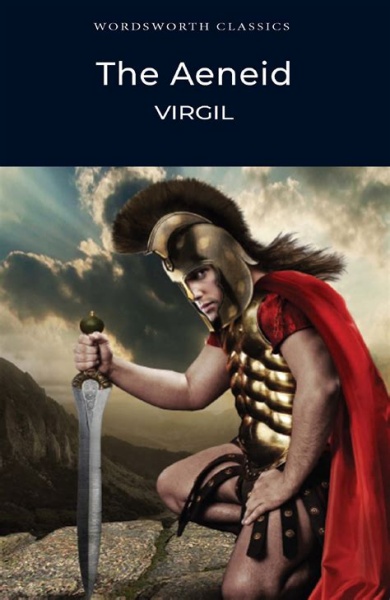
I went from the entertaining to the challenging with “The Aeneid”, by Virgil (c. 29-19 B.C.). I like to read things from the past, though have seldom gone this far into the past. But alas, this was next up on my bookshelf of imposing classics, so I rolled up my sleeves and dove in. The story, written fairly late in the Roman Empire, recounts a tale of Aeneas of Troy who escaped that city after its fall and ventured to Italy, in time for the foundation of Rome. And yes, the tale of the Trojan Horse is part of the story. There are travels and wars and capricious gods. Lots and lots of capricious gods.
My high school latin classes were a long time ago, so my knowledge of the various Greek and Roman gods is cursory, at best. This book reminded me of the treachery and pettiness of those deities and how they were said to roam about looking for things to butt into. If you want to appreciate the radical nature of Christianity in its day, compare it to the gods and goddesses of the Greek and Roman periods. And if you want to read The Aenead, an audiobook is probably not the best format. For most modern readers, a pad of notepaper for jotting notes about who the various characters are would have been helpful. So, my final verdict: Checked. Off. The. List.

Next up: “God Only Knows, The Story of Brian Wilson, the Beach Boys and the California Myth”, David Leaf. I was well into (but not finished with) this book when I wrote my retrospective on Brian Wilson awhile back. This book began as a 1978 biography of the group, and then continued to grow into later updated editions (1985, 2022) as the author continued his immersion into the fascinating world of Brian Wilson. The print version of the 2022 edition is 480 pages, so this is a major project, but a worthwhile one for anyone interested in learning about Brian Wilson and the group that was an inextricable part of him.
The 2022 book, which includes all of its editions, is a fascinating and evolving look at Wilson and The Beach Boys, finally culminating in Wilson’s returning to the music scene. Because Leaf eventually became one of Wilson’s confidants, the final parts are a valuable inside look at Wilson’s slow and sometimes halting return to the public spotlight after years of exile due to a multitude of problems. If nothing else, the book gave me a new appreciation for the music of Wilson and the Beach Boys, much of which was put out after the group’s mid 1960’s popularity peak. I enjoyed it a lot.

Next up is an epic of another kind – “Washington, A Life” by Ron Chernow (2010). The print version runs to 904 pages, which makes for a really deep dive into a period of history I have ignored for too long. George Washington was a singular and fascinating figure, and this book succeeds in bringing the man to life for the reader. Things like the cherry tree and the wooden teeth are fables, though Washington was beset with dental problems for much of his life and did struggle with ongoing sets of dentures made of other materials. A forgotten truth is that the man possessed a volcanic temper, something he spent his entire life trying to conquer and control.
Really, “Washington” deserves more than a couple of paragraphs but, sadly, will not get them today. He exhibited uncommon bravery in the French and Indian Wars as a member of the British military, and later accomplished the seemingly impossible as General of the Continental Army by keeping an ill-equipped and nearly starving group of volunteers together long enough to defeat a great world power. He was also a reluctant President who only took on the job out of a deep sense of duty. This was a fascinating and engaging read about a man who turned out to be indispensable in the formation of these United States.

A few weeks ago, I waxed rhapsodic on the 1997 neo-noir film “L.A. Confidential”, which made me wonder about the source novel by James Ellroy. It turns out that “L.A. Confidential” was the third of four books that have become known as the L.A. Quartet. The only answer was to start at the beginning with “The Black Dahlia” (1987). The book is a kind of historical fiction treatment of the still-unsolved 1947 mutilation and murder of a young woman later identified as Elizabeth Short.
In it, two Los Angeles cops are tapped to investigate the grisly murder, but the case soon turns their lives inside out in an all-consuming world of vice and corruption. Wikipedia can’t manage a plot synopsis in under 12 paragraphs, so I am not even going to try. However, we expect a good neo-noir plot to have more twists and turns than an amusement park and this one satisfies on that score. My only real criticism is that the literary world of 1987 could have used more of the restraint that was required in the world of the 1940’s when the story takes place. But I suppose those seamy sides of life always existed whether they were explicitly described or not.

I needed a change of pace after the sex and violence of 1940’s L.A. and followed it with “Fairy Tales Revisited” by The Brothers Grimm, Omnibus Edition, which includes 3 print volumes. My mother read from Grimm’s Fairy Tales when I was a tot and I was curious how these tales written down early in the 19th Century hold up in the modern world. My conclusion: overall, quite well.
The Brothers Grimm described a world where virtues are rewarded and bad behavior is not. Many were stories I knew while others were new to me. And there were some interesting twists – for example, the Princess did not kiss the enchanted frog to turn him back into a prince, but instead allowed him to eat from her plate at dinner and sleep in her bed (though only after her father insisted that she keep the promise she had made to the frog who saved her from being lost in the woods.) My conclusion? Modern toddlers could do far worse than to spend time with these traditional fairy tales.

My final selection: “The Jazzmen: How Duke Ellington, Louis Armstrong and Count Basie Transformed America”, Larry Tye (2024). This is a deeply researched bio of three transformative jazz artists that is not so much about their music as it is about their lives and how their lives affected the rest of ours.
I also found this to be a fascinating look into the music business of the early and mid 20th Century as experienced by the three most enduring black jazz performers of that era. Each was a complex man who mixed virtue, vice and musical talent in his own unique way. I enjoyed the book a lot, but was especially appreciative for the really deep look into the life and world of Count Basie – the first that I have ever seen. The Count was an exceptionally private and enigmatic man, so getting to see something of the Basie who existed off the stage and outside of the recording studio was a real treat.
Summer is now winding down to its final hours, and I think I squeezed as much good reading into the season as I could. I hope I can provide other readers with some interesting ideas, and also look forward to comments about these books or other suggestions of things to try this fall. In any case, let’s all keep reading!
 J. P.'s Blog
Chernow’s biography of Washington is so good it is almost bad, since it is a very rare biography that can hold a candle to it.
LikeLiked by 1 person
I agree, it was excellent. It put me into a mind to search out bios on as many former U.S. Presidents as I can find. I have a very shallow (if not absent) understanding of U.S. History before the Civil War, and ought to remedy that. Chernow really did a great job of bringing these historic names to life.
LikeLike
It is a bucket list item of mine to read a biography of every president consecutively. This fellow did and reviewed them all, might be helpful if you are looking for recommendations. https://bestpresidentialbios.com/curriculum/
LikeLiked by 1 person
Oooh, thanks for this. It may save me a lot of research!
LikeLike
I’ve found that Chernow writes excellent, deeply research biographies. I haven’t read a bad one yet. His Hamilton was excellent, as was Grant, Morgan, etc.
LikeLiked by 1 person
This was my first experience with him, and I do not doubt your experience with the others.
LikeLiked by 1 person
Big fan of summer reading when I was a kid. Too hot many times to be outside! Didn’t everyones local library have a summer “Bookworm Club” with weekly meetings, book recommendations, and charting of your ‘reads’? I’ve read the Black Dahlia as well, I’m a sucker for that type of ‘palate cleanser’, altho not what I would refer to a ‘light reading’. I’ve read the Jazzmen as well, an excellent account of the impact that those music titans had on the world at the time, and also an amazing look at how popular overall jazz was in that era. It’s hard to believe that any musician today would be able to foment the changes in society. One of those books that was a library read that I think I should have bought for my bookshelf.
LikeLiked by 1 person
The Jazzmen was one of those happy, serendipitous finds I stumbled across when I was wondering what to tackle next. I was out of credits on Audible and went to the audiobook app that is linked to my local public library (Libby). I forget what my first search term was, but this book came up, something I had not heard about at all. Each of those guys was truly fascinating, and particularly they way they became such enduring figures despite the obstacles of their era.
That Black Dahlia murder story is something else I find fascinating – including the way that people are still trying to figure out what happened to that poor girl nearly 80 years on.
LikeLike
I read Brian Wilson’s autobiography when I was a kid. His home life was so different from mine, it was so foreign to read about. I’ll always appreciate his work… I sort of refuse to go to any Beach Boys concerts now with Mike Love fronting the Zombie Band.
After our talking about LA Confidential, I re-read it. I didn’t know it was part of the larger series — but I didn’t enjoy the book as much this time as I did when I was younger. As it happens, the movie was on Prime or something and I rewatched it: I appreciated its tightening up the story.
LikeLiked by 1 person
After The Black Dahlia, I am on the fence about working through the rest of the series. Maybe if I stretch it out. A guy can only take so much of an immersion into the worst parts of human nature.
The Leaf book(s) is in the category that is not a big fan of Mike Love. The later editions clearly try to tiptoe around that situation but it’s clear there is no love lost between Mike Love and the author.
LikeLiked by 1 person
The dilemma becomes: do I read these all at once and descend into the depths or do I space them all out so I forget what’s going on in the wider arc. After my last read, I think I’ll just pass on more Ellroy.
Incidentally, have you read Blood Meridian?
From my perspective, Love seems to love (haha) being the antagonist. I’ve seen some bad band break ups (Pink Floyd); but he really does seem to be militant about being a jerk about it. Given it wasn’t his songwriting that made him famous….
LikeLiked by 1 person
I have not read Blood Meridian, looks like something worth a try.
And good points on both Ellroy and Love.
LikeLiked by 1 person
I’m not sure I’d recommend it, honestly. But yours is a perspective I’d be interested in hearing if you get around to it.
LikeLiked by 1 person
I’ve been slogging through Dostoyevsky’s Notes From Underground.
I say “slogging” not because the writing is bad, but rather I have to stop reading after every 2-3 pages and let what I’ve read soak in so I can understand it. It’s a fine “little” book, and it has shown me that I’m not nearly as intelligent as I thought!
LikeLiked by 1 person
I read Dostoyevsky’s Crime and Punishment, and it was a little bit the same way – not a light read at all. 19th Century Russia must have been a bleak place.
LikeLiked by 1 person
Howdy. You are a dedicated reader with eclectic tastes. I’m in the middle of a novel by Tim O’Brien right now. I like it so far. The characters ring true. The book is titled July, July.
LikeLiked by 1 person
Thank you, and thanks for the tip!
LikeLiked by 1 person
Thanks for suggesting The Jazzmen. That’s one I definitely want to “read”. This past year I finally got rid of my Audible account (I listened to audiobooks rather sporadically and built up a lot of un-used credits that I always felt guilty about), but thanks also for reminding me about the public library audio book thing which I always forget about having access to!
LikeLiked by 1 person
I highly recommend it. My middle son texted me this morning that he just finished chapter 5 and is really into it.
I am the opposite with Audible – I eagerly await that new credit every month. The rest of the time I seek out the free stuff there or go to the Library app. I found another app that offers only things in the public domain and read by volunteers (Librivox), but the audiobook quality is often poor there.
LikeLike
After Junior year Chemistry class in high school, I checked Science off the List. After Senior year Latin, I checked the Aeneid off the List. I really enjoy your reviews and admire your commitment to reading. Wow, this Comment makes me look like a Slacker. Usually I hide that fact better.
LikeLiked by 1 person
I think that once a person gets north of age 65 or so, being a slacker isn’t a bad thing at all. In fact, it kind of becomes the ideal, doesn’t it? 🙂
LikeLiked by 1 person
A pad of paper to jot down who is who and who did what to whom is something I do with most books! I just finished “The Thursday Murder Club” by Richard Osman which is light reading compared to your choices… but I ended up reading it twice because I neglected the jotting down process the first time… I loved the characters because they are sleuths in their late 70’s and 80’s.
LikeLiked by 1 person
I have never really been a note-jotter when I read. My first experience with note-jotting was when my sister and I were cleaning things from my mother’s house. As her memory deteriorated she started writing more and more notes as she tried to get through a book. At some point she just gave up reading (something she loved to do) because she couldn’t follow the story any more. So it is good to see your example of someone with full faculties who jots notes too. And you make me feel better about wanting to become a note-jotter with The Aeneid! I was starting to worry a bit with my mother as my only example of a note-jotter. 🙂
LikeLike
Nice of you to assume I still have my full faculties…
I’ve been a note-jotter for a long time, especially if the author introduces a lot of new characters quickly or the plot is complex and moving along in a hurray!
A few members of my family are also book underliners. They underline words, phrases or passages that resonate with them. (Or jot notes in the book margins.) Then they loan the book to someone else in the family who reads it and underlines what they liked. When they get the book back, they look, of course, at the new underlines or notes.
LikeLiked by 1 person
Perhaps it is my background of being raised by people of German descent, but the idea of making marks on the pages of a book is a horror to me. “You just don’t DO that!” are the words I hear in my head (in my mother’s voice, of course) whenever I think about it. When I try to apply logic instead, all I come up with is how I don’t want to be drawn to what someone else thought was important – I want to be able to come to my own conclusions, which I can’t do when someone else before me has poured interpretive opinions all over the pages. I would never cut people off over differing politics. Book underliners/markers, on the other hand, present a tougher problem . . . . 🙂
LikeLike
I understand what you are saying. This group of underliners (there are 4 of them) enjoy it immensely. To them it is like getting together at a Book Club when time and distance does not allow them to actually get together!
They want to see the book through someone elses eyes as they are reading it. In this case, the perspectives come from a nurse, a draftsman, a retired oil man and a woman who worked with various special needs groups. Their favourite books will get skimmed a second time in order to see what the other three said.
And who am I to judge that they marked up a book! I fold books into various things and cut them into pumpkin shapes with a scroll saw!
You also got me thinking about audio books vs books you read yourself. Seems to me that the person who is reading the book to you will be injecting interpretation with the inflections of their voice? I’m thinking too of songs. The voice itself plays a large role in how we feel about what we hear.
Thanks for this Sunday morning think! Now, if I could just get some words put together for a blog post.
LikeLiked by 1 person
You raise some great points. One more example of that “My way isn’t the only way” lesson I have had to keep learning.
LikeLike
I do not think I have ever lived in a time when ‘my way isn’t the only way’ is more important.
LikeLiked by 1 person
JP, this was another comprehensive summary of the books you read this Summer. I was doing pretty well with my reading, averaging one or two a month after the howling/whining dog next door died in mid-June. I thought I was in Heaven with the peace and quiet, then six weeks later, she got another dog, the same whiny, breed that suffers from separation anxiety. There went my peace and quiet and reading every afternoon.
I think I’d like to read “God Only Knows” as I read so much about Brian Wilson the latter part of his life, plus your detailed blog post about him. I went to see The Beach Boys in concert several times in the 70s.
“Washington, A Life” sounds interesting, though I’m not much of a history buff and wow – 904 pages. I never knew Washington had anger management issues.
Fairytales are an important part of growing up – I enjoyed my mom reading them to me too. I hope the youngsters today get a taste of the Grimm Brothers’ fairytales, read from a book and preferably curled up in a parent’s lap.
LikeLiked by 1 person
Wow JP you really went into the vault for this one…..Virgil? You are the only person I know who has read Virgil, although I sometimes think we are witnessing the decline of the Roman empire. I have nothing to suggest as my genre is basically murder mysteries and family dramas, although I am currently reading a non-fiction book on Van Goth. But just a gentle reminder…….Pride and Prejudice still awaits your opinion!
LikeLiked by 1 person
P&P is somewhere on my imposing shelf of classics and will get its turn. I sure wish it was next in line instead of the Shakespeare plays staring me in the face. Maybe it’s time for a nice light bio of John Adams. 😁
LikeLiked by 1 person
Good luck with Shakespeare! Reminds me of high school…..
LikeLiked by 1 person
Do people in high school even read Shakespeare any more? In my era, everyone had to read at least one, especially if they were college bound. I went to a boy’s trade and tech high school, so there was no Romeo and Juliet for us, it was Merchant of Venice, especially because of the whole ‘pound of flesh’ thing! Of course, being in Wisconsin, we all referred to it as Merchant of Venison.
LikeLiked by 1 person
I had to read at least 1 Shakespeare play in high school, which I think was The Merchant of Venice. I remember absolutely nothing about it. Except that we were assigned to read the parts of a particular character. I don’t even remember which character I got, but do remember that my buddy in the class was “The Apothecary”.
I do not recall hearing any of my own kids report of an encounter with The Bard, so maybe he is no longer a thing in modern education.
LikeLike