JP’s A to Z Challenge – R is for Studebaker Lark R2
No, not R2 as in R2D2 that everyone remembers from the original Star Wars movie. Today is about R2 in the world of Studebakers, which stands for a rip-snorting series of V8 engines that the company put into its cars in the last year or so of full operations in South Bend, Indiana.

I will admit it – I am a Studebaker homer. They were built in my home state, about 80 miles northwest of my hometown of Fort Wayne, and several of their products inhabited the driveway of my childhood best friend as late as the mid 1970’s.
Studebaker had been on a downward spiral since the mid 1950’s, a victim of its own bad decisions and of ever-tougher competition from the deep-pocketed “Big Three” in Detroit. Even American Motors and its Rambler had been crushing poor old Studebaker during those years.

Studebaker’s last years had two bright spots – first, there was the compact Lark model in 1959, which was cleverly created by some careful cutting and pasting to existing models that dated to 1953. Then there was a new company president, a dynamic young guy named Sherwood Egbert. Egbert believed that all the company needed was a new image, and the way to get there was high performance.
Studebaker made money on the Lark, and spent a lot of it buying other companies. One of them was a manufacturer of automotive superchargers called Paxton Products. In that purchase, Studebaker got a guy named Andy Granatelli, who soon set up a little shop designed to wring some real performance out of Studebaker cars. You may remember Andy from his years representing STP (another Studebaker Division) at the Indianapolis 500.

The glamour girl of the Studebaker line was the 1963 Avanti (which I briefly wrote about here). Under Granatelli’s lead, a new series of performance engines, which Studebaker called its “R” engines, came with the Avanti, and were soon available across the whole line. The R1 was a mildly hopped-up version of Studebaker’s old 289 cubic inch V8, with an advertised 240 horsepower.

The big dog was the R2, which added a Paxton supercharger. A supercharger blows pressurized air into an engine, which gets more fuel where it needs to be, which makes for more power. Studebaker never advertised the horsepower on the R2, but it seems to have been in the 290-300 horsepower range – which was impressive for such a small engine.
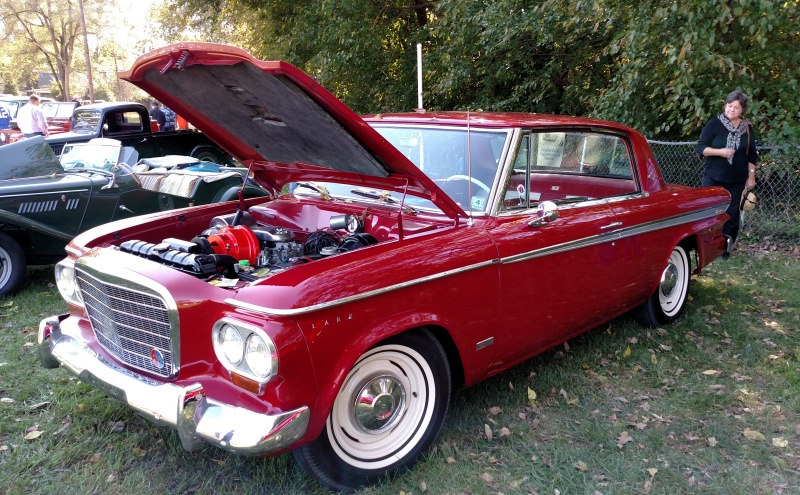
Records tell us that 325 R2 Larks were made. This is not one of the 53 “full package” R2s built, which included additional performance bits and were advertised as “Super Larks”. But isn’t this one rare enough? And these things were FAST, advertised as reaching 132 mph at tests that Studebaker ran at Bonneville when these cars were new and fresh – impressive given the car’s brick-like aerodynamics.
These R-engined Studebakers have participated in the annual Pure Stock Drag Races, held in Michigan. A couple of them, the Stude Tomato (a red 1963 Lark driven by veteran drag racer Ted Harbit) and the Plain Brown Wrapper (a brown 1964 driven by George Krem) have acquitted themselves well over the years. Harbit has said that because the supercharger doesn’t come on until higher rpms, if he is within a car length of an opponent at the midpoint of the race, he knows it is in the bag for his Studebaker. A video on one of those races is here (with actual racing that starts at the 14:45 mark). (Spoiler alert: Harbit’s Stude Tomato beats a 67 GTO 3 out of 3 races).

It can be argued that Studebaker built a GTO a year before Pontiac built its famous one. If the criteria is a fast, smaller-than-full-sized car with bucket seats, this would be true. The one thing the Studebaker was missing was the sleek, modern looks to go with the hot equipment underneath. But even with this cars conservative looks, this R2 version of the Lark romps, races, rocks and rolls as well as most of the better known muscle cars of the 1960s and 70s.
But it was too little too late, and Studebaker closed its South Bend operations in December of 1963. With that closure, the R series of engines was no longer on offer. Technically. Because Andy Granatelli and his brother kept building a small number of R series engines (including the later and extremely rare R3 and R4) versions as long as they had parts on hand. The last of those engines was reportedly finished in 1969 and sold to one of the Studebaker faithful, people like Harbit and Krem, who have kept Studebaker performance alive.

It was a real treat for me to find this bright red Lark, in its top level Daytona trim, at a local show few years ago. Fortunately, it was sitting still, or else I would never have been able to catch it!
Epilog: After this piece published, I learned the sad news that Ted Harbit, the longtime drag racer who campaigned the Stude Tomato, died on Sunday, August 24th, 2025 at the age of 90. Rest in peace, sir.
Photos by the author, at a car show in the Broadripple neighborhood of Indianapolis, Indiana, October 12, 2016. (except as otherwise noted)
 J. P.'s Blog
There’s a hint of Mercedes in that styling.
It’s a stellar-looking car.
LikeLiked by 1 person
Interestingly, Studebaker was the American distributor for Mercedes from maybe 1958-64, and Mercedes cars were often sold by Studebaker dealers. And I agree, these things had a Germanic vibe in their no-nonsense style.
LikeLiked by 1 person
Ah, I didn’t know this. How interesting.
I guess that gives them a somewhat likely chance of being inspired by the German cars. If you’re going to copy a car’s styling, you could do worse than the S Class.
LikeLiked by 1 person
Studebaker tried to go out with a bang. It’s my understanding that the Board of Directors hired Egbert to continue the diversification push and slowly phase out the auto business. They weren’t too happy when he tried to revive it. But it was really a lost cause by 1961, as Studebaker not only needed a new car, but also a new plant (or, at least, an extensively remodeled one). The dealer body was also seriously deficient.
These R-powered Larks are interesting, but the problem was that, upon close inspection, these cars have a cobbled together look. It was obvious that Studebaker was patching up the basic 1953 body. As interesting as these cars are today, if I had bought a new car in 1963, I would have gone with a Ford Falcon two-door hardtop with the V-8.
LikeLiked by 1 person
Yes, it seemed that Egbert knew what the market was looking for, and he tried to get there without the resources that would prove necessary.
I must confess that I would probably have been like you. I had more chances to buy old Studebakers as daily transportation in the 70s than most, and a great resource in my neighbor who would surely have given me plenty of guidance. But I wasn’t interested in them than. I occasionally kick myself over that.
LikeLiked by 1 person
My father’s first car was a 1951 Champion four-door sedan, which he sold to his parents when he bought a one-year-old 1953 Champion Starlight. He had put a deposit on a 1956 Flight Hawk, but then he was drafted, so he decided against buying it.
LikeLiked by 1 person
I think the Flight Hawk was the six cylinder version – kind of the opposite of today’s car.
LikeLike
Stude Tomato is a great name and the race was cool. Thanks for the tip on when the race starts. I remember being a boy and seeing Andy Granatelli on STP commercials. I thought he was a cool, tough guy. I knew about STP because the man at the service station my dad went to would give me free stickers, some of which were STP, and let me take a map now and then. I had STP stickers everywhere. I knew if I ever got a car I needed “STP – it’s the racer’s edge.”
LikeLiked by 1 person
Those STP stickers were everywhere when I was a kid!
And yes, the Stude Tomato is the best name for a race car in the history of the world!
LikeLiked by 1 person
It’s nice to read about the cars because all I know about Studebaker is the food. Tippecanoe Place – at the Studebaker mansion in South Bend – was THE place to go for a celebratory brunch when I was at Notre Dame in the mid-1980’s (including my graduation celebration). The whole experience was first-class, including several rooms of serve-yourself food, and the chance to roam the halls of the mansion after the meal. It’s a shame they didn’t put a few of the cars on display in the driveway, if only to give a cred to how the beautiful residence was bought and paid for.
LikeLiked by 1 person
I have never been to that mansion, but I understand that it is gorgeous! And before the cars, it may have even been paid for by wagons and carriages. That company dated back to 1852 and had once been the largest manufacturer or horse-drawn vehicles before the age of the automobile. The Studebaker National Museum actually has a really nice display of horse-drawn vehicles, including a couple of Presidential carriages.
LikeLiked by 1 person
No wonder there aren’t any cars at the house – the museum is only a ten-minute walk from there! Wish I’d known about it when I was in school; looks like a great collection. My wife would appreciate anything pulled by a horse.
LikeLiked by 1 person
In your defense, the modern museum building was not around when you were in school. I visited the old museum once, probably 1988 or 89, and I have very few memories of it. It was in one of the old factory buildings and was not the kind of place that would have attracted the attention of someone not really into the cars.
LikeLiked by 1 person
Great photo, so nice learning about all of these old cars. Love the red color too.
LikeLiked by 1 person
Thanks! I find it interesting that Studebaker called the color “Regal Red” – I have never thought of bright red cars as being particularly regal, but maybe that’s just me.
LikeLiked by 1 person
The Larks with the R1 (or even R2) option have fascinated me for a while. A somewhat dowdy appearance yet anything but under the hood; in other words, a nice sleeper. This was a great catch.
LikeLiked by 1 person
I have been meaning to give this one a proper writeup at CC, but have not made the time. I find them fascinating too.
LikeLike