JP’s A to Z Challenge – H is for (The Fabulous) Hudson Hornet
Everyone who had kids in the 2000s (or who was a kid in the 2000s) knows this car. In the Pixar film “Cars”, who could forget the scene where the aging race car, Doc Hudson, goes out into the desert and runs flat-out in a big dirt circle unaware that the aspiring young racer is watching. (If not, you can watch it here) Well, Doc Hudson was based on a very real car – the Fabulous Hudson Hornet.
Hudson was a longtime Detroit company named after the department store owner who originally provided financing to get the operation off the ground. In 1948 they introduced their new postwar lineup.
Called “stepdown” Hudsons, the cars were very low to the ground so that you had to step down into them (something that became didn’t become common until the end of the 1950’s). Because these cars were low, wide and aerodynamic, they seemed natural for racing. Hudson introduced the Hornet in 1951, which included the biggest (308 cubic inches) and most powerful version of its 6-cylinder engine that was considered an obsolete design even then. Hudson also provided plenty of engineering and an inventory of “export” parts designed to support those who wanted to take these cars racing. And take them racing they did!
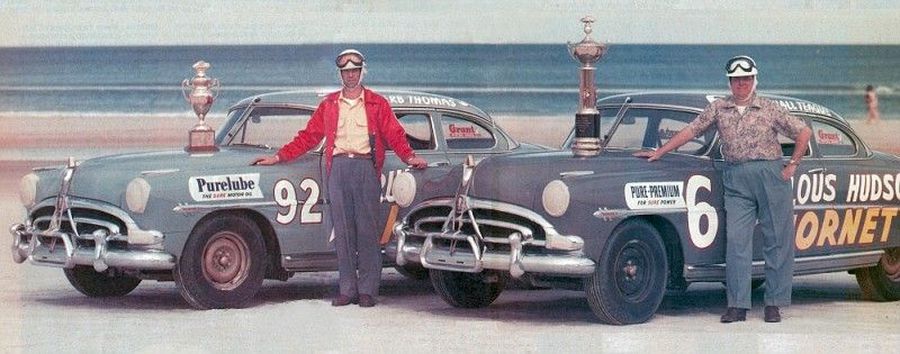
In the early days of NASCAR stock car racing, Hudson Hornets were the cars to beat. The factory-sanctioned team included at least 9 cars, which racked up over 108 wins in 1951, 52 and 53.
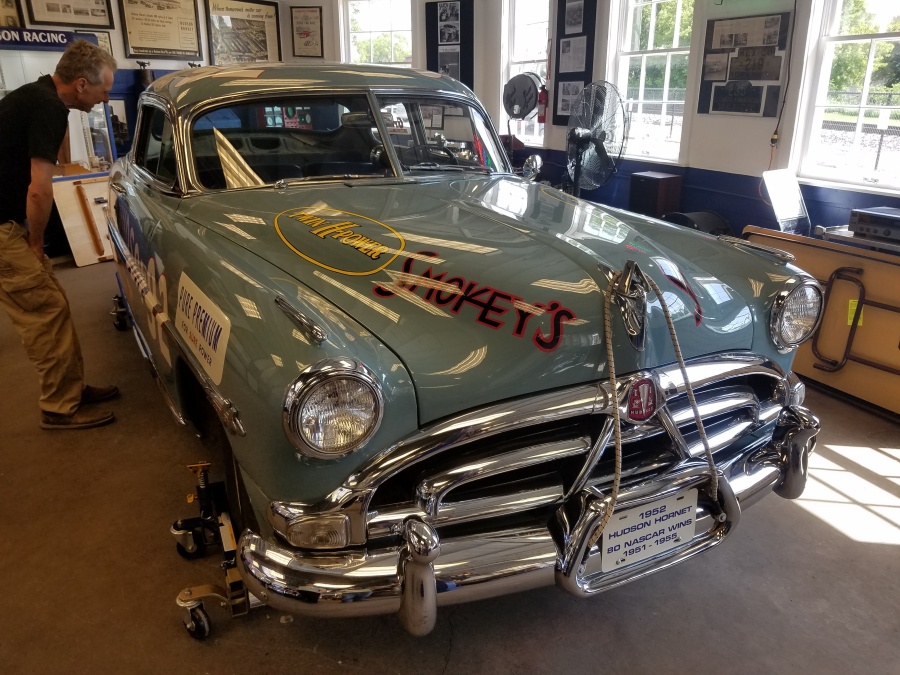
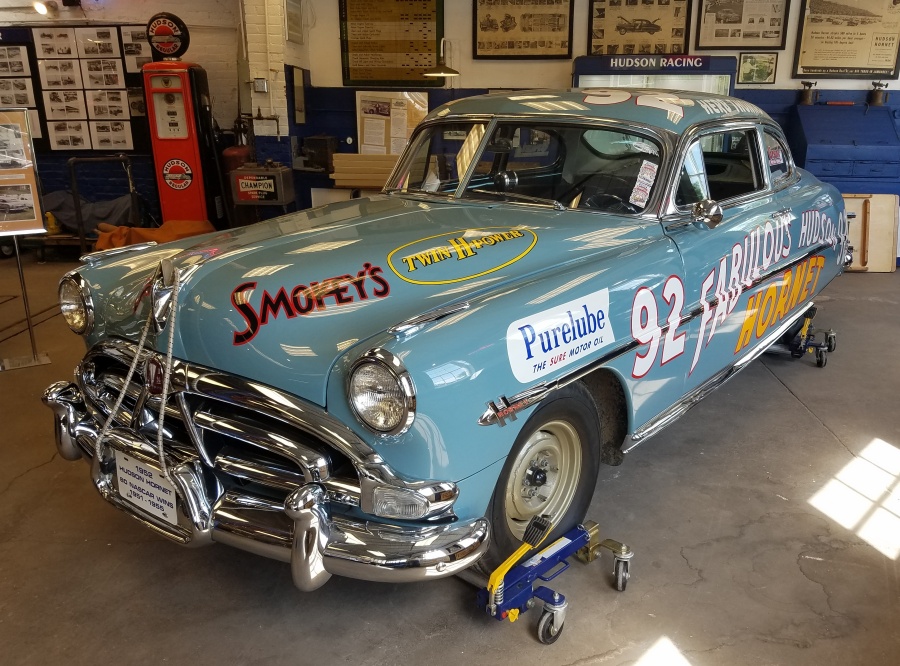
This car, a 1952 model with the number 92, was the car Herb Thomas drove to dominate the 1953 NASCAR season with 12 races won and the 1953 series championship. When Thomas bought a new Hornet to race in 1954, he sold this one as an ordinary used car. (Only driven on Sundays?) It was eventually found and restored and was on display at Ypsilanti Michigan’s Automotive Heritage Museum, where I saw it.
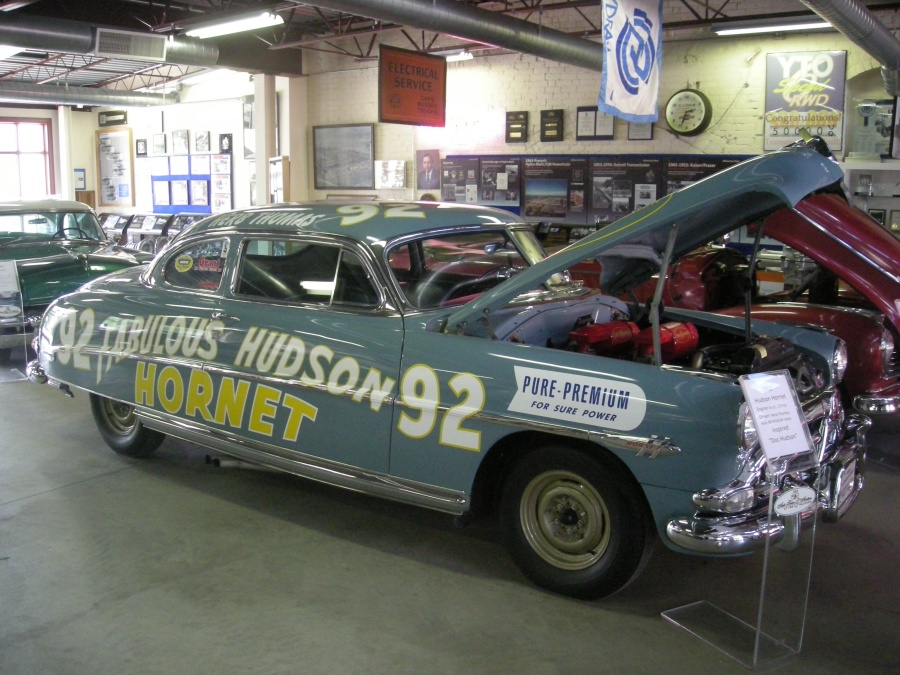
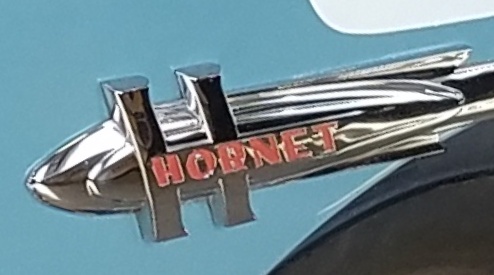
I didn’t take as many shots of this car as I should have, but how could I get past “H” without a Hudson Hornet (with the dual carburetor setup Hudson called “Twin H Power”)? I am going to cheat and add one additional photo (above) I did not take. But it is of the exact car at the same location and shows the side much better than the shots I took.
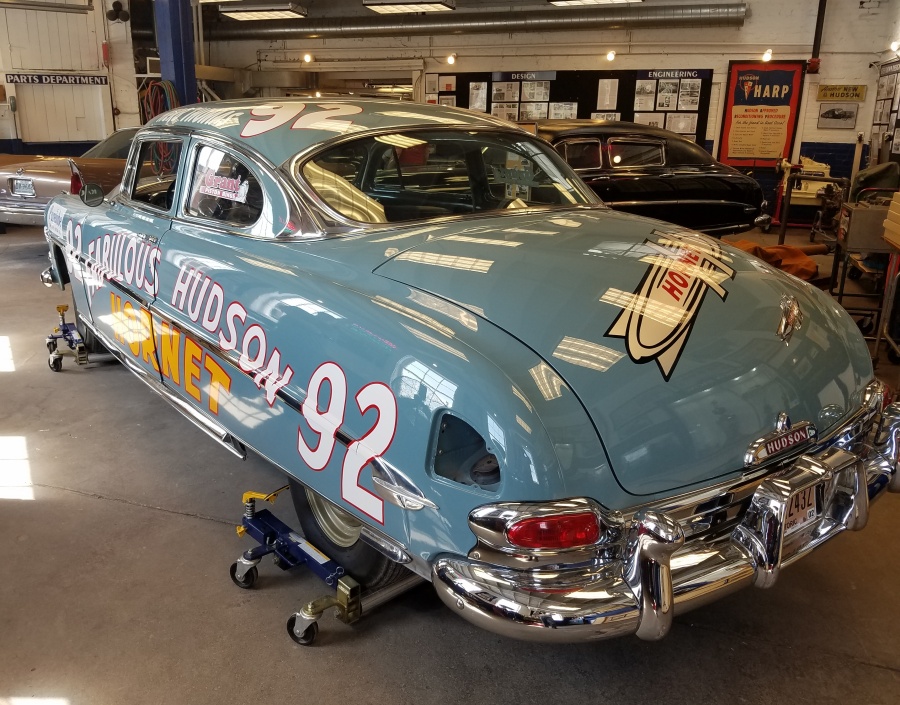
Everyone loves an underdog, and that’s why I love the old Hudson Hornets. It was when a small, independent auto company with obsolete engine design could put a car in the showroom that would take the big companies with their modern V8 engines to school on just about any race track.
Except as otherwise noted, photos by the author, June 3, 2017, at the Automotive Heritage Museum, Ypsilanti, Michigan.
(1) Photo source: https://historygarage.com/the-fabulous-hudson-hornet/
(2) Photo source: https://en.wikipedia.org/wiki/Fabulous_Hudson_Hornet
 J. P.'s Blog
I’ve seen very few of them in my lifetime, but every time I see one, they just looked like they were made for speed. Interestingly enough, I walked out of my apartment one Saturday morning in Zionsville, and the guy across the street was rolling one out of his garage, getting it ready to take to a car show! Didn’t know I had one in the ‘hood! Got to chat with him for a while. He mentioned that the car, and other cars from the same era, were not as dependable as people remember them; and those memories were based on the much lower yearly mileages people used to drive. He did say there were still a lot of “new/old” OEM parts available, and the Hudsons still had a strong aficionado network to help out.
LikeLiked by 1 person
I know there is a strong local club hereabouts. A favorite memory is from the day I was on a tour of IU in Bloomington with my oldest son when he was looking at colleges. A very original but worn green one burbled down a main street right past me, and I soaked in the very brief combo of sight and sound. I never saw it again, despite 2 kids who covered an 8 year period of me visiting Bloomington.
LikeLike
When I saw “2000s” twice in your first sentence, I thought that can’t be right for a Hudson! But then I saw the Doc Hudson reference. My kids were all adults by then, so I missed all that. Thanks for clip!
LikeLiked by 1 person
I could watch that one all day. I would bet money they got an authentic sound recording from one of those old Hudson racers. That is the unmistakable snarl of a big 6 cylinder engine. Yes, I’m a geek about things like that.
LikeLiked by 1 person
I’m sure there’s a Hudson in the Henry Ford Museum of American Innovation on Ford’s campus in Detroit. My brothers and I toured the museum last fall and, among so many other things there seemed to be a vehicle of every make and model on the planet. Your post makes me think we may have even driven by the site of the original Hudson factory. As for “Cars”, the movie was just a little too late for my kids’ interest; hence this is all new information to me.
LikeLiked by 1 person
It’s funny how a kids movie can be central to 2 generations and irrelevant to those in the rest of them.
LikeLiked by 1 person
Very cool and something new to me. Thanks so much for sharing.
LikeLiked by 1 person
Happy to help. Especially when it gives me a chance to blather about something fun! 😛
LikeLiked by 1 person
We have Cars 1 and Cars 2 on DVD. Hard to say who watched them more often – the grand children or the grandfather.
We saw a 1953 Hornet at an Alberta Car Show last summer. I should have paid more attention to the license plate because now I see that the plate is from Minnesota. That might have been an interesting story if I had found the owner to talk to!
LikeLiked by 1 person
I love talking to owners when I get the chance. So many of them have interesting stories about their cars, often about prior owners.
LikeLiked by 1 person
Well this Hudson Hornet is a classy-looking car to begin with, let alone being jazzed up as a race car. I didn’t know that the Hudson car was associated with the department store magnate. I had not heard of the Pixar “Cars” movie, so thank you for including the link of the car – I like the “eyes”. The old film of the race was interesting to me too. The view from the photographer filming from inside the race car and those back-in-the-day vintage shots of the beach, spectators, commentator, etc. – all interesting. It seems hard to believe they were racing cars that were so large, when you think of how aerodynamic looking race cars are today.
JP, I may not have ever mentioned before that I worked for a paralegal who had a race car and raced at Flat Rock Speedway every Saturday night. I went to see him race one time. He had a “street stock” car and raced in Figure Eights races. He’d be in one race event on Saturday night and then spent the entire next week doing repairs from minor crashes. The car was his baby. His wife had a horse which was her baby. They sure didn’t get in each other’s hair. 🙂
LikeLiked by 1 person
I loved watching that old race film. The idea of racing on a sand beach would surely never happen today, same with drivers continuing to race around accidents!
When I was barely old enough to remember, my father and a friend went together in building a race car. It was in an old jalopy class and I don’t think it did well. That was the only time I ever saw my father mess with a car. That is certainly a hobby that requires lots of time and money!
LikeLiked by 1 person
The first year they had the Grand Prix in the streets of Downtown Detroit, we went on our lunch hour to watch the time trials at the designated time. The drivers, however, did not like the sharp curve near Cobo Hall and insisted on more “padding” so the race organizers kept lugging out “padding” which turned out to be more piles of tires at that turn. It took so long to do that, we had to head back to the office without seeing the time trials at street level – we watched from the office window.
It is an expensive hobby, that’s for sure. My boss Terry’s main sponsor was his chiropractor and her clinic name was plastered all over SS #81!
LikeLiked by 1 person
These cars have disappeared from even the big Antique Automobile Club of America (AACA) show in Hershey. Too bad that Hudson used its final development dollars for the Jet, which was discontinued immediately after the merger with Nash.
The film of the race on the beach was interesting. The fellow who entered with the Henry J was…optimistic. I also counted a Packard and a Studebaker among the race cars. Two Chryslers each lost a front wheel, and an Oldsmobile 88 lost a rear wheel. But then, this was truly STOCK car racing!
Hard to believe how close the spectators were to the actual track. The 1955 LeMans disaster would change that.
LikeLiked by 1 person
I know, that racing seems so primitive! Maybe the guy with the Henry J figured he could take corners faster to make up for weakness in the straights. Apparently not.
LikeLike
An excellent choice! Having also seen the featured Hudson Hornet, pictures don’t quite convey how much visual stimulation this Hornet possesses.
When I first learned of these having that huge flathead six, and so successfully competing in NASCAR, my mind was blown!
LikeLiked by 1 person
Agreed on all counts! I wish I had taken more detail shots of this car. The decals (which may actually be painted signs) alone would have been great to get up close.
LikeLike
BTW, as an aside, and in line with your previous literary theme, Neal Cassady’s ’49 Hudson was virtually a character in Jack Kerouac’s “On The Road”. I didn’t think I even knew anything about them until reading the book, known as the “Beat Bible” when I was high school. Lots of across the country speeding around in the Hornet, and after seeing this entry, it was tickling the back of my mind.
https://www.kerouac.com/49-hudson-arrives/
LikeLiked by 1 person
I have not read Kerouac, so this is new info. How fun!
LikeLike
The Daytona film was interesting…..but would they ordinarily have had to stop for gas? If the course was 150 miles I think he said, but the guy who won it didn’t have to stop?
LikeLiked by 1 person
Yes, the winner got by without stopping for gas, which was a gamble.
LikeLiked by 1 person