JP’s Book Report – Spring 2025

I began this occasional series as a way to share what I have been reading (OK, listening to) as a way to occupy time in my second career of driving. Audiobooks have been a great way to kill two birds with one stone – occupy my time behind the wheel and to spend more time consuming books, which is something I enjoy but had found difficult to do while at home.
My early book reports covered quite a few reads, owing to long night shifts with hours of behind-the-wheel time on desolate highways. But for close to a year now, I am working days and driving locally, which limits drive time quite a bit and has therefore cut down on my “reading” time. Anyway, I have four books to share this time, so let’s get at them.

First up: “A Connecticut Yankee In King Arthur’s Court”, Mark Twain (1889). I had read this book in high school, and remember enjoying it a lot. I found it hilarious, and it opened my eyes to Mark Twain as an author who wrote something other than Tom Sawyer or Huckleberry Finn.
A half-century later, however, I found it a chore to finish. It is a story about the manager of a New England munitions factory who gets smacked on the head and who wakes up in the England of King Arthur’s day. The protagonist manages to survive and thrive (mostly) by passing himself off as a magician with powers far greater than those of the egoistical and jealous Merlin. He becomes known as “The Boss” and does his best to turn King Arthur’s realm into 19th Century New England.
The first problem had nothing to do with Mark Twain – the audio version I chose was read by Nick Offerman, best known as the actor who played Ron Swanson on the television show “Parks And Recreation.” I was never a fan of the show, and found the dreary voice of Ron Swanson a terrible distraction.
The second problem was all Twain. The book is chock full of that late 19th century attitude of superiority over all that had come before. I have read a lot of history in the fifty years since I last read “Connecticut Yankee”, and if I can say anything about mankind of the middle ages it is that they were certainly not idiots. But they were in this book – yes, people who had never lived through the several centuries between their lives and Twains were written as fools or buffoons. Offerman’s delivery only added to the condescending tone of Twain’s text.
The book also opened a window into the harsh anti-Catholic views of middle America of the late 19th Century. In Twain’s story, it was the Church that was responsible for pretty much all of what was bad about the Britain of that period, and Twain expended much effort in bashing that institution in countless ways. And not bashing it from the standpoint of one who abhors Christianity in general, but from one who was steeped in the Calvinistic traditions common to Americans of the day.
Which is all too bad, because it starts with a great premise and there were parts of the book that were plenty of fun to read, the kind of humor that only Twain could write. I had remembered the book as simply hilarious, and the other stuff never registered with teenage me, or somehow didn’t stick. See? I can change my mind about things.

James Bond movies have been a thing for pretty much my entire life, with Sean Connery’s “Dr. No” having been released in 1962. It recently dawned on me that I had never read a single one of Ian Fleming’s novels which had been the source of the Bond movie franchise. This spring I got through two of them. First was Casino Royale (1953). This was Fleming’s first novel featuring the character of British secret agent 007, James Bond. The story was about a Russian spy (known only as Le Chiffre) who has embezzled money from the communist-affiliated trade union which he ran. His plan is to win the money back through a game of baccarat at the casino. Bond’s mission? To win that game himself.
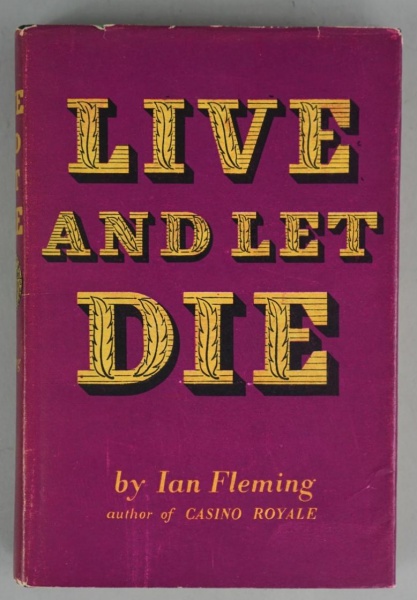
I also read Fleming’s follow up – “Live And Let Die”, (1954). The book’s plot involves Bond being sent to America to investigate “Mr. Big”, a huge black man who is a soviet counter-intelligence figure in the U.S., and who is believed to be financing soviet operations in America by salvaging and selling gold coins from a shipwreck off the coast of Jamaica. Bond’s mission? To figure out how Mr. Big is getting the gold and to stop him.
It became clear right away that the movies have picked and chosen elements of the Bond novels to mix and match in films. For example, both the film “Dr. No” (1962) and “Live And Let Die” (1973) are based on different parts of the plot of the 1954 book. Actually, multiple scenes from other movies were in the pages of these two novels.
All in all, the Bond stories were very enjoyable. But then I like a good spy novel. There is less technological gimmickry in the books than in the movies, but I did not count this against the books. Rather, the novels are a different way of getting the James Bond experience. Or maybe a way of getting a different James Bond experience. In either case, I can recommend these.

The surprising favorite of this bunch happened when I reached back to my shelf of classics and pulled up “Barchester Towers”, an 1857 novel by English writer Anthony Trollope. The story concerns the Archdiocese of Barchester, and the goings-on following the death of the old high-church Bishop of the Church of England. A change in governments leads to the old Bishop’s son being passed over in favor of a low-churchman, the Bishop Proudie. All that follows is an enjoyable story of church politics, human frailties and failings, and a touch of romance besides. A little research reveals that this is the middle of three books Trollope wrote about the world of Barchester and its environs, but may be the one that is the all-around best.
The clergy, their families and the people of the community all make for an entertaining yarn. It is a far better satire than the Twain novel, above, because it takes a more honest look at the kinds of humans who have always been among us. We see a parade of pride, anger, jealousy and greed, all mixed in with people who are honest, good and patient. And, as in life, some of those traits mix and match among those who display them. Of course, as in all proper English novels of the time, everything works itself out in the end.
As a final note, I loved Trollope’s satirical English way with names. In addition to the Bishop and Mrs. Proudie, there is Mr. Slope (the dishonest, scheming chaplain), the poor clergyman with 14 children (Mr. Quiverful) and minor characters like the physician Dr. Fillgrave and the social climbing Mrs. Lookaloft.
So there we are – three authors, four books and a fairly wide range of styles and eras. I am following up with something that is more modern non-fiction, but have not yet finished it. I will report on that one and presumably some others in the future. So until then, keep reading! It’s fun!
 J. P.'s Blog
Ditto with Ian Fleming. Liked the films as “light entertainment”, but as a constant reader, I realized I never actually read the books. Read a few a couple of years ago and found them to be “light entertainment” as well, a good intellectual palate cleanser, and in some cases, an interesting sociological look at the eras in which they were written. What’s not to like? I think I read someplace that JFK was a fan of Ian Fleming and the books.
BTW, as a literary aside, yesterday, April 10th, 2025, was the 100 year anniversary of the publishing of Fitzgerald’s The Great Gatsby! One of my favorite authors and books, it’s seems like it’s deceptively simply written, but has very visual and heart-felt prose. Always listed in the top ten of any list of American books to be read, and is generally still taught in both high school and college. It remains one of the first books written about the modern era and the machine age, and the changes in how we view love and money.
LikeLiked by 1 person
I neglected to mention that Ian Fleming had actually worked in intelligence for the British during and maybe right after WWII, so he some understanding of James Bond’s world. And I agree, these books are a great window into the world of the Cold War.
I had not realized that yesterday was the 100th of Gatsby’s publishing. I am continue to have trouble thinking of anything from the 1920’s as 100 years ago. I thought that was the 1870’s and 1880’s. 🙂
LikeLike
This is a nice variety. Like you, I have read the Twain book and never read either of Fleming’s books. Your memory about Connecticut Yankee is better than mine; I remember nothing.
The only thing I can add is, given the British theme of your selections, I recently read C.S. Lewis for the first time.
LikeLiked by 1 person
I have never read anything by C.S. Lewis. I think I ought to try one of the Narnia books.
Isn’t if funny how some of the things we read in school left no impression at all?
LikeLike
I enjoyed your reviews. I haven’t read a Bond book in ages. I’m tempted to now.
LikeLiked by 1 person
I have found that re-reading things now that I am older gives me a new perspective on things I read a long time ago. I wonder if re-reading some James Bond would be that way for you. If I had read any of these for myself when I was younger, I would know. 🙂
LikeLiked by 1 person
I recently read through all the Fleming Bond novels (in order) as well, something I haven’t done since I was — 13? younger? Reading through them again with so much more perspective in life was interesting.
My dad introduced me to James Bond with Goldfinger and I was instantly smitten with Aston Martin — a love affair I have to this day. There’s a lot of pick’n’choose from the novels to the films — I sometimes wonder if some of the movies would’ve been better if they stuck more closely to the source material (as if that’s the first time that’s ever been said).
LikeLiked by 1 person
Haha, I had the same thought about the relationship between the books and the movies. I have only read two of the books, but I suspect that this sort of thing goes on with the rest of them too. The biggest problem is the switching in my mind’s eye’s version of James Bond in books between Connery, Moore, and even Daniel Craig. I am envious that you started reading these so young – I wish that idea had come to me somehow.
I guess a 2 hour film has to cut a lot out of a book to tell a coherent story, so I guess all there is to do is to enjoy both of them for what they are.
LikeLiked by 1 person
I remember watching A Connecticut Yankee with my dad on our portable B & W when I was little and laughing so hard I cried in a lot of places. I read the book later on, as a teenager, maybe, and while I saw the attitudes you talk about I merely wrote it off as being a product of his times. It was never my favorite book by him, though. My favorite Twain book has to be The Prince and the Pauper.
I’ve only ever read one Ian Fleming book, Chitty-Chitty Bang-Bang, and it was very, very different from the movie.
LikeLike
Wasn’t Bing Crosby in that movie? I’m not sure I’ve ever seen the whole thing.
And if I ever knew that Fleming wrote Chitty Chitty Bang Bang, I had completely forgotten.
LikeLiked by 1 person
Dick Van Dyke. And while many assume/confuse that it was a Disney movie..it wasn’t. It was produced by the same guy (Broccoli) that produced the James Bond movies.
When I was a kid, I was a big fan of Dick Van Dyke, James Bond, Ian Fleming, and the Bond movies (where the Broccoli credit as producer always drew a laugh). It wasn’t until later that I eventually realized that they were all related.
Oh, and that Chitty Chitty Bang Bang was an actual car (sans flying) that had deep and storied roots in prehistoric motor racing history!
https://en.wikipedia.org/wiki/Louis_Zborowski
LikeLike
Yes, I always laughed at Mr. Broccoli’s name too. And I’m not sure I ever saw the Chitty Chitty Bang Bang movie – did my parents commit childrearing malpractice? 🙂
LikeLike
Yes, Bing was the star. I don’t remember it very well, except the laughing part. I was at a thrift store and saw it on a shelf and thought, “Doesn’t this guy write James Bond novels?” I don’t remember it very well, either, just that it was very different than the movie.
LikeLiked by 1 person
Well JP you are getting more books read than me these days, with the exception of “Theo of Golden” by Allen Levi which I recently read in two days. As to your choices in this post, I have only read “Huckleberry Finn” by Mark Twain and that was many moons ago. I do however, like the seemingly endless quips and quotes by Mark Twain, who tells it like is as that saying goes.
I am probably one of the few people who has never seen a James Bond movie, nor read a book about James Bond, nor any books by Ian Fleming. When I worked at the ad agency, right after college graduation, the name of George Lazenby was floated for a car ad. This was exciting to everyone but me, who had never heard of Mr. Lazenby, nor the movie “On Her Majesty’s Secret Service” and, at that time, 1978, my coworkers were amazed I’d never seen a James Bond movie.
I remember you have written in the past about your series of classics on your bookshelves – so Anthony Trollope’s book “Barchester Towers” is another book I never read in school or otherwise.
I guess I need to up my reading game!
LikeLike
I don’t think my exposure to literature in high school was much (or any) better than yours, which is why so many of these are new to me.
I always wondered why George Lazenby only played Bond once.
LikeLike
I always said when I retired I’d like to read all the classics books that I never read in high school or college. I looked at a list of the 100 top classics and I have not read many at all.
I don’t recall if he was used for Chrysler-Plymouth national or local dealer ads, so I’m wondering if it came to fruition – everyone was excited at the time though. For Chrysler they used Hal Linden (Newport) and Ricardo Montalban (Cordoba … that rich Corinthian leather) and opted for a woman, Judy Strangis from Room 222 TV series for Plymouth (Duster and Road Runner). Her character was “Mean Mary Jean”.
LikeLiked by 1 person
I think those ads were national, because I remember the Hal Linden ad. The one with Montalban is famous!
LikeLike
Yes I think so too – the Hal Linden ads were during his “Barney Miller” days and yes, that smooth as silk voice by Ricardo Montalban – people used to try to imitate that part of the ad when it was popular. My boss wrote both those ads.
LikeLiked by 1 person
A good list of books. I’m listening to this book on audio, it’s very good, “One Wrong Step,” by Jennifer A Nielsen.
LikeLiked by 1 person
I looked it up and it sounds interesting. I have not read much historical fiction, and ought to do something about that.
LikeLiked by 1 person
Also, I laughed at your comment last week, when you wondered if I was going to come back to this topic soon. I had this one roughed out then, but decided to let the suspense build. 🙂
LikeLiked by 1 person
LOL, it sure did. For book readers, we like to see what others are reading. Gives us new ideas. I’ll have to share a few myself.
LikeLiked by 1 person
I like when authors like Trollope name characters with a bit of whimsy because it makes it easier for me to keep them straight.
LikeLiked by 1 person
Agreed – it really helps.
LikeLiked by 1 person
All of the previous comments focus on Fleming and/or Bond (and if you have grandchildren, you MUST watch “Chitty Chitty Bang Bang” with them – right up there with Mary Poppins). Having said that, you have me most curious about “Barchester Towers”. I will give it a try, if only for the reminder I need to occasionally step back to the classics instead of favoring the latest bestseller.
LikeLiked by 1 person
I was surprised at how much I enjoyed it.
LikeLiked by 1 person
That is quite a varied list JP! I haven’t read much by Mark Twain that I can remember, perhaps Tom Sawyer, as my parents had an old edition. No to Ian Fleming either, it’s hard to even think of those films as stemming from books, as opposed to screenwriters. I wonder who will be the next James Bond? No to Anthony Troloppe too, although I’ve read a lot of Joanna Troloppe, (British author, a distant relative), I think my list of classics is sorely lacking.
LikeLiked by 1 person
Thanks Joni, good to see you are diving into your catch-up-on-the-blogs project! Yes, I have a bad tendency to go down rabbit holes, and am purposely trying to mix up genres and authors instead of following my normal bent of reading one thing until I get tired of it. And I am making myself go through a 50-ish volume set that has been gathering dust on my bookshelves for more years than I care to admit. The education of JP must continue! 🙂
LikeLiked by 1 person
Ha! That is an admirable goal. I hoped to achieve more reading variety though bookclub, but the “old ladies” (an attitude not an age) tend to want to read the same old romance fluffy type books
LikeLiked by 1 person
It is easy to fall into our comfort ruts, that is for certain!
LikeLiked by 1 person