
JP’s Book Report – Catching Up
It has been awhile since I have reported on my reading. Or, well, my listening – because it is only the audio version of a book that I can cram into my life while driving during my work day. I had to look – I last reported on this in June. So, what’s new?
The reason for this long delay was that my driving schedule changed dramatically in the spring. Before that, I could rack up several hours of driving during a twelve or thirteen hour night shift. Now I am working days in a different division that has me driving in the metropolitan area that surrounds my city. I still get a few hours of driving per day, but it is broken up into several hops measured by half-hours. I stopped listening to audiobooks entirely for awhile. I was being trained on new routes and duties and was getting comfortable with higher levels of traffic and new procedures. But now that I have been settling into more of a routine again, I have dipped back into the audio book pool and it is time for an update.
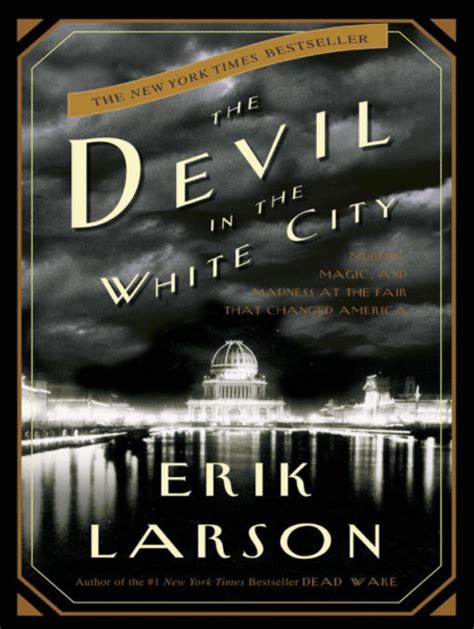
My first dive back into that pool was “The Devil In The White City”, by Erik Larson (2003). It was an engaging history work that intertwined two stories – that of the 1893 Chicago World’s Fair and of H. H. Holmes, a man who may have been America’s first serial murderer. Each is fascinating on its own, and both together make for a good book about two big events in the closing years of the nineteenth century. The fair was a tremendous undertaking and a great success. Sadly, it was also the thing that drew single women to Holmes’ World’s Fair Hotel not far from the fair site, a place that would be the last place some of them would ever see. If you are looking for an engaging read, this book is hard to beat.

I finished a project that was interrupted – J. R. R. Tolkien’s Lord Of The Rings series. I have previously reported on the first two books of that trilogy and finally finished the conclusion – “The Return Of The King” (1955). There is not much to add to what was said about the first two volumes, except that it makes a satisfying end to a great fantasy read. One story that did not make the Peter Jackson film series is how the hobbits are forced, upon their return, to drive out the tyrants who have ruined their beloved shire. Of course, the good guys win.

I continued my immersion into the late nineteenth century by reading another presidential bio: “American Ulysses: A Life Of Ulysses S. Grant” by Ronald C. White (2016). I have not read enough about that era and this book fills a big knowledge hole for me. Honestly, a serious reader would do better with the printed version to make use of the maps that would have been helpful in making more sense of the chapters covering the Civil War. It is a long book (well over 600 pages in print) but a thorough portrait of a man who was both famous and famously enigmatic.
Grant’s reputation as a heavy drinker is largely refuted here, as is his reputation for presiding over a highly corrupt administration. Grant was an honest man who had a hard time seeing the tendencies towards dishonesty in those around him. The book gave me a new appreciation for the difficulties he encountered in bringing the former Confederate States back into the Union. Left alone, most of those states would attempt to recreate the closest thing they could get to slavery. But too heavy a hand would ignite a long guerilla campaign of continued rebellion. Grant’s efforts at reconstruction tried to strike the delicate balance between Federal enforcement of the rights of the freed and re-integrating a conquered people into the fabric of the country. Sadly, it would be another century after the Civil War’s end before there would be much progress towards the vision of freedom for all.
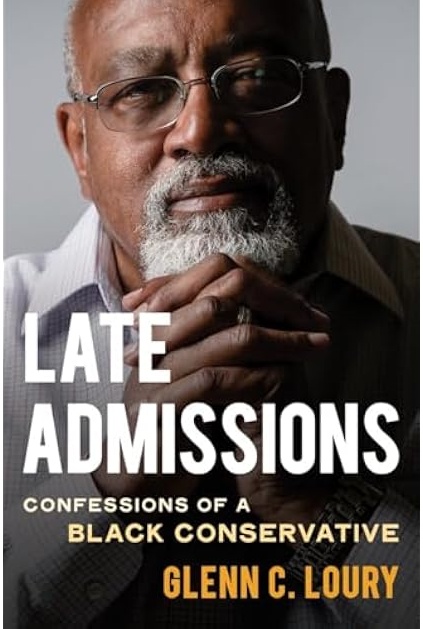
I followed that book with another bio – this one in the form of a memoir that has only recently been released. “Late Admissions: Confessions Of A Black Conservative” (2024) is by/about the iconoclastic economist and social critic Glenn Loury. Loury’s story is fascinating – a child from an unstable home on the south side of Chicago who made it to the economics department of an Ivy League university. Loury has struggled with these two parts of his life, first as an outspoken black conservative during the Reagan years, then as a man of the principled left before “coming home” to his conservative roots about twenty years ago.
Loury shares the worst parts of his life, including serial infidelities and drug abuse which arose from seeds planted in his youth. His has been a life-long struggle to stay on the right side of an imaginary line that too many of his background ended up on the wrong side of. As an econ major in my college years, I was also fascinated by his struggles to decide whether he was a “black economist” or an economist who happens to be black. In recent years I have followed his podcast, called “The Glenn Show”. His takes on economics, politics and race are often polarizing, but are always interesting. In a genre that is too often a “greatest hits” of life, Loury’s memoir is an engaging story about the good, the bad and the very, very ugly parts of a fascinating life.

Next, I went back to the beginning of the twentieth century for G. K. Chesterton’s fantasy-adventure novel “The Man Who Was Thursday” (1908). The plot involves a man who is made a police detective in order to infiltrate an organization of anarchists. The book has been described as a transitional hinge between the fantasy adventure of Lewis Carrol (Alice in Wonderland) and the darker, more nightmarish style of Kafka.
Chesterton’s prose is always a delight, both witty and sharp. The story is quite complex, with the plot going into unexpected places with things not being at all what they first seemed. Being Chesterton, he weaves Catholic themes into the book, but in ways that serve the story. This book probably rates a second read/listen to more fully appreciate the subtleties that I surely missed the first time through.

A day or two before Halloween, I found myself in the mood for a quick read appropriate for the season. I decided on “The Legend Of Sleepy Hollow” by Washington Irving (1820). This is the short story that everyone knows: Ichabod Crane and the headless horseman. I had seen multiple film adaptations (from Disney to Tim Burton) but had never read the story. It is actually a delightfully funny read about an awkward teacher and his ill-fated infatuation with the daughter of one of the local farmers. Was there a headless horseman? Or was Crane the victim of a practical joke played by the girl’s primary suitor? That, dear readers, is a question that Mr. Irving declined to answer, which is what makes his story so successful and enjoyable even two hundred years later.
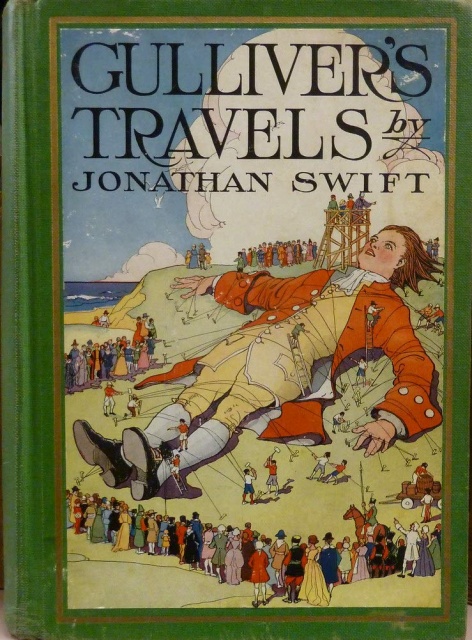
I revisited my bookshelf of classics with “Gulliver’s Travels” by Jonathan Swift (1726). I had read this book many years ago and decided to take another run at it. It is a fantasy story that is a thinly disguised critique of British society of Swift’s day. Swift tells the story of four times he set out on ocean voyages and four times that he found himself marooned/abandoned in strange lands. The tiny subjects of Lilliput are the most famous, but he also spent time with the giants of Brobdingnag. The travails of a giant among the tiny and being tiny among the giants are ably described.
Swift also spent time in lands ruled by the floating island of Laputa. There, he explores the pursuit of science to the exclusion of all else, except for stultifying bureaucracy. He also visits with a race that suffers eternal life and has the ability to converse with the dead from prior ages. His last stop is the land of the Houyhnhms, a race of intelligent horses who rule over unintelligent humanoid beasts. As one not well versed in the political details of the British Empire of the period, much of Swift’s satire drifted over my head. The parts that did not seemed a curious foreshadowing of things that civilization would dabble in over the ensuing two-and-a-half centuries. I concluded the book with much the same reaction I had the first time I read it – I was glad it was over.
Having expanded my mind quite enough, thank you very much, I think it may be time for some mindless pulp fiction next time. So you about all of you – have you read any good books lately?
 J. P.'s Blog
A terrific list although i have no contributions. The last couple of months have been filled with my preoccupation of current events in election years.
However, i will suggest an author whose works are quite varied and ive enjoyed all I have read from him. It is Winston Groome. Yes, he wrote Forrest Gump (which the book is nothing like the movie) but that was a one-off. Groome was more into historical documentaries but he made them enjoyable to read.
LikeLiked by 1 person
Thanks for the suggestion, I have made a note to look into him.
LikeLike
I read The Devil in the White City a couple of years after it came out. A fascinating story I had never heard before. I now read anything Erik Larsen writes as soon as it’s available at my library.
Had much the same reaction to Gulliver’s Travels as you, J.P. I was glad to be done with it!
LikeLiked by 1 person
Not liking that I have to log in again to leave a comment on blogs when I have already left a like and the blog knows who I am. Anyway, Anonymous is me…
LikeLiked by 1 person
But I am not this Anonymous… I am the Anonymous who doesn’t seem to have shown up in your comments… I give up…
LikeLiked by 1 person
It was there – one of my spam defenses is that any comment by a first-time commenter must be manually approved by me, the King of this realm. If there is a delay in an anonymous comment showing up, it is because I am delayed in waving my approval scepter.
LikeLike
Scepter waving – good description!
LikeLiked by 1 person
Something must have changed with WordPress – I am seeing a lot more “anonymous” postings. I am also having more difficulty commenting on the blogs of some others.
LikeLike
Something is always changing with WordPress…
LikeLiked by 1 person
I have not read anything else by Larson, but probably should!
LikeLike
Another interesting selection. I listened to a podcast on Holmes and the Chicago World’s Fair, chilling!
I think I tried to read Gulliver’s Travels in my early teens and was unsuccessful. Ditto for the Lord of the Rings series, I couldn’t even get through the movies.
A good book I read lately is Outsider by Brent Popplewell, about a reclusive elderly ultra marathon runner who lives in an old school bus in the woods of British Columbia. A more complicated and impressive tale than I expected. I’m also listening to Malcolm Gladwell’s Revenge of the Tipping Point. As always J.P. I recommend you season your informational diet with a dash of Gladwell, his connecting of things doesn’t always ring true for me but it’s an interesting process.
LikeLiked by 1 person
I have added your suggestions to my “Look Into These” list. I am glad to see that I have plenty of company of Gulliver’s Travels!
LikeLike
Terrific list and great suggestions. The book about Grant is definitely going to be an upcoming listen for me.
I too am a big fan of Erik Larson. If you haven’t read it, you should check out In the Garden of Beasts. That book came right before the book about H.H. Holmes. In the Garden of Beasts may be almost a little too on the nose for our present day given its subject (growing awareness, and willing avoidance, of the evolving political situation in Germany between 1933 and 1937), but it’s a fascinating read nonetheless.
LikeLiked by 1 person
That does indeed sound like a good suggestion! I read The Rise And Fall Of The Third Reich by Shirer. That one, from 1960, represented the mindset of the generation who lived through it (Shirer had been an American press correspondent in Germany before the war). It would be interested to see a more modern perspective on the disaster that was pre-war Germany.
LikeLike
You have been busy!
I read The Devil book by Erik Larson. I also liked his book The Splendid and the Vile.
LikeLiked by 1 person
Erik Larson has quite a following here! That sounds like another good one.
LikeLike
Amazingly I have actually read four of the books you reviewed. The Devil in the White City was my favorite. I just finished reading The Exchange by Grisham because I like to feel that my life as a lawyer was very boring!
LikeLiked by 1 person
Haha, yes, Grisham can make law practice look far more exciting than mine ever was.
LikeLiked by 1 person
That’s quite a diverse collection of books you’ve read JP. I have only read the latter two, “The Legend of Sleepy Hollow” and “Gulliver’s Travels”. back in the day. There are many classics I’ve never read and I was a literature minor in school. I did not set as high of a Goodreads goal as I did last year, so have read only four books this year, but I started studying French three weeks ago. The course is intense in my opinion and I studied French all through college, the last two years without speaking a word of English in the class. I am practicing about 90 minutes a day which is taking up a chunk of time for sure. I bought “Spare” by Prince Harry last week at Meijer as it was now in paperback – hope I am not sorry. I’ve heard it is a lot of whining and complaining about Wills, but I’ll enjoy the part about Harry’s relationship with his mother.
LikeLiked by 1 person
Marianne studied French in high school and college, but recalls very little of it. I salute you for taking it up again. Does this mean a trip to Paris is in your future?
LikeLiked by 1 person
I’m sorry I didn’t keep up with it JP. And I find there are expressions used back in the 70s, that are not used now and vice versa. I have always wanted to go to Paris, but to be honest, I am not sure I will ever make it there.
LikeLiked by 1 person
Good job on the reading, an interesting selection.
LikeLiked by 1 person
Thanks! It is a lot of fun. Mostly.
LikeLiked by 1 person
Agree, and I like audio, but I go back and forth… audio / actual book.
LikeLiked by 1 person
I thought I’d read the Larson book fairly recently but it’s actually been six years. Somehow the dark side of the novel escapes memory but I was enthralled with the evolution of the Fair itself (especially the architecture/landscape details), and the political hurdles cleared to make it happen. I always admire an author who goes to great lengths to research his/her subject. I was surprised to see two references to fantasy fiction. As a young adult I was drawn to the fantasy of Tolkien and Piers Anthony, as well as the inherent fantasy of science fiction. But it’s been a long time. My well-read son suggested I try Brandon Sanderson’s “Mistborn” series, so I’m giving it a go for lack of anything else at the top of my list. I won’t say I’m hooked (yet), but I’m still turning the pages.
LikeLiked by 1 person
I too was enthralled by the story behind the Chicago World’s Fair. It was amazing that they could pull it off given the number of things that went wrong.
It is always good to get reading suggestions from those younger than we are!
LikeLiked by 1 person
Pingback: JP’s Book Report – Winter 2026 Edition | J. P.'s Blog