Two Records From 1940: How To Combine Social Criticism, A Good Sense Of Humor and First Rate Jazz Music.

Jazz music from the era generally featured here is not of the kind that usually tackled social or political themes. But there is the occasional outlier, and we have two of them for you today: “It’s The Same Old South” by the Count Basie band and “W.P.A.” by Louis Armstrong and The Mills Brothers. The good news is that each of these selections makes its points with good humor and wraps it in some great music.
It is hard to think of examples of jazz music from before the 1960’s that dealt with social or political topics. One well-known exception is Billie Holiday’s “Strange Fruit”, a song on the topic of racially-motivated lynchings in the south. For the most part, jazz from before the era of the long-play record was all about the music. The problems of life were for the poets and the novelists, and music was to be an escape from the ugliness of the world. In a way the two records featured today find a way to do two things at once – make a serious point, but to do it with humor and with good music too.

The first offering is “It’s The Same Old South” by the Count Basie band. The song was written by Edward Eliscu and Jay Gorney and was featured in a 1940 musical review called “Meet The People”. That show was made into a movie in 1944 by MGM, but this song did not make it into the film. The lyrics skewer the American south, with the theme that the “new south” was pretty much the same as the “old south”.
Basie was not one to seek conflict or controversy, and was reluctant to record the song. His promotor John Hammond disagreed, and convinced the Count to make the record, which he did on December 13, 1940. For what it is worth, Hammond was a wealthy New Yorker who was very much in tune with New Deal liberalism that was then at its peak, so he likely had little use for southern sensibilities. And Basie was a New Jersey native who really had no dog in the fight, except that his band did make occasional tours through the south. In any case, the song was released as a “B” side and never received any significant promotion so that it was soon forgotten.
This musical attack on southern life was not done with a blunt instrument, but with some wit and playfulness. From the start (“It’s a regular childrens’ heaven, where they don’t start to work ’till they’re seven”) it is one barb after another, though always delivered mostly in fun. I will confess that I had to look up one word that has always mystified me. Towards the end is the line: “Let the northerners keep Niagra, we’ll stick to our southern penagra (?)”. One source (1) claims that that the last word is actually “pellagra”, which was a vitamin deficiency common in black fieldworkers of the era. Another (2) ID’s the word as polygra, which it claims is a word for southern tradition, though I cannot find any support for that one. It will have to remain a mystery.
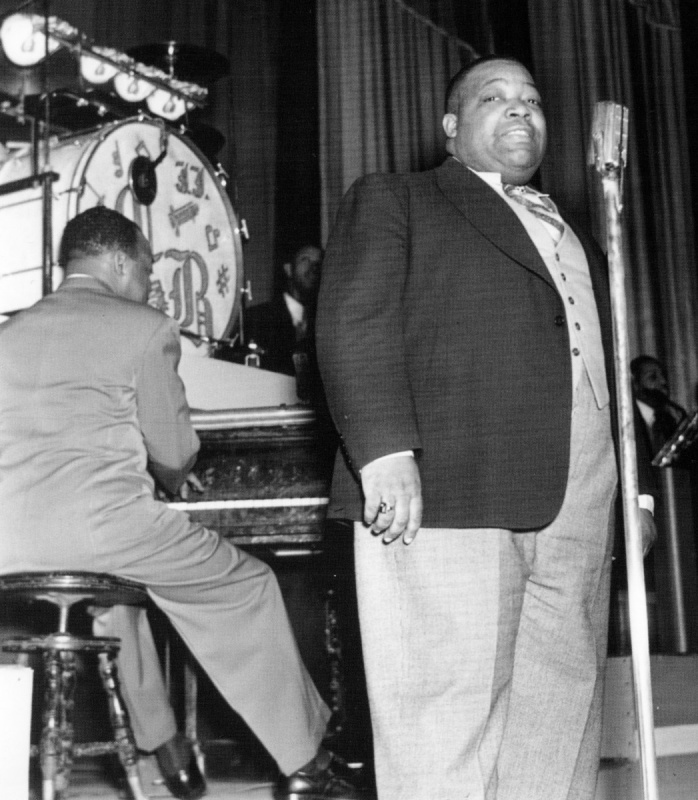
What is not a mystery is the good music. Basie’s is not usually remembered as a “singer’s band”, but his blues shouter Jimmy Rushing was a was a staple of the outfit. Sometimes called “Mr. Five by Five” for his short, stout stature, Rushing was primarily a blues guy but he could punch out a good performance on pretty much any song that did not require a crooner.
The piece also features solos by longtime Basie trumpet man Buck Clayton and, of course, the Count’s economical keyboard work. And as we might expect, the “old testament” (pre-1950) Basie band swings it from beginning to end. Interestingly, the song was revived by the Texas swing band Asleep At The Wheel in a 2021 album.
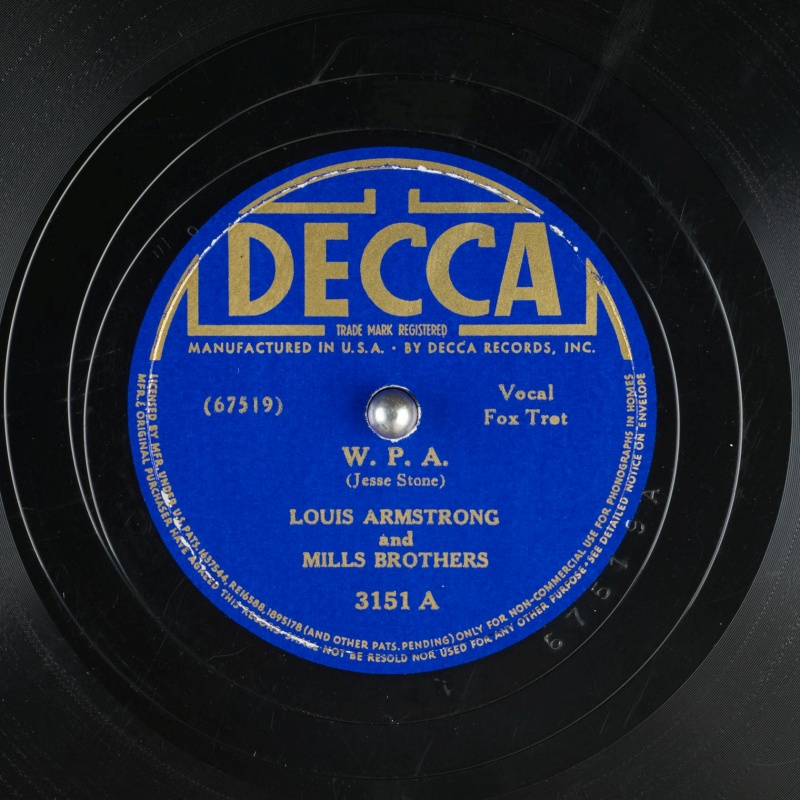
The second selection is less well known and skewers a less familiar target. Also from 1940 is “W.P.A”, a joint effort by Louis Armstrong and The Mills Brothers. Those up on their history will recall that W.P.A. stood for the Works Progress Administration, one of the signature make-work programs of President Franklin Roosevelt’s “New Deal” in the mid 1930’s. The genesis of the song (written by Jesse Stone, who would later author “Shake, Rattle & Roll”) is unclear, but the program had been criticized for not hiring black workers in proportion to their numbers or unemployment rates (particularly in the south), and had also earned a reputation as a place where poor work habits were more the norm than the exception. “How can you tell which direction is north? Look for the moss growing on the W.P.A. workers.”
Neither Armstrong nor any of the Mills Brothers were political, but all had their opinions on racial matters. The Mills Brothers, for example, made it a point to not perform south of the Mason-Dixon line until after passage of the Civil Rights Act of 1964. Was this the basis of these two Decca recording artists coming together to record the song? Or was it just a fun, catchy tune about current events? It will remain a mystery. What needs no speculation is the backlash this disc caused. The major radio networks banned it from play over the air, claiming that it was “in bad taste”, and Decca Records soon yanked it from stores. (3) But the cult of FDR has weakened much from 1940 and we can now enjoy this good-humored poke at a one-time sacred cow of FDR’s New Deal. “Sleep while you work while you rest while you play, lean on your shovel to pass the time away” – who wouldn’t want that kind of a job?
Musically, this record is a treat. By 1940 Armstrong was known as much for his unique singing style as for his mastery of the trumpet. He bumbled into doing vocals in the 1920’s, and they became as popular as anything else he did – a topic that deserves to be explored here on some future date. Louis sang much like he played the trumpet – a melody was merely a suggestion, and his vocals were often improvised as much as when he played.
We have already highlighted the Mills Brothers’ early days (here), and this piece gives us everything one could expect from their performance. Their unique and oh-so-smooth vocal blend gives Satchmo every bit of accompaniment anyone could ask for. When they are not taking their turn on lead vocal, they provide the background riffs that allow the session to make do without the kind of band that was the norm in those days.
There we have it: two not-so-common examples of popular jazz that served to ridicule certain aspects of society. These records are unique in the way performers who were not active in politics or social causes could occasionally record a song that made a larger point, so long as that point was made in fun. They also show that certain topics (like the American south) were considered fair game by those with influence in 1940, while others (FDR’s New Deal programs) were not. In any case, both records help their messages go down smoothly because those messages were surrounded by good music that turned out to have a much longer shelf life than whatever then-current issues might have inspired them.
(1) https://www.grammarphobia.com/blog/2010/01/lyric-victory.html
(2) https://sonichits.com/video/Jimmy_Rushing/It’S_The_Same_Old_South
(3) American Made, Nick Taylor (2009) at p. 469.
 J. P.'s Blog
Excellent Friday morning reading on two relatively unknown songs by two well known players! Jazz offers a lifetime of mysteries!
LikeLiked by 1 person
Indeed it does! There is always something new no matter how old it is.
LikeLike
Leftist Authoritarian Dictators never did like being criticised; and apparently the mass media never had any credibility at all.
LikeLiked by 1 person
I think it’s more like the school playground – some things are deemed OK by the cool kids and some things are deemed not-OK. The cool kids of the late pre-war years were definitely all-in on FDR’s New Deal. What is kind of funny is that both the state of the retrograde American south of that era and the proponents of the liberal New Deal were both pushed by different wings of the same political party.
LikeLiked by 1 person
I keep meaning to learn how to put things tactfully like you can… One of these days…
I don’t disagree with your analogy: It’s still that minority of most forceful pricks that bully the rest of those trying to simply peacefully enjoy the playground.
While I have many years of hindsight to view FDR’s actions through, I don’t think he didn’t know what he was doing (both Roosevelt presidencies crippled our country and freedom in varying but highly effective ways).
It’s massive cognitive dissonance — and a testimony to the efficacy of the Big Lie — that the particular political party to which you are referring considers itself entitled to the votes of (well, anyone) the demographic they’ve held down for a couple centuries.
LikeLiked by 1 person
Really good, informative essay. You know your stuff!
LikeLiked by 1 person
Or maybe I have just spent too many years going down seldom-traveled rabbit holes.
LikeLiked by 1 person
Penagra=cravings?
LikeLiked by 1 person
Good question. I tried looking it up and all that came up was the similar penegra, which is a generic term for a prescription for, um, male difficulties.
LikeLiked by 1 person
Although I remain an FDR fan, good playing on the WBA song. Good guitar work too, typical jazz era archtops sacrificed sustain for punchiness and volume.
LikeLiked by 1 person
Plus one for FDR, if it wasn’t for him, most people’s grand parents would have been “retired” to a refrigeration box down by the river, or worked until they died!
LikeLiked by 1 person
I think we will have to agree to disagree on this one. We would probably agree that Hoover took a nasty downturn and made it worse than it should have been. But I would argue that FDR’s example was of the “Don’t just stand there, Do Something!” school. The problem is that too much of what he did was counterproductive, or at least not helpful. He made different mistakes than Hoover made, but they were still mistakes because things were almost as bad in 1938 as they had been in 1933. Just one example – there were more new Chevrolets built in 1933 (what many claim was the worst year of the Depression) than there were in 1938. It was the combination of the outbreak of war and the fact that many of the original architects of the New Deal were no longer in positions of influence in FDR’s administration after 1940-41. The New Deal (especially early on) was all about “command and control” rather than about creating a safe, stable environment for private industry to flourish.
LikeLike
I think disagreeing is the word. My parents were able to survive because of the New Deal, and my grandparents in South Carolina: ditto. You are too quick to drink the right wing “business solves everything” Koolade. Ronald Reagan and his “trickle down” economics theories, which never worked, will not control the admiration he does now, when the history is written a hundred years from now. As a person who has spent half his life living in areas of the country with high populations too large for the amount of employment: salary and benefit compression based on competition for jobs is a real thing, and has resulted in average household income being a fraction of the national levels. Business has no problem making their workers poor if there’s a lot of competition for the jobs, and I ran across this as recently as eight years ago, trying to hire competent workers for my positions in Indianapolis on salaries that out of state people would not accept. This is the wrong column to even cover a lot of this….cause, hey, jazz! But, why argue? AI will soon enough show what’s what when the government is going to have to figure out what to do with out of work, and under-educated employees! Why do you think the dock workers are striking about stopping technology? I’m perfectly happy to stop trying to educate, based on my history of labor courses, and sit back and watch what happens!
LikeLiked by 1 person
It may surprise you, but I have plenty of criticisms of our current system, that has spent the last 60+ years chasing “efficiencies” and short-term results to the exclusion of almost everything else, to the point where businesses become ever larger and those of us on the ground are left with fewer and fewer choices and opportunities. And I do not doubt that certain New Deal programs helped certain people. My argument is that centralized “command and control” has never worked well in the economic arena and that many of FDR’s efforts were in the nature of attacks on business which kept the economy in a state of virtual paralysis far longer than it should have been. And for the record, my assessment of Hoover is no better. Anyway, we clearly disagree on many of these issues, but I always appreciate hearing your thoughts on them.
But to get back to the topic, I had not known that the W.P.A. song caused as much blowback as it did, and it reminded me a bit of things today – some topics and opinions are encouraged by Big Tech, Big Media, Big Pharma and Big Government and some are assuredly not. It has apparently ever been so.
LikeLike
I do love the sound of that guitar! One of the brothers (John Jr.) played the guitar until he died in 1936. When the boys’ father (John Sr.) took over the bass vocal part, they hired a guy named Bernard Addison to play the guitar for them. He played for a number of well-known musicians for years, and was still around until 1990. It is not an issue in this group of performers, but those old acoustic guitars often had to punch through a lot of loud horns.
LikeLike
JP, I think you could always find a third career down the line as a DJ on a jazz radio station – it appears no one could stump you as to this genre.
LikeLiked by 1 person
Haha, thanks Linda. I think if you define an area narrow enough, pretty much anyone can be an expert on something. I am no good identifying birds or wildlife, but can at least hold my own with this era of music.
LikeLiked by 1 person
Well JP, I guess my knowledge of different music genres is like the saying “jack of all trades, master of none”. I follow a nature photography site of all 13 Metropark photographers – I thought I was becoming a fair birder, but they show photos of birds I’ve never heard of, let alone seen!
LikeLiked by 1 person