Random Things I Don’t Understand
I like to think that I have been around the block a time or two. Figuratively, of course, because I have literally been around my block quite a few times. What I mean to say is that I think I have reached the age where I understand most things. I may not like some of these things, but I at least understand them. However, there are things I do not understand at all. Let us examine three of these things.
Tipping. Marianne and I enjoy going out to eat. It is enjoyable to not have to cook, and even more enjoyable to not clean up after not cooking. But going out to a restaurant gets more expensive every year. And then there is the tipping.
I remember when the commonly-agreed tip for good service was 15% of the check. Does this make me old? I don’t recall this being so long ago. I remember tips going up during COVID when the restaurant industry was in dire straits and tips on carry-out and higher tips for those rare dine-in times were seen as good things for servers whose incomes had plummeted.
But COVID (as a societal phenomenon) is over. Yet every time I go to carry out a meal I am hit up for a tip at the new and improved higher rate. When we went out most recently, the little handheld electronic thingy (to not get too technical) on which we pay our check helpfully suggested tips of 20, 22 and 25%, and even more helpfully calculated each. Yes, the electronic device allowed a “custom tip” but who wants to go through those extra steps?
The part I don’t understand is that the old 15% is a percentage. 15% of a $17.95 sandwich and fries provides significantly more money for the server than the 15% of a 2015 sandwich and fries which was probably closer to $10.95. So, when prices go up the server gets a raise. Unlike, for example, for lawyers and truck drivers. But evidently they wanted a bigger raise because the percentage is now higher. Oh well, it’s only money.
Harvey Weinstein. OK there is a lot to not understand here. You will recall that good ol’ Harv was the proprietor of a Hollywood casting couch and somehow kicked off the short-lived “Me Too” movement. But the part I don’t understand is the way we pronounce his name.
W-e-i-n followed by s-t-e-i-n. I understand that there is a German rule and an everywhere else rule when it comes to pronouncing e’s and i’s. German words and names (according to a fellow I knew who had one of those names) pronounce the second vowel when two of them appear together. His name was Giesel. “It rhymes with diesel” was what he had to tell everyone. Because people wanted to pronounce it “guy-sel”. But that would have been the pronunciation for the real name behind Dr. Suess – because his last name was Geisel. This is why the thing from which Germans drink beer is pronounced “styne” – the “i” in “stein” is the second letter. Nobody refers to a beer “steen” because that would be pronouncing the “e”, which is the first letter.
Now back to Harvey Weinstein – which is always pronounced “Wine-steen”. Do you see my problem? “W-e-i-n” at the beginning of the name has the same “e-i” combination as “s-t-e-i-n” that makes up the last part of the name. So why is the first half pronounced differently from the second half? It seems that it should be either “Wyne-Styne” or “Ween-Steen”. But no – he pronounces it “Wyne-Steen”. And that’s just wrong. Yes, there is lots of time to think of random things while driving a truck.
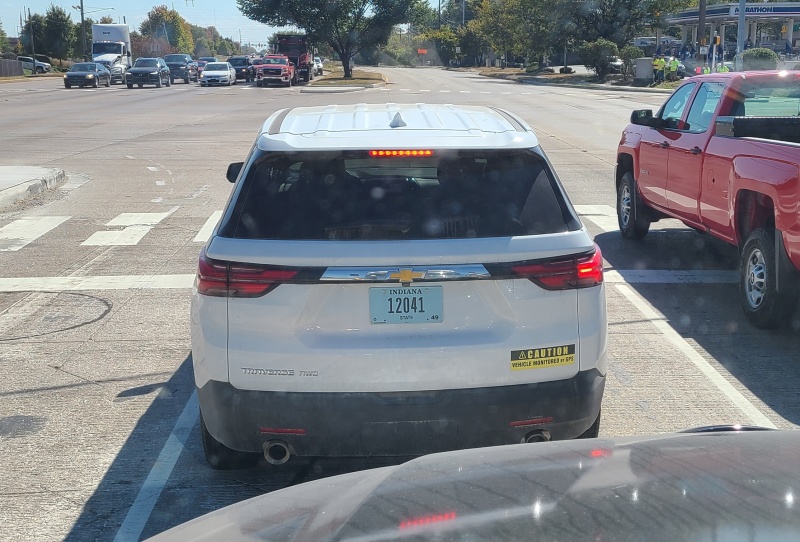
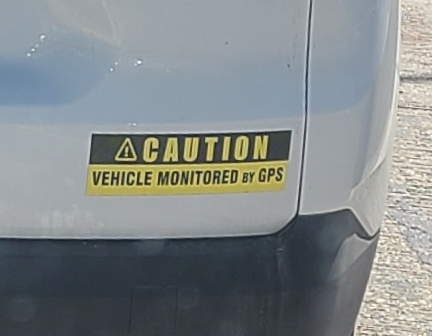
Caution. I began this little list after seeing the bumper sticker depicted above. The sticker was attached to the back of a state-owned car. But what is the purpose of this sticker?
I understand GPS. I understand that a vehicle can be monitored by GPS. But to whom is the “Caution” directed? Is it aimed at someone like me who is following the vehicle in traffic? Does the GPS increase my risk of danger somehow? I mean over the GPS in the cell phone of every other driver on the road (and the one in my own vehicle). Or is it that the GPS monitoring will somehow cause the driver to do something wacky like make a sudden turn or slam on the brakes with no warning?
But maybe I am not the target of the warning. Is it a warning directed to the State employee who has been entrusted with the vehicle? “Be careful Sid – if you lose this car we will be able to find it.” Or “Be careful Sid – if you spend your afternoons at the Red Garter drinking beer and stuffing dollar bills into places where they don’t belong we will be able to tell.” But why not just put a small sticker on the dash rather than a great big sticker where Sid cannot see it, unless he is opening his trunk to grab an extra wad of dollar bills.
Or is it aimed at would-be car thieves? “Be careful – if you steal this car we will be able to find it.” “If we pay enough attention, anyway.” It seems to me that when dealing with car thieves, threatening them with jail time would be far more effective than a simple caution. And if this were the case, I would think the sticker would be on the driver’s door. Am I missing something?
There are, of course, many more things than these that I don’t understand. But this is a start. And perhaps my astute readers can explain some of these things to me. Or maybe I can make some of you as confused as I am.


An interesting list. I always assumed the vehicle’s speed was what was being monitored by GPS and that the caution was for those who might follow it and choose to drive over the posted limits.
LikeLiked by 1 person
Not a bad idea, and you are probably right. Although by the time a following vehicle gets close enough to read it, that driver probably already knows that he is overtaking the car ahead.
LikeLiked by 1 person
Absolutely correct. If you have a vehicle that controls to the posted speed limit plus allows a margin of, say 2 mph, it will adjust to the local speed limit as defined by the GPS.
Which means the vehicle may go a lot slower than the Redneck sat behind him wants to travel, hence the risk of an incident goes significantly up.
Especially when the vehicle behind is a truck and its driver is paid by the load and not by the hour!
LikeLiked by 1 person
Great point!
LikeLike
I love going out to dinner, but rarely go anymore just because, hey, I’m old, and I can’t get motivated to do it. In fine restaurants, the fifteen percent tip was dead thirty years ago (where are you living?). I am shameless about tipping. If I get treated well, and beyond expectations (and in many places I am), I might figure twenty percent and round up even above that. If you can’t afford to tip, don’t go out for fine dining. If you’re counting your pennies, don’t go out for fine dining. If I’m not treated well, I don’t tip at all. If I’m at a diner, eating an eight dollar meal, and am treated well, I tip whatever I think is appropriate based on the expenses of living. Eight dollar meal? Are you going to leave a dollar twenty? No, you’re going to leave five bucks. If you can’t afford it, don’t go out to eat. My local coffee shop charges me two bucks for a cup of coffee, and sneaks me more, even when there is a no free refill policy; I leave a dollar, that’s fifty percent. I don’t leave tips on electronic pay systems, I always press “no tip”. I bring enough cash money to leave a cash tip, even if I pay the bill with a credit card. I know most restaurants and bars don’t track cash tips, so it’s my way of sticking it to the man! The wealthiest couple I know, when they take me out to a fine venue dinner, we are always a bunch of wise-asses, so it’s easy to start riffing with the waitstaff and having fun. Hence, I’ve seen them double the bill and leave it in cash! Not because they’re playing “Mr. And Mrs. Big”, but because our waitstaff is making us feel wonderful, and they have the ability to make someone’s day! Maybe it’s because I grew up in Chicago, but I think if you make a decent income, it’s incumbent on you to throw a little of it around!
LikeLiked by 1 person
We seldom go to “fine dining” establishments, but do go to lower and mid-priced places. Most places we get average service, which to me merits an average tip, and we certainly up the tip when we get service that goes above and beyond the norm. My gripe is that “the systems” are all pushing us to up the percentage for even average service when the meal prices themselves are driving tip increases anyway.
The cash tip is a great idea, but I have gotten out of the habit of carrying much cash, so am usually not prepared for a cash tip when we are out.
LikeLike
You are correct that it seems like the rules of tipping seem to be changing, and mostly driven by the restaurants and venues. My tip objections are focused on credit card payment systems, mostly companies like “Square”, that demand you respond to a tip question, and in my case, answer “no tip”, before a transaction can be completed, even in an interaction where there was never of history of tipping anyway. Buying something at a small boutique type store, and just checking out, does not warrant anyone getting a tip! I object to having to respond by clicking “no tip”, and wonder how many people are “shamed” into clicking 10%? Ditto to my grocery store asking me if I want to “round up”, and then people in-line giving me the “skunk eye” when I say no. They don’t know my financial support of charities I agree with?
LikeLiked by 1 person
Given the warning is on a State-owned vehicle, I’m sure it’s there as a warning that an even-moreso-than-usual-brainless biounit is occupying the front-left seat paying attention to its phone…
Tipping is bullshit, and we should stop doing it entirely (as a society). I’ve become so annoyed at being technologically panhandled at every turn. But even worse than that is the idea the recipient is entitled to your money, irrespective of their earning it.
LikeLiked by 1 person
It would probably be good if brainless drivers could be monitored by GPS, but I am not sure we are there yet.
The tipping trend that really irks me is for carry-out meals. When I go to a counter and order and stand at the counter to pick up my food to go, I am not seeing much in the way of service to be tipping.
LikeLiked by 1 person
I think that GPS tracking warning should be pasted on the steering wheel, since the driver may well be the only one who cares. And perhaps Harvey Weinstein should have had a few warning stickers applied to him back in the day.
As for the tipping, I think a big part of that is a living wage issue. Good service in a restaurant is quite enjoyable, but if you can’t make a living being a server than you won’t get good ones. In Ireland they did not do tipping at all, which was quite refreshing, but apparently servers get paid a decent wage.
That could be another good reason for you to visit Ireland Jim, do a little research on the issue.
LikeLiked by 1 person
A Weinstein warning sticker would have been a great idea!
I have never worked in a restaurant and have always wondered about the economics. I have suspected that people in high-end restaurants make good money, but those who work in a place like Denny’s or such don’t get paid a lot. I wonder what makes a person go into restaurant work instead of, say, work in a more traditional blue collar field.
LikeLike
LikeLiked by 1 person
The accent thing is interesting. I used to hear this in reverse – I had a secretary who was fluent in Spanish. When she was on the phone with someone who also spoke that language, she pronounced everything with that Spanish accent, but when it came to a street name or some word in the English language, it came out in a perfectly flat midwestern accent. I always laughed at that.
Older truckers say that modern regs have taken a lot of the fun out of trucking. I understand that there used to be a lot of games played with log books (which track hours driving and hours on duty as per federal requirements), but that the modern GPS-based systems have eliminated that. My company requires adherence to speed limits, and gets reports on driver speeds from the system. But we don’t have bumper stickers on the trailers to tell anyone about it.
LikeLike
Tipping is an exhausting topic, so I leave that discussion to others. I think I am a good tipper because I tip street musicians. I may be a bad tipper because I have not yet tipped Bloggers who request tips. Reconciling pronunciations is also exhausting but way more amusing! I do love bumper stickers. In the late 1960’s, my brother lived in Hawaii. He found in the trash a State of Hawaii stencil that read Official Business Only and provided a phone number where you could report violators. He painted it on the door of his Volvo. When I visited him on my Spring Break, he was parked in a prime airport spot. In a day before cell phones, most people ignored him. But when a surf board was on top, I can remember seeing people trying to scribble something down, presumably the phone number and/or the license plate number. Nothing ever came of it, though.
LikeLiked by 2 people
Haha, I love that use of the stencil!
LikeLiked by 1 person
BTW, as an aside, those of you that have a maybe less than positive attitude about tipping, should make yourself a note, never to date or marry a woman who was a waitress at a fine dining establishment sometime in her career. You will be “straightened out” about tipping, forthwith!
LikeLiked by 1 person
JP, this post reminds me a little of the late “Detroit Free Press” newspaper columnist, Bob Talbert, whose weekly feature “Out of My Mind on a Monday Moanin'” was so fun to read. He would analyze and comment on local random items he saw or took photos of, then “put it out there” for readers to comment on. I bought the paper on Monday just to read it as we got “The Detroit News” at home.
As to the tipping issue, I guess it goes along with inflation, but I feel you should NEVER be presented with options for a percentage tip or optional larger tip, but give what you want and they should be satisfied with it – after all, it should be based on your wonderful service received, correct? Back when I slung hash in my college days, I’d smile extra wide for a quarter and remembering a customer’s usual order or preferences went a long way. I don’t agree with tipping for carryouts – perhaps I’m cheap, but unless it’s a Mom and Pop place, a “team” of workers processed that order.
I never knew that was how to pronounce Dr. Seuss’ real name – poor man was saddled with “going with the flow” since no one addressed him with the proper surname. I can identify. I hated the first day of school and rollcall – there were many ways to mangle, er … mispronounce the name “Schaub” mostly confusing it with the pronunciation like the financial company Charles Schwab. That Harvey Weinstein pronunciation.
I’m thinking the bumper sticker is to deter theft – you steal this vehicle and we’ll track you down in a heartbeat – remember how popular LoJack was when it first came out?
LikeLiked by 1 person
Yes, tipping on carry-outs is really irksome. It is worst at a place where you frequent, so you feel guilted into it – like a kind of extortion. “Nice meal you’ve got there. It would be a shame if something happened to it the next time.” I am sure most of these places would never do this, but you can never be sure!
I always felt sorry for people with names that have unusual pronunciations. We had a local newscaster with the last name of Shapiro – which he pronounced Sha-pie-ro. That must be hard when your name is pronounced differently from the way everyone would normally say it.
LikeLiked by 1 person
Funny you say that about the non-tipping retribution as I have no doubt that happens whether dining in or to-go orders.
I eventually got used to the first day of class mispronunciation of my name and sometimes, depending on the situation, I have just let it go.
LikeLiked by 1 person
When I was a teenager and a young man, way back in the nineteen-hundred and seventies, the standard tip was 10% for standard good service. When my buddies and I would go out to eat we were a loud bunch but we also tipped at least 15% if not more. If we were in a large group the restaurant would add 18% to the bill automatically. The managers might not like to see us come in but the waitresses around town loved us. I think the time has come to make restaurateurs pay a regular wage. I am with the commenter who said to tip in cash. How much of that tip does the manager keep otherwise?
Having a German name myself I know that, unless the person has had a little exposure to Germans they always pronounce the “th” instead of saying it as a hard “t” sound. And they never get the “ie” right either.
Most of the warning stickers like that mention that the speed is monitored by GPS but since it’s likely been developed by some bureaucrat somewhere it could mean anything.
LikeLiked by 2 people
I grew up in a very German area, and German names were very common. So common that people had trouble pronouncing my Irish name.
LikeLiked by 1 person
Chinese take-out $8. Tip $2. Getting home and finding they forgot part of your order – riceless…
LikeLiked by 1 person
Oh yes – a fouled up carry-out is the worst of all.
LikeLiked by 1 person
Well, since it seems I fall into the category of “even-moreso-than-usual-brainless biounit” category of bureaucrats, I would wager a stout guess the sticker is there as an indirect way of telling others to keep off the driver’s butt, as they will not speed up to accommodate your impatience, and speeding could also cause them problems later on. Plus, think about it…if you, as a taxpayer, has paid for that vehicle, how does it look to see the driver speeding? I suppose being brainless has its advantages. 🙂
Like with others, I prefer to tip in cash. I am also perplexed about the pronunciation of Harvey’s last name, but I can’t help but wonder if he took a creative liberty to make it sound better. To me it’s like the old investment firm having the name of, I think, Drexel-Burnham-Lambert. Lambert is my mother’s maiden name, plus the name of the airport in St. Louis, plus the name of a very popular restaurant near where I grew up (once featured on 60 Minutes, I think), so I know how it is pronounced. The pronunciation has a “t” at the end whereas the investment firm, likely to sound more sophisticated, pronounced it as “Lam-bear”.
Kudos for managing to get a picture of that Traverse in the off cycle of the blinker. At first I thought it sad such a new vehicle had a brake light out, then it dawned on me.
LikeLiked by 1 person
I always thought of Lambert the sheepish lion from the Disney cartoon of my youth. So yeah, I never understand Lahm-behr either.
I was waiting to hear your thoughts on the bumper sticker. I think you are probably right, but I don’t think the person who chose it picked one that was very clear in getting the message across.
LikeLike
My only real issue with tipping is that the predetermined percentages are based on the total amount, which includes tax. I always do my own tipping calc based on the pre-tax amount. I’m sure my tip is then perceived as less than the intended percentage but that’s the wrong way to look at it. And yes, we need to get back to the standard of 15% for expected and 20% for above-and-beyond. Anything less means something went wrong with the service; anything more is beyond reasonable.
The bumper sticker reminds me of the alarm company sign we have at the entrance to our property. We didn’t want the service when we moved in, but the company never picked up the sign. Fine by us. Let would-be thieves think the system is active 🙂
LikeLiked by 1 person
That is Marianne’s big thing on tipping – it should not be calculated from the amount after taxes are added. I am usually too lazy to do the math in my head and rely on the figures that are printed on the check or that appear on the screen of the little hand-held device used for payment. After this piece ran we were out and were reminded of what truly exceptional service looks like at a restaurant. We left a cash tip well in excess of any of the numbers on the little screen.
LikeLiked by 1 person
Meant to acknowledge your comment about cash for tips. I totally agree. It’s the only sure way to get the tip into the hands of the right person. Whoever said there’s no longer a use for cash? 🙂
LikeLiked by 1 person