The Making of Ella Fitzgerald

I love a good origin story. And when it comes to my favorite kinds of music, I love learning about how the great performers got their start and developed their craft. Most of these stories involve at least one lucky break, and some music worth listening to, even if it is not the stuff for which they later became best known. And Ella Fitzgerald’s story (and early music) does not disappoint.
Ella Fitzgerald was born April 25, 1917 in Newport News, Virginia to unmarried parents who did not stay together for long. When Ella was a toddler, her mother and a new boyfriend moved to Yonkers, New York, and when Ella was fifteen, her mother died in a car accident. The following year found Ella moving in with other relatives, hanging with the wrong crowd and then being sent to institutions for wayward youths or living on the streets. Ella never talked much about these experiences, but there were rumors of abuse by her stepfather.
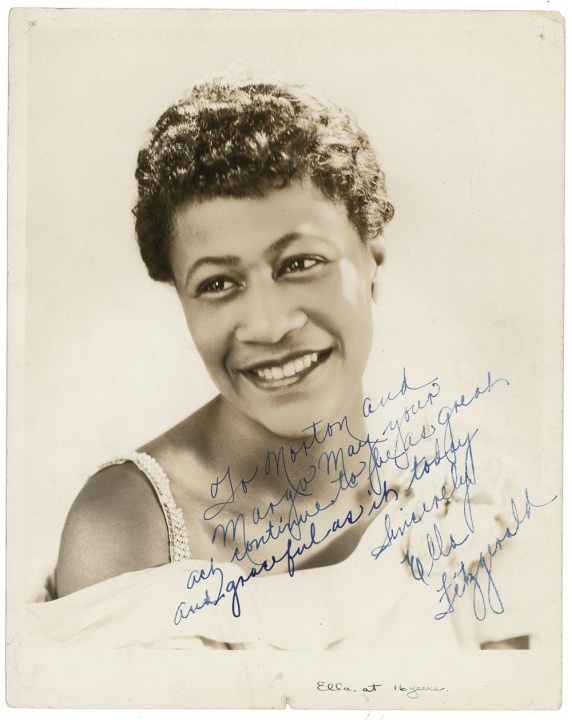
In late 1934, the seventeen-year-old Fitzgerald entered an amateur night contest at New York’s Apollo Theatre. She had intended to dance, but was frightened by another dancing act and decided to sing. Ella was a fan of the Boswell Sisters, especially the lead singer Connee, whose New Orleans-flavored style was a great influence. Fitzgerald ended up winning that contest, and found herself picking up singing gigs here and there.

In 1935 Fitzgerald was recommended to bandleader Chick Webb, who was looking for a singer. Webb is not well remembered today, but in 1935 his was the home band at the Savoy Ballroom in Harlem. A small man who suffered spinal problems likely caused by a childhood fall down some stairs, Webb became a powerhouse of a drummer and led one of the best swing bands of his day. Although Webb was initially put off by Fitzgerald’s looks, he came around and hired her and the young singer was soon a popular member of the band. Ella’s personality has been described as sweet and shy, and she got on well with her bandmates.
On June 12, 1935, young Ella found herself for the first time in a recording studio and this version of “I’ll Chase The Blues Away” was one of the two songs she recorded that day. It is a typical swing band vocal record which gives the band both the first and the last words, while the singer’s chorus is sandwiched in the middle. But among first recorded performances of those who became stars, there is nothing typical about Ella’s, which displays a voice, a style and a level of poise uncommon for an eighteen-year-old newbie.
Webb must not have been satisfied with this record because it was only released overseas and the song was re-recorded in October of that year for the version released here in the U.S. Those prone to rabbit holes can listen to it here. This record has a significantly faster tempo but shows that Ella had put the intervening time to use in polishing her chops.
This next example of Ella Fitzgerald getting her start is a fascinating one. This is a surviving version of a performance captured by the Radio Transcription Service in February, 1936. Transcription discs were intended to be played on the radio and were recorded with significantly higher fidelity than the 78 r.p.m. records pressed by the millions for retail sale and home use.
For those who are less prone to geeking out over the tech of the day, the performance shows Ella’s remarkable progress in less than a year with the band. I find this record remarkable in two other ways. First, it shows the way Ella’s personality could burst though a performance (especially from the 2 minute mark until the end), and may have been her earliest recorded use of scat-style improvisation. Finally, the recording’s final two measures displays the way this band and this singer were synched into a single unit in the way everyone could slide upward on the final note in a virtually perfect unison with everyone hitting that last note right on the money. This is a testament to both the singer’s skill and the level of polish that the Webb orchestra was known for.
Ella’s breakthrough hit with the band came out of a session on May 2-May 3, 1938. In a song on which Ella shared writing credit, this one was all Ella with very little room for the band other than to provide back-up for its star. The song was Ella’s idea, and she co-wrote the lyrics. She and the band practiced it for about an hour before they recorded it, and Webb had to argue with Decca executives in order to get it released.
Webb turned out to be right – this song cemented Fitzgerald’s fame, spending several weeks in the top spot on the “Your Hit Parade” radio show, and sold a lot of records for playing in homes and jukeboxes everywhere.
Tangent Alert:
Not that the band was incapable of more – an instrumental from that session (one issued as the flip-side of “A Tisket A Tasket”) shows what the Chick Webb was capable of when it was not showcasing its star singer. Yes, I know – I am supposed to be shining the spotlight on young Ella Fitzgerald, but I simply cannot ignore this fabulous band that could (and did) hold its own by going toe-to-toe with the best known bands of the day in bandstand battles with the likes of Count Basie or Benny Goodman. A second tangent is that Webb’s featured trumpet player was Mario Bauza, who later became the architect of the latin jazz played by Machito and his Afro Cubans (which we featured here).

But enough of tangents, let’s get back to our star of the day. Actually, that last tangent has some relevance after all because it shows us the quality of the music that surrounded Ella from the first time she got a steady gig on a bandstand. Ella always displayed a rock-solid sense of rhythm and swing to go along with that lovely voice, and this was undoubtedly due in no small part to her tutelage by the great Chick Webb.
We all know that Ella Fitzgerald went on to become part of America’s jazz royalty during the 1940’s and beyond. Sadly, Chick Webb was denied that fate when he died in 1939 from the spinal tuberculosis that had plagued him for much of his life. But after his untimely death it was Ella who was positioned as the band’s new leader, an organization which she fronted until disbanding in 1943 in order to pursue her solo career.
“Everyone has to start somewhere” is a well-known saying, and it is certainly true. But Ella Fitzgerald and her time with Chick Webb show us that some people start out at a higher level than others. Many jazz stars’ early recordings are more about providing context for later success than for enjoyable listening. As always, Ella Fitzgerald was the exception.
 J. P.'s Blog
Great Friday read, especially covering Chick Webb as well. Even when I can stream a decent jazz station to listen to, Webb is rarely covered and it’s a damn shame. Miss Ella, as well as Louis Armstrong, are two beloved titans that were on my radar, and getting television play, long before I fell in love with jazz in my early 20’s, and while I was still listening to British Invasion music on my ten transistor radio. An example of how they were viewed and loved by the general public before jazz seemed to become an esoteric sub group of music.
LikeLiked by 1 person
I think a lot of the bands of the 30s (even the best ones) have kind of fallen off the radar, and only those who were well known in the 40s-60s are still listened to. I have wondered how Webb would have evolved (as all of those musicians did) had he lived another decade or two.
I also think he falls into a musical crack. As leader of a band of black musicians, he never saw the mainstream success of someone like Tommy Dorsey or Artie Shaw, so never got to ride the nostalgia wave that kept those bands in memory at least through the 1970s-80s. At the same time, he was not just a niche jazz group, but played the music the dancers at the Savoy Ballroom wanted to hear, so (other than fans of his drum abilities) he was never fully adopted by the jazz people. Among the black bands, I think he may be the closest analogue to Benny Goodman’s among the white bands in terms of both playing quality and musical choices.
LikeLike
I think you’re really correct there. I think jazz people who played for people who liked to dance were sort of given the “skunk eye” by the early 60’s if they weren’t around to reinvent themselves. I tirelessly defend the Welk band, as one of the last touring “sweet” bands that people could dance to, and they made a niche for themselves, whether jazz people like it or not. Most jazz aficionados would balk at the name Lawerence Welk, but if you happen to catch a very early black & white kinescope of the band on PBS, they are most certainly “tearing it up”, and do some very hot numbers!
LikeLiked by 1 person
Well there I learned something again today, thank you. I don’t think I’d ever heard of Chick Webb, not the usual “jazz player dies young” story but perhaps even sadder than most.
LikeLiked by 1 person
It’s true, Webb had a lot of obstacles in his life but became fabulously successful in spite of them. It is too bad he isn’t better remembered, because he led a really great band right up until his death. I don’t think Ella had the personality or the experience to be a leader, and it is a testament to her star power that she kept that band going for several years after Webb’s death.
LikeLike
A fine essay. Ella was one of the best. As for her recordings, I especially like her Songbooks, and also the Porgy And Bess album she made with Louis Armstrong.
LikeLiked by 1 person
I have actually never listened to her Porgy and Bess album – I need to do something about that. I started listening to her backwards. I was a big Count Basie fan in the late 70s and my first taste of Ella was a live album the two of them had recently recorded. I started going backwards from there.
LikeLiked by 1 person
Another singer I thought I’d never heard before, but in listening to your audio selections I realized I had indeed heard “A Tisket, a Tasket” (though admittedly it was probably in connection with an Easter fixin’s ad). She was lucky to land a gig so young, even if it was not her intended dance routine at the outset – another example of being at the right place, right time as 1935 was big for Ella Fitzgerald.
LikeLiked by 1 person
Excellent backstory as usual. Thanks!
LikeLiked by 1 person
Happy to be of service!
LikeLiked by 1 person