Laura – A Multimedia Extravaganza
I have written about books I have read, and have regularly covered vintage jazz (and jazz-adjacent) music from the pre-LP era. I have also written, though not as frequently, about classic movies. Today will be the first time we combine all three topics into a single piece to cover a book, a movie and a song, all of which shared great success, and the same name: Laura.
I book I omitted from last week’s reading roundup is “Laura” (the mystery novel). Author Vera Caspary hated detective stories. Her opinion was that the murderer is the most interesting character in the story, but the plot of any murder mystery requires that person to stay in the background as much as possible until the very end. ”Laura” is different.
The basic plot is that a woman named Laura Hunt turns up dead in her apartment, and a police detective searches for her murder. As he delves into the crime he begins falling in love with her – or at least the idea of her. But then Laura Hunt turns out to be very much alive, and becomes a suspect in the murder of the dead girl who had been staying at her apartment.
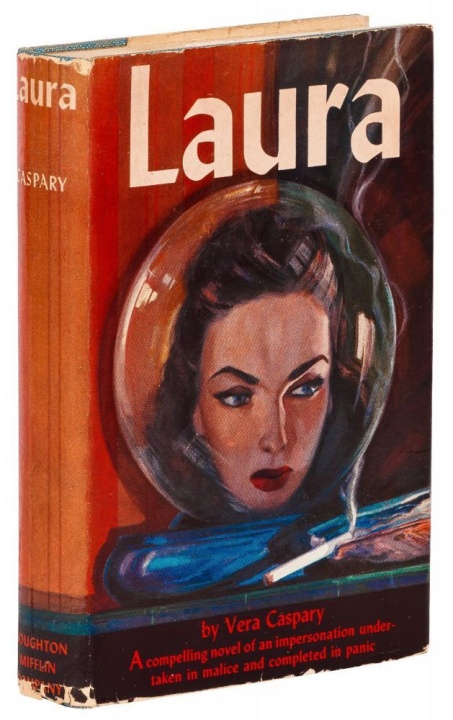
The novel is unique in that it the main characters rotate in the role of narrator so that several points of view are used. There is Waldo Lydecker, the fastidious and prissy man who has influenced and molded Laura into a woman of sophisticated tastes. Mark McPherson is the ace detective who is assigned the insignificant case by a vindictive superior. There is also Laura herself, who helps us understand her relationship with a fiancée whom she financially supports. That man is Shelby Carpenter, who possesses everything from his upper-class southern society upbringing, except that he has spent all of his money. He tells some of the story too.
The book was published as a series in Colliers Magazine in 1942 and in book form the following year. It was very well received, was printed in multiple languages, and has been reprinted multiple times over the ensuing decades. I will not spoil the plot (can that be done after 90 years?) but will say that it was an excellent and unique read. The title character was a very modern woman, with a successful career, a house in the country and a kept man. She was modeled, at least somewhat, on the author herself, who had a long writing career.
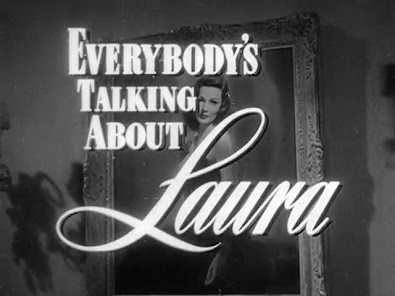
Caspary easily sold the film rights to Twentieth Century-Fox, which (after some inter-studio drama) turned the project over to director Otto Preminger. Preminger was a notoriously difficult man, but he could make a really fine film – and did so here. The 1944 movie probably eclipsed the novel in fame and in reception, with a nomination for Best Director and having won the award for best black and white photography. Although Caspary complained (and not wrongly) that the title character was shorn of most of her personality, the film works quite well in its own way.
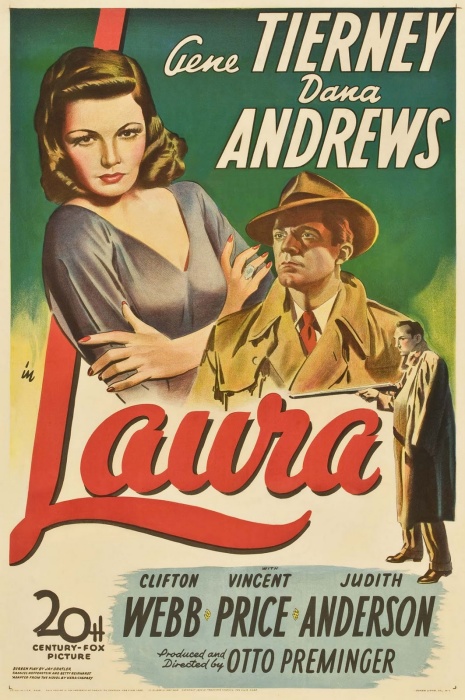
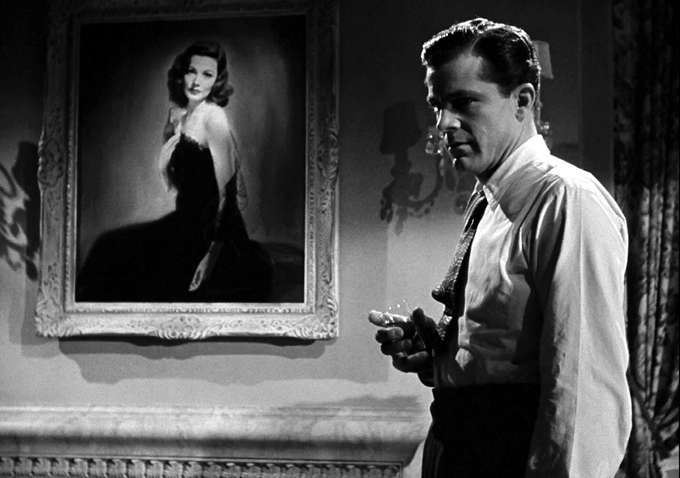
A young Gene Tierney was cast in the title role, with Dana Andrews as McPherson the detective. Note for modern readers unfamiliar with this era in Hollywood: Gene is the girl and Dana is the guy. The most memorable character may be Otto Lydecker as portrayed by Clifton Webb (best known for a series of movies as Mr. Belvedere). It is also interesting to watch Vincent Price from an era before he was typecast in creepy, ghoulish roles.
The movie skillfully wove story and mood into what is now regarded as a classic in film noir (a genre that did not really exist in 1944, at least by that name). The American Film Institute lists “Laura” as No. 4 on its list of the ten best mystery films ever made. I was able to rent it on Amazon for $3.99, and I heartily recommend it to anyone who likes a stylish mystery film.
The film’s greatest impact may have been in its theme music. David Raskin was tasked to do the film’s score, and wanted to use Duke Ellington’s “Sophisticated Lady” as a theme. Otto Preminger had other ideas, and gave Raskin a weekend to come up with something fresh. Raskin later recalled that the particular weekend was one in which he received a “Dear John” letter from his wife, which brought news that she was leaving him. The freshly-dumped Raskin related that the melancholy theme music practically wrote itself after that. It is interesting that none of the five Oscar nominations achieved by the film involved the music.
After the movie’s release, ace lyricist Johnny Mercer wrote words for the song, and it made a tremendous splash in both popular music and jazz, a splash which created ripples that are still being formed. The first to record the song was band leader Woody Herman in early 1945. Herman led a band that was very much a jazz outfit, but arranger Ralph Burns skillfully blended jazz flavorings into a lovely ballad. Herman’s version was a million-seller, which undoubtedly put it on everyone else’s map.
The arrangement is unusual in how the initial instrumental chorus (with Herman playing the alto sax instead of his usual clarinet) only makes it part way through the song before things reset and the vocal takes over. Herman himself did the singing as well, and while he will never go down as one of the great vocalists in history, did quite a good job of it here. The follow-up is a great combination of Bill Harris’ trombone and Marjorie Hyams’ vibraphone, and finishes with a touch more vocal and just the slightest touch of fire and brimstone at the end – because the Woody Herman band was as powerful as any of its era.
The first two instrumental recordings that treated the song as jazz (and not as the lush movie theme that it was) were also released in 1945: The first by a very young Errol Garner and his piano trio, and the second by tenor sax man Don Byas with his small group.
Errol Garner became a jazz fixture through the 1950’s and 1960’s, and is best known for composing the tune “Misty”, which was prominently featured in Clint Eastwood’s 1971 film “Play Misty For Me.” You can listen to the 1945 version here, but for my money, a 1951 recording by a more mature version of Garner is far superior. Errol Garner always played a lot of notes, but comparing the two recording shows that he grew out of his early “if more is better, lots more is lots better” approach.
Likewise, the 1945 version by Don Byas is quite good – and you can check it out. But this version which he recorded in France between 1950 and 1952 (as close as I can get for now) is simply sublime. I think tenor saxophonists who hit their stride in the mid 1940’s may have been the high water mark for a saxophone style that combined a lush, full bodied tone with a lyricism that made for music that just wraps you up in a soft velvet blanket. Byas was featured on several early recordings by Dizzy Gillespie and Charlie Parker, but this record makes it clear that Byas was not a natural beboper in the way that those two pioneering players were. Byas is not as well known as others because the late 40’s saw him permanently decamp for Europe, were he lived and played for the next quarter century.
The number of jazz players who have recorded “Laura” is virtually innumerable, and some research shows that it has been a go-to in pretty much every decade since the song’s 1945 introduction. A person could get lost chasing “Laura” through online recordings. But I could think of worse fates.
An interesting side note has to do with the popularity of “Laura” as a name for baby girls. It had been a popular name in the early 1880’s (think Laura Ingalls Wilder) but then faded, and even fell out of the top 100 names for baby girls by the 1930’s. But the name jumped to 77th place in 1945 and continued an upward trend until the early 1960’s, when an entirely new musical ethic was influencing new mothers Including “Lara’s Theme” from “Dr. Zhivago” that resulted in quite a lot of baby girls being named Laura-without-the-U.
It is not unusual for a book to lead to a movie, or for a movie to lead to a hit song. It is unusual, however, for the book, the film and the song to each be both very popular and also of such high quality. It is even more unusual for each to have stood up so well to the grinder of pop culture that is measured by a succession of calendars. There may be other book-film-song trifectas that have been as good and as durable, but I am not thinking of them at the moment. What a great time to be alive, when a trio such as this is available for consumption on demand.


One of my favorite films and songs! Those of us lucky enough to live in a city that has a Movies! Broadcast channel (49.2 in my town) will find Laura in fairly often rotation on their Noir Days (all day Thursdays, and Sunday evening). In retirement, during the winter, I actually changed my laundry and cleaning day to Thursdays, just to stay in with the channel playing all day! Clifton Webb is his Clifton Webbiest, and Vincent Price is a delight in a role people from my generation rarely saw him in. It’s worth saying here, that I gained a far greater respect for Price for his portrayal of a ham actor who steps up to hero status in the quirky 1951 thriller: “His Kind Of Woman”, with Robert Mitchum and Jane Russell. Russell here, being her femme fataliest!
LikeLiked by 1 person
I came across an interesting backstory on the movie. The head of the studio (Daryl Zanuck) hated Otto Preminger, and allowed him to be a producer of Laura, but not to direct it. After the other director (Roubin Mamoulian) kept trying to take things in another direction with casting and script re-writes, Zanuck finally allowed Preminger to take over directing. Clifton Webb was by then a Broadway guy, and had not acted in a movie since 1930. Webb was Preminger’s idea and Zanuck agreed that he fit the role perfectly. The original director had cast Laird Cregar in the role. But Preminger thought that his having recently depicted Jack the Ripper would give the plot away. It is hard to second-guess any of Preminger’s choices in this movie.
I agree that there is a lot to like in Vincent Price’s early film work. Personally though, I think that Zachary Scott would have made a better Shelby Carpenter. Scott elevated the smarmy pretty-boy character to a high art. But Price was not at all bad in the role.
“My Kind of Woman” is a great movie!
LikeLike
I think Laird Cregar would have been a miscast, but I have to say, I’m a huge Cregar fan! I wonderful actor whose life was cut short!
LikeLiked by 1 person
I have seen the movie but was not aware of all the back story. I need to watch it again!
LikeLiked by 1 person
I recommend it! And if you do, you will certainly recognize the theme music.
LikeLike
Wow – a triple whammy for me JP since I had not heard of “Laura” in any way, shape or form. How sad is that given the choice of a book, song or a movie, but, on a bright note I did know that Gene Tierney was a woman and I’ve never heard of Dana Andrews. Thank you for making me aware of “Laura” and I just looked and it is available for streaming on Amazon Prime, so I will have to try it sometime.
LikeLiked by 1 person
If you like stylish mystery/detective yarns from that era, you will like it. I know, I live in the past. 🙂
LikeLike
Yes, well the past is good JP … they say anything that thrived in the past will come around again, styles, especially.
LikeLiked by 1 person
Another book to add to my “To Be Read” pile. I had heard the Woody Herman version from a couple of different places but, of course, I like this guy’s version best of all:
LikeLiked by 1 person
Haha, I wondered if anyone would bring up the Spike Jones version! I thought about mentioning it, but decided that it was an unnecessary tangent. Glad you did, though!
LikeLiked by 1 person
I love Spike Jones. and Allan Sherman. And Weird Al. And a few others that are more obscure.
LikeLiked by 1 person
I had “Rebecca” and Laurence Olivier on the brain until I was well into your description of the plot. I was surprised I recognized the theme music (since I hadn’t heard of the movie or the book) but your mention of countless recordings over the years made it seem more likely to have heard it. I listened to each of the versions you posted but it wasn’t until the Erroll Garner Trio that I recognized it (and maybe because I’m partial to the piano). Anyway, the story is intriguing and your recommendation strong, so I downloaded a free sample of the book from Amazon. Thanks!
LikeLiked by 1 person
Glad you found it of interest. I would be interested in your impressions of the book – the movie and the music seem to be consumed far more frequently.
LikeLiked by 1 person