Ring A Ding Ding – The Album That Made Me A Sinatra Fan
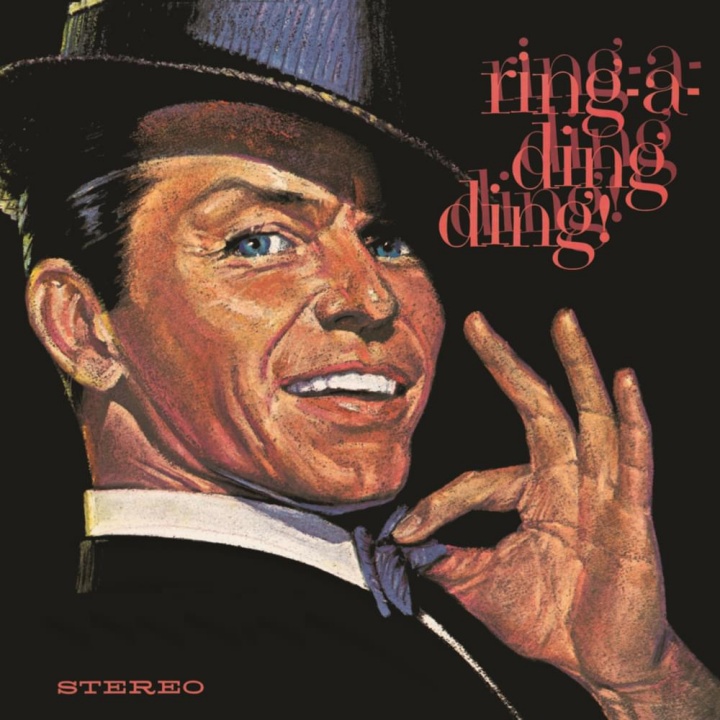
Frank Sinatra had a long career, one that spanned several musical eras. Today’s music fan can pick and choose from among them, from his early days as Tommy Dorsey’s “boy singer” to his triumphant “New York, New York” period in the early 1980’s. As a kid who grew up in the 1960’s, the Sinatra of my youth was the aging balladeer who was trying to navigate the post-Beatles world of popular music.
AM radio was still a thing – neither of my parents had a car that picked up the FM band until the early 1970’s – and the big AM station of my childhood was a middle-of-the-road powerhouse called WOWO. Frank Sinatra was a regular on their playlists, with songs like “It Was A Very Good Year” (1965), “That’s Life” and “Strangers In The Night” (1966) and his 1967 duet with his daughter, “Somthin’ Stupid”.
In my adolescence I became tuned into jazz. I had never thought of Sinatra as a jazz singer. He had been a crooner as a young star, and in his maturity he seemed to revert to his roots as a balladeer, though one with a thickened and huskier voice. I thought of Francis Albert Sinatra in much the same way as I thought of Elvis Presley – a pop music phenomenon in youth who transitioned into a nightclub performer for older listeners. Sinatra’s string of classic albums from the 1950’s (with his often-collaborator Nelson Riddle) might have modified my view, but my sole exposure to 50’s Sinatra had been a single album of ballads that had been in my mother’s music collection (“Where Are You” from 1958). That exposure had buttressed my view that Sinatra had always been a popular balladeer and little more.
I was in college when a friend’s brother became a big Sinatra fan. Based on my experience, I didn’t really understand that and could not see his enthusiasm as anything other than a way to become counter-cultural after the first kind of counter-cultural had become mainstream. What changed my mind? Listening to the album “Ring A Ding Ding”.
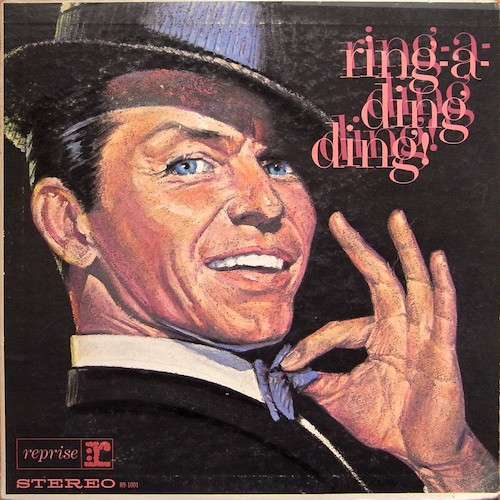
Released in 1961, this is an album that is often overlooked. The 50’s albums with Nelson Riddle on the Capitol label usually soak up the spotlight for those who love “Rat Pack Sinatra”. And for good reason, as there is a lot of great music there. But Sinatra had chafed as his contract with Capitol was concluding, and his final albums for that label seemed “phoned in” as he was making preparations to launch is own label – Reprise Records. This album was the very first Reprise release – for Sinatra or for anyone else.

Sinatra initially had wanted Nelson Riddle to do the arrangements and direct the orchestra, but Riddle was tied up with projects (and a contract) for Capitol. There was he same problem with his other favorite collaborator on up-tempo projects, Billy May. It was then that Frank reached out to a young jazz guy named Johnny Mandel. Mandel was in his mid 30’s (and about a decade younger than Sinatra), and had played both trumpet and trombone in some name bands of the late 1940s and early 1950’s, including a 1953-54 stint with Count Basie. Mandel had also attended some music schools and was a skilled writer/arranger, which landed him in Hollywood to do film work in the late 1950’s. He is probably best known today for having written the theme for the movie (and television show) M*A*S*H.

In a 2008 interview, Mandel recalled that he had come to Sinatra’s attention through some arrangements he had done for singer Vic Damone for a show in Las Vegas. Sinatra summoned Mandel to a meeting and things went from there. The album concept was for a jazzy, up-tempo vibe, and Mandel was encouraged to do is own thing rather than try to emulate what Riddle or May might have done. I had never known until researching this piece that Mandel got pressed for time and had to subcontract a few of the arrangements, and that he was not wowed by the results. But then name a creative type who thinks someone else can do his project better than he can.
Picking samples from this album would have been hard – everyone knows great albums that have “that one song” or “that one track” that we could have done without. Ring A Ding Ding is not one of them, and every single track is well above average. Johnny Mandel himself came to my rescue and named his favorite three arrangements on the album, so that’s settled.
“Ring A Ding Ding” (the album) followed a familiar pattern of a new title song, followed by new treatments of standards. ”Ring A Ding Ding” (the song) was the album lead-off, written by Sammy Cahn and Jimmy Van Heusen – a team who had penned several Sinatra hits. This song sets the mood for the entire album, and shows Frank Sinatra at peak swagger. He was undoubtedly excited to be the literal chairman of the board for the new record label, and this arrangement (and others like it) punched harder than anything he had done. Musically, I mean.
Frank Sinatra started his career in front of the top big swing bands of the big band era, so the ability to feel that style of music went deeply into his bones. Mandel’s arrangements and this band’s performance showed that when a band could punch fast and hard, Sinatra was every bit up to the task. Or perhaps it was Sinatra at the peak of his ability to punch fast and hard that brought the band along with him. I will not pick a side here, but will go with this being a great synergy.
Next up is “In The Still Of The Night”. Some of Sinatra’s best work was done with Cole Porter songs, and this one is no exceptions. But this time, Mandel turned the song from a mellow crooner’s delight into a hot treatment that works despite the way the lyrics might suggest a more tender approach.
As with many things by Cole Porter, it is a fairly complex song that offers plenty of places for both singer and band to shine. For those who came of age after the age of the LP record album, the order of songs could be almost as important as the song choices themselves. This track finishes out Side 1, and was a strong finish that urged the listener to flip the disc to Side 2 for more good stuff. This track accomplished that role, and then some.
In the same way, the opening song of Side 2 had to help the listener overcome the inertia of a comfortable chair and (maybe) a martini – this was the job of “The Coffee Song”. This was an old chestnut that Sinatra had been the first to record after it was written in 1946. Sinatra was then at his peak of popularity as a solo artist, but he was still a young crooner who excelled at a more relaxed pace. The 1961 version of the song is so, so much better.
The song itself was probably written as a throw-away in an era when pop songs were churned out with great rapidity, and Frank’s early version was fun, but not one of his more memorable hits. This time was different, and I count this as one of Sinatra’s very best up-tempo recordings of the era. Listening to Sinatra interact with a really good band is always a delight, and they do not disappoint here. As an example, listen to the line “You-can’t-get-cherry-soda-cause-they’ve-got-to-fill-that-quota” and you can detect the way the singer is just a fraction of a beat ahead of the band, as if to pull them along, while at other places (like the following line) he is smack dab on the beat. I could listen to this record a hundred times in a row before I would tire of it.
Frank Sinatra’s career seemed to follow two conflicting arcs. First was that of his amazing voice, an arc that began with almost vocal perfection in his youth, and which slowly lost its range and elasticity as the performer aged. The second was in his style, which started low as a garden-variety band crooner and which built over the decades in ways that made the man wholly unique in his abilities to craft a song into his own.
The album “Ring A Ding Ding” may have been where those two arcs crossed. This was not the young singer whose lovely voice floated above a hard-swinging band or the older singer who used style and personality to overcome a voice that had lost much of what had made it special. All of life is a compromise, but this record is a compromise between voice and style that is worth a listen. It also proved to me my gateway drug for an appreciation of Frank Sinatra and the entirety of his amazing career.
Note – there is a good 2008 Interview with Johnny Mandel, found at https://www.jazzwax.com/2008/10/interview-joh-5.html
 J. P.'s Blog
Never much of a Sinatra fan, altho there’s no denying his abilities and place in the pantheon! My mother actually liked Dino better than Frank, I think she liked the romantic crooning better; and Frank seemed to have a stigma for my parents, left over from his popularity with the Bobby-soxer era, endlessly made fun of in era-appropriate cartoons (Frankeeeeee!). Also no denying he straddled the popular music and jazz world, tho.
Couple of things I’ve always felt. If you want to hear the actual state of the art of magnetic tape recorded music, the mid to late series Sinatra records are the pinnacle. Pristine vinyl albums from that era on a high end turntable are stunningly beautiful. Those in-studio albums with high-end RCA ribbon mics and German Neumann mics, recorded on magnetic tape running at 15 or 30 ips are just sonically in a class by themselves!
The second thing you kind of touched on, is where are those “adult” music radio stations of our youth? I get in this discussion every once in a while and was in one just recently. Even in my teens and twenties, there were stations that played not only Frank and Dino, but Bert Kaempfert, Percy Faith, Ray Coniff, 101 Strings, Paul Mauriat, and of course, Burt Bacharach. I was most certainly listening to rock, especially prog rock, in my youth, but even before what I consider to be bad “hair” band arena rock drove me into jazz, I used to be a “secret” listener of my Dads style radio stations to hear what I considered to be the sophisticated adult music of Burt Bacharach and others, especially in the late evenings when they played a very smooth program! My city hasn’t had a full time jazz station since about 2005, and I say it’s time to brings these two formats back to my town!
LikeLiked by 1 person
My mother was never much of a fan either. She was in high school when he was in the doldrums and clearly a fad that had aged out of relevance. Nor was she much into jazz, so my jazz tastes didn’t get much feeding at home.
And yes, “adult radio” definitely died. Or at least adapted to ever younger generations of adults who came of age in the rock era.
I agree completely on the quality of those records, with the exception of Capitol Records early versions of stereo, that were just poorly engineered.
LikeLike
Good point about the two arcs. I can’t imagine there’s a lot of performers who managed such a feat.
However, I’m more of a Bob Dorough fan on the coffee song.
LikeLiked by 1 person
DougD, thanks for the Bob Dorough lead. I knew of him, but very little, and a trip to wiki to read more was amazingly informative of a fabulous career I knew little about!
LikeLiked by 1 person
That was a fun addition, and one I have never heard! His new lyrics are every bit as good as the originals.
LikeLike
I have come to appreciate Sinatra but for a long, long time I did not understand what all the hoopla was about. I just didn’t think his voice was anything special. He was just some man who sang like any man could, one who could carry a tune anyway.
Thank you for sharing these recordings. Whoever mixed them did a brilliant job of creating a sound stage. Sinatra is at the center, surrounded by the instruments – to his left, to his right, and even behind him.
LikeLiked by 1 person
it is true that these recordings were very nicely done. Beyond that, I still crave the sound of a loud, powerful big band sound I loved in my teens and 20s the same way others still love the heavy metal music of their youth. This record still delivers the goods for me.
LikeLike
You could not be my age without getting regular doses of Frank Sinatra. I enjoyed him and he was an icon, but I guess he was too much part of my parent’s generation for me to get too excited. Of course, my musical tastes are not as sophisticated as yours. I always enjoy your research.
LikeLiked by 1 person
Thanks – I started out the same way, thinking of him as “parent music”. I am not sure my tastes are more sophisticated, but they are certainly out of the ordinary (or weird) for my age. What a great time to be alive, with virtually every kind of music available for a few mouse clicks.
LikeLiked by 1 person
Good observation. How amazing that so much music is so accessible today!
LikeLiked by 1 person
For those looking for an “adult” station, try Pandora’s “Mantovani Channel.” It plays many of the artists that Andy Umbo cited in his first post.
LikeLiked by 1 person
A, thanks for the recommendation! I recommend internet stations like Arctic Outpost as well, for vintage 78’s, but it’s still sad there isn’t any advertising funded local radio near me playing these, and jazz programming. I actually hate the idea that everything is now on the internet, which means I basically have to have a computer running for everything, and I have no local DJ spinning and telling me about the local scene. Jazz, and other, has gotten so small in my area now, and the internet so ubiquitous, that no one even tries to fund a local broadcast station…
LikeLiked by 1 person
I really enjoyed these pieces, especially the last one.
LikeLiked by 1 person
Thanks, Herb! I always like it when my random musical thoughts get a good reception and am glad to increase the total amount of enjoyment in the world. 🙂
LikeLiked by 1 person
When I was a kid, had to be explained to me by my parents!
LikeLiked by 1 person
JP, I have never really been exposed to Frank Sinatra’s music unless you touched on it here. I am familiar with the songs you mentioned in your second paragraph, especially the one with his daughter Nancy. My parents did have albums which they listened to on the weekends and they really only liked the “real” country music crooners (Hank Williams, Sr. or Hank Snow and Patsy Cline or Loretta Lynn). Not the modern country – they were not fans. I could sing along to Mitch Miller or Jim Reeves’ music now as I likely know all the words to this day and it’s been four decades since I heard any of those albums played.
As to the song “Ring A Ding Ding” off this album by the same name, I had to smile at the line: “She takes your hand, this captivating creature and like it’s planned, you’re in the phone book looking for the nearest preacher.” Life was swell back then wasn’t it?
LikeLiked by 1 person
Yes, the lyrics of those old songs was a cut above, especially when they came from the pros.
As for the parents, my father was never much into music at all, while Mom’s tastes ran more to easy listening and light classics. Country was wholly absent from my house, but I have come to enjoy some of those old-school country songs.
LikeLiked by 1 person
I was exposed to different types, so I had some variety. My parents weren’t keen on my music choices. I had to wear my headphones when listening to music so I had to sit cross-legged on the floor as the headphones cord wasn’t very long. 🙂
LikeLiked by 1 person
He’s no Sinatra but I can’t help hearing Michael Buble when I hear these songs. Whether voice or style, I draw the parallel because I’d put myself more in Buble’s era than Sinatra’s. Regardless, I enjoyed the snapshot education on a singer I’ve really only ever known for “New York, New York”.
LikeLiked by 1 person
Happy to help! 🙂
I have not listened to a lot of Buble, but the parallel is undeniable.
LikeLiked by 1 person