Summer Turns To Autumn – With Help From Woody Herman
I live in a place where we experience all four seasons of the year. My personal favorite is Autumn – at least since I quit being a full-time student and autumn meant the start of a new school year. Each of the other seasons has its high points, and I can understand the attraction others may feel towards them. Winter brings us indoors to cocoon near a warm hearth. Spring brings us outdoors in a colorful burst of renewed life, and summer is the time for recreation and vacations.
We spend less time thinking about those uncertain periods when one season transitions into another. By the end of November, fall is spent but winter is yet to begin. The start of March can be both winter and spring, or it can be neither. And who can tell when, precisely, spring ends and summer begins? We are in another of those transitions right now. The leaves are still green and attached to their trees and the daytime temperatures can be quite warm. Yet cooler days (and much cooler nights) are upon us to let us know that autumn is knocking on the door.
There are plenty of songs that we can associate with seasons. There are far fewer musical associations with those transitions between seasons. Today, however, I bring you two of them which are tangled together in a way that makes it almost impossible to consider either of them on its own.
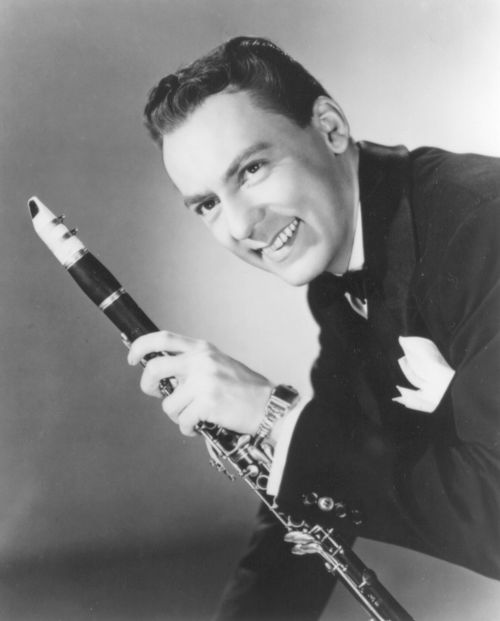
Woody Herman was a clarinet-playing bandleader during the peak of the big-band era in the 1930’s and 1940’s. That era knew two titans of that niche – Benny Goodman and Artie Shaw. Both Shaw and Goodman were extremely competitive and agreed about few things, but one of them was that Woody Herman was not in their league as a player of the clarinet. They may have been right, and Herman’s popularity outside of the top tier of hit bands was confirmation of that fact. But where both Shaw and Goodman lost influence after WWII, Herman’s trajectory went in the opposite direction, and he became one of the most influential bands of the time.

The Herman band of 1945-46 has become known as “The First Herd”, and was a hard-charging, bop-influenced band full of top musicians. The band also boasted a top-flight young writer and arranger by the name of Ralph Burns.

The Herman Band was booked for a concert at Carnegie Hall in mid 1946, and one of the pieces to be performed was a piece written by modern classical composer Igor Stravinsky. The band needed some additional material for the concert, and Burns came up with a three-part piece that ran about nine minutes and was called “Summer Sequence”. The band recorded it in September of 1946. It is not an unpleasant listen, but it is also not well remembered. Then, within a few months Herman pulled the plug on the band for reasons most likely due to his wife’s worsening alcoholism.
Herman came back the following year with a new band (the Second Herd) that had significant changes in personnel. Late in 1947, Herman asked Burns to work up a fourth part of Summer Sequence that would feature his band’s new sound. What became known as “Summer Sequence, Part IV” was recorded December 27, 1947, and is the one that really had some legs.
The record begins with a theme developed in Part I of the earlier work. But where Parts I-III are OK pieces of music, Part IV is one of the most lyrical works of its era. Of any era, really. The piece is mostly a showcase for the trombone of Ollie Wilson and the tenor saxophone of a twenty-year-old Stan Getz, with Herman playing an alto sax between the two. That Getz solo (starting at about the 2:00 mark) is one of the loveliest I can recall.
To me, this recording does a marvelous job of capturing that seasonal transition from summer to autumn when we know that summer activities are coming to an end. It is not hard to imagine a still warm day at a nearly deserted beach when listening to Part IV, or maybe a cool evening on the porch when you have to debate yourself on the need for a sweater.
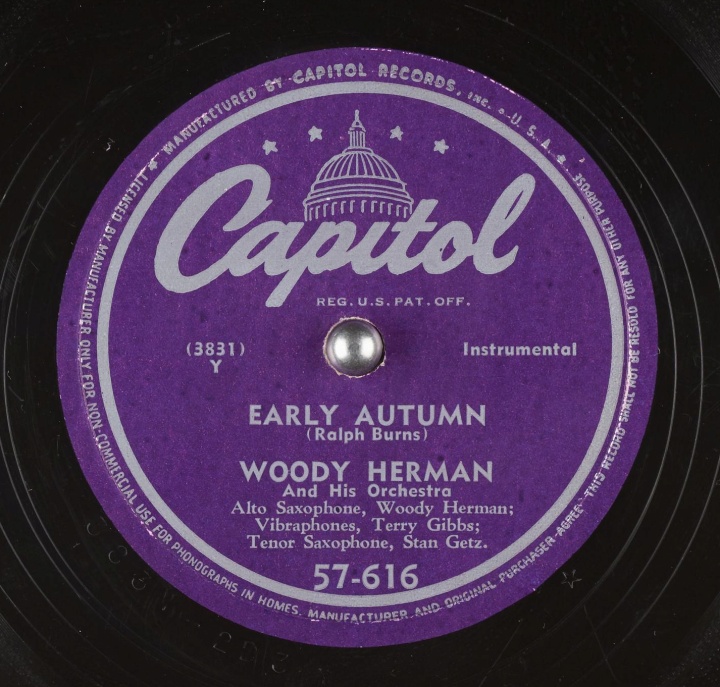
The following year, Burns took hold of the final phrases of “Summer Sequence Part IV” and built a new piece from them – it was called “Early Autumn” and was recorded December 30, 1948 – not long after Herman moved from Columbia Records to the Capitol label. This is another performance that is truly evocative of the season from which it gets its name.
As in the earlier record, Herman trades his usual clarinet for an alto saxophone, and Stan Getz provides another of the performances from which he made a decades-long career. One change from Part IV of Summer Sequence is the addition of Terry Gibbs’ vibraphone to the list of soloists.
I have a hard time trying to decide which of these two pieces does a better job of turning a brief part of the calendar into music – or which one I enjoy more. The happy conclusion is that such a decision is unnecessary. Each of them does a fine job of capturing a time of year that is a little of one thing yet a little of another. Both of these recordings have been favorites of mine for a long time, and it is at this time of the year when I am happy to remember them again.
(The entire 4 parts of “Summer Sequence” (Parts I-III from 1946 combined with Part IV from 1947) can be heard here).
 J. P.'s Blog
Ditto with the idea of fall being a favorite season. Most of my childhood memories revolve around overcast and cool days, leaves on the ground. Even love fall cloths the best, including tweeds and cords. When I was still a young lad, the big band era was long gone, but Woody Herman was still in play, and some form of his band was still touring. My parents, of course, would talk about Glen Miller and the Dorsey’s, but Woody was still there and available. BTW, I never discovered this until my 30’s, but those interested in a sort of melancholy fall and winter theme music should really listen to the Jackie Gleason orchestra offerings. Makes you wish you had a hot toddy, a fireplace, and was looking at the leaves falling outside your window.
LikeLiked by 1 person
Yes, Herman led some pretty adventurous bands for a long time.
Not many could play things so hard and loud and be equally adapt with things like these.
I need to dive into a Gleason album some time. I think he featured the trumpet of Bobby Hackett, who had a gorgeous, rich tone.
LikeLike
Yup, autumn is my favorite as well. At least the dry cool fall with leaves underfoot. This is some wistful fall music for sure.
Are we doing Barney Kessel’s Autumn Leaves next week?
LikeLiked by 1 person
I keep thinking about something about Barney Kessel and not doing anything about it. An excellent suggestion, though probably not next week. The leaves won’t be falling much here before mid October. 🙂
LikeLike
Thanks for introducing me to these pieces. I’ve never listened to much of Woody Herman’s music. My loss.
LikeLiked by 1 person
He put out a lot of good stuff, especially in the first decade after WWII.
LikeLiked by 1 person
I like the vibraphone part best!
We call the season “Fall” because the leaves can fall down quickly when the snow falls on them…
The leaves have mostly (and quickly) turned color here and we had the first frost this morning. Forecast is for possible light snow tonight or tomorrow. We might still get an ‘Indian Summer’ after the first snow, though that is probably not the correct term to use anymore and the whole thing might get ‘cancelled’…
LikeLiked by 1 person
You are about a month ahead of me. I have to get some grass cut this weekend!
LikeLiked by 1 person
Autumn is my favorite season as well JP, even though it is the precursor to Winter. I love everything about it, from the food, to the change of clothing to match the chill in the air and of course the colorful leaves. We have similar weather to yours here in Michigan, so the leaves are just starting to turn – the best is yet to come. That was an appropriate song to preview with this post and it was a first time for me hearing Woody Herman’s music.
LikeLiked by 1 person
You are probably a little farther into Fall up there than I am. I look forward to “real fall”, when the more typical autumn sights and activities start. Like Christmas trees on display in the stores. 🙂
LikeLiked by 1 person
Yes, that is true JP. I would miss having the four seasons to be honest. The back-to-school stuff is whisked away to put out Halloween costumes, decor and candy, then all that disappears on November 1st for the Christmas decor and goodies waiting in the wings.
LikeLiked by 1 person
A couple of nice pieces. Do you actually walk around with all of this knowledge in your head or do you have to look a bunch of stuff up?
LikeLiked by 1 person
I walk around with far too much of it, but I need to do research, too. I imagine this stuff displaces quite a bit of more useful knowledge.
LikeLiked by 1 person
Well, I always learn something from it when you do these.
LikeLiked by 1 person
Wonderful Autumn music. I love the season except I know it surrenders to Winter in the end.
LikeLiked by 1 person
It is unfortunate that every silver lining comes with a cloud.
LikeLike
The imagery comes easily here. The meandering melody has me on a sun-dappled path in the forest. Then the vibraphone shows up as falling leaves. That’s my interpretation and I’m sticking to it. The vibraphone is a middle school memory. There were three pianists and one piano for the orchestra, so two of us took a shot at drums, vibraphone, and other instruments. Didn’t go so well 🙂
LikeLiked by 1 person
Haha, I love the vibraphone story. I had not thought of it as falling leaves, but I can see that now. I love the rest of the imagery you came up with, too.
LikeLike