Jump-Starting An Old Highbrow Habit
I wrote fairly recently about one of the changes my new lifestyle as a professional driver has brought – long stretches of time suitable for audio books has re-ignited my love of recreational reading. It has now brought me back into something I failed to keep up on perhaps thirty or more years ago.
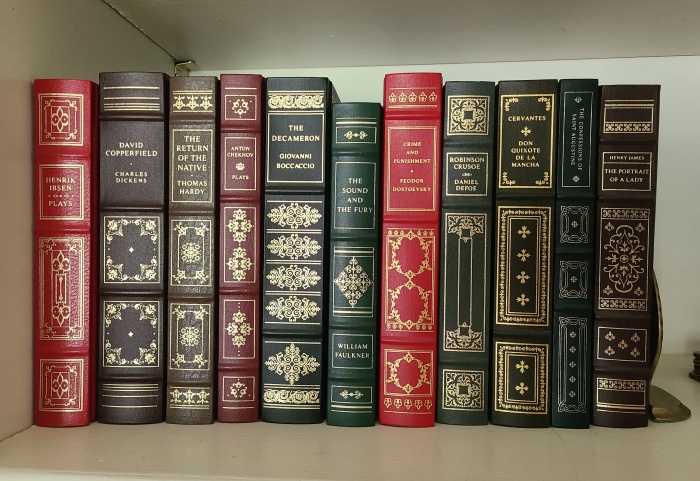
When I became a newly-minted attorney in the mid 1980’s, nobody was more proud of my accomplishment than my mother. Mom had her idea of what a successful attorney’s home should look like, and part of that idea was shelves of books. And not just a bunch of jumbled paperbacks and pop-psychology best-sellers, but highbrow books with expensive-looking bindings.
I think it was around 1986 or so when Mom got an ad or something in the mail from The Franklin Library. It was a publishing division of The Franklin Mint, which offered “collectibles”, such as commemorative coins, high-quality small scale-model cars, and such. They were offering a series of fifty classic titles, with gilded edges and high-quality bindings. You would get (and pay for) one book each month.
Mom presented me with the information and made me a proposition: she asked if I would go in with her to split the cost of the books 50-50, with the two of us alternating on which would pay the monthly bill. “You can keep the books at your house, and I can borrow them from you to read from time to time.” What this actually meant was “I really want you to have these, and will pay half to make it happen.”
We went through that exercise for probably two years, until one month I received a letter that said, essentially, “Look – you have been paying for and getting these books at a rate of one a month. We’ll make you a deal – you pay us $XXX now and we’ll send you the rest of the books in the set all at once.” There was a discount involved, so we took them up on it. Meaning that we split the price. But I got all the books.
My mother never did ask to borrow one of those books. Her work was done once they were on a shelf in my house. I, however, had much to do. Having been through high school in the second half of the 1970’s, I always felt that I had been shortchanged just a bit by an education in world literature that was not terribly rigorous. It seemed that the books in this collection were the kinds of books that a well-rounded person who professes some level of literacy ought to have read. Shouldn’t an educated person at a wine and cheese party be prepared to contribute to a discussion of Chaucer’s “Canterbury Tales” or maybe some plays by Henrik Ibsen? And so I began.
I probably got about a third of the way through the “high-class books” on my shelves. Although it became necessary to read a fun palate cleanser between them – a spy novel by Tom Clancy, or maybe some historical non-fiction. Some of them were easier to read than others, but some were quite memorable. I particularly recall reading Augustine’s Confessions. St. Augustine’s was an early Christian writer who lived in the decades either side of the year 400 A.D. His writings proved to me that people in the year 400 were not too different from people in the year 2000. The only difference was probably a much slower pace of life, which led to a style of writing geared to readers far more patient than most of us in the late twentieth century.
But then marriage and family life got in the way. It never seemed like a great idea to suggest to Marianne “Hey, let’s sit in the same room to read books and not interact at all.” And “Moby Dick” was not the kind of thing that could be consumed while in the bleachers of a 4th grade boys’ basketball game. The project pretty much ground to a halt and the books in my little oasis of culture have not been touched in decades, but for the occasional need to dust them.
But this past week I am back in the game, having finished an audio version of Dostoyevsky’s “Crime And Punishment”. Published in 1866, it is considered one of the great Russian novels. It was a slow starter, due in part to my intense dislike of the primary character, Rodion Romanovich Raskolnikov, whose self-absorption and laziness was made worse by his sense of entitlement. He determines that he is among the rarified class of humanity to whom ordinary rules do not apply, so that he is perfectly entitled to murder an old pawnbroker so that her money can be used for higher purposes. After working through my distaste for the character, I eventually became quite engaged in the complex story, re-learning the lesson that times change but humanity does not.
My new goal is to line up audio versions of my unread classics. As before, these reads will be broken up by lighter, selections that are lower of brow and (hopefully) more fun. Will I be the only driver of a tractor-trailer engaging with a cross-section of classic world literature as I hurtle down the nighttime highways? Quite possibly. But then, I have never been very good at being normal.
Photo by the author.
 J. P.'s Blog
Amusing, I do think back then our parents wanted beautiful books on the shelves. Fast forward to today where we read books on Kindle or Ipad and listen to audio. I’m sad to see the printed books go away.
LikeLiked by 1 person
I agree. I have far too many shelves filled with books at home. Wait – is there such a thing as too many books? My children will think so if the filled bookshelves outlast me. 🙂
LikeLiked by 1 person
When I was a kid growing up in Chicago, you could get a library card the minute you could sign your name. My Mom made us sit down and practice our name and I’m sure I had a card by the time I was three or four, and we went to to local library every week. To this day, I still go at least a few times a month. When I lived in Zionsville Indiana, I even lived two blocks from the library and went almost daily. There are years I’ve read 75 books, and usually track between 40and 50 a year. I have had trouble over the years hauling my books around the country to different jobs, and sold about 80% of them back in 2007. This year, I’m determined to set myself up for my death, and hence have been getting rid of everything In my storage space. I just donated over 60 books to my local Wauwatosa library, which leaves me with 3 book cases of books I just cannot shed myself of. Starting about 20 years ago, I’ve tried to get the books I want to read from the library, and save myself the storage and cost. Unfortunately, this only works when you live in an educated part of the country with a long history of library support; which is why I’m living back in Wisconsin, where my library will buy virtually any book you request.
Reading is not “high brow”, in many cases in the past, it was the only way to disseminate a wide variation of ideas, experimental and otherwise. The media only disseminates ideas that can be paid for with advertising. You can make the case books are getting like this, but there’s still a lot of leeway for alternate ideas. 50% of this nation are imbeciles, and from the polling results I’ve read parsed out, what they don’t like about the other 50% of the nation is that they are educated. When I lived in Washington DC, I was told that if you go on a first time date, and went to your apartment, and you had zero books around, that would probably be the last time you’d go, a very negative first impression. Maybe that’s why I liked living there. I have to laugh when you described sitting in the same room with your spouse reading, because that’s exactly what was going on with my last fiancé, in between mixing cocktails and passing the Sunday NYT crossword puzzle around! A civilized society. We weren’t home streaming Duck Dynasty or Bachelor shows.
One of my favorite authors has always been F. Scott Fitzgerald, and I’m always glad to see he’s usually in the top ten of any of those reading lists they publish. I actually always have a copy of Gatsby in my glove compartment in my car. BTW, if a person thinks reading, and talking about ideas, is “snobbing” people, you are part of this nations current problem!
View at Medium.com
LikeLiked by 1 person
I do not mean to suggest that reading is a highbrow activity, but reading “the classics” seems to be. My mother grew up on a farm, but her family was full of intelligent people and they were readers. My father grew up on the toney Philly Mainline suburbs – he was highly intelligent, but was never much of a reader, mainly because he struggled a bit with it. My mother always claimed that, as a rich kid in private schools, he was subjected to “progressive” ideas about teaching kids to read. True or not, he never read for enjoyment that I ever saw.
I don’t think that half of the population hates the other half because they are suspicious of education – I would argue, though, that too many with educations are educated in ways that 1) make them quite sure that they are superior to everyone else in everything and 2) make them quite sure that their expertise in one esoteric field makes their opinion important in every other topic. I am fairly well educated myself, and those people really irritate me too. But I had best stop before I wade into my opinions about the product that the modern higher education system churns out. Let’s just say I have doubts about how many modern college students will ever read any of the books that are on my “high class” bookshelf.
I need to read some Fitzgerald as an adult. I think I read the Great Gatsby in high school, and do not recall that it left much of an impression. But I like to think that my tastes have matured since then.
LikeLike
I would not have thought that half America hates the other half until I heard a story on BBC World Service early one morning talking about some European polling and branding services trying to figure out why working class Americans would vote against their own self interest by voting republican. They polled a large swath of people across America with multiple questions written in similar ways but with enough difference to try and parse out details rather than large reactions. They said at the end of all the data crunching, about the only thing they could see as an overall reaction is that it seemed like the working class just hated the college educated! They believe a lot of this was generated by listening to small town right wing radio programs and inaccurate infotainment channels, like Fox News!
I’ve spent a long time in senior management in retail organizations, and hence looking at a lot of polling and research. Unless it’s your business to see some of this stuff, then mostly a persons reaction to this is based on opinion from personal experience, not a concise source of information. I’ve lived in blue collar towns for years, and I’ve been alarmed by the rise in animosity against the educated by the blue collar! There are blue collar people that are absolutely sure that the educated are keeping them down and laughing at them behind their backs. A brooding hate! I have to tell them that in absolutely no circumstance I’ve ever been in, from Washington DC, to Chicago to San Francisco, has anyone ever brought up the subject of working class people and how the educated keep them down. No one I know cares what the working class is doing at all. This “fake” fight between sociological groups in America has been totally fostered by right wing media.
I can absolutely concur that modern millennials educated in college have little experience reading the classics, but it’s because STEM education programs, which eliminate the arts and classics from programs in favor of ensuring that the educational system is building drones for big business. My brother-in-law, who has been an executive director of an educational science program for kids for over 25 years, has said that republican and big business educational programs will not only never yield artist, writers, musicians for the modern world, but subtly ostracize and devalue those people, and people that think like that.
LikeLiked by 1 person
I think we may have to conclude that we have a polite disagreement on this issue. If the BBC research’s thesis was “trying to figure out why working class Americans would vote against their own self interest by voting republican”, then this seems to me just one more example of the modern progressive establishment’s inability to understand why the working class has been moving away from them for decades.
They are missing the biggest realignment in American political parties since FDR. The modern Democratic party has become the party of the wealthy and of big business (especially tech, entertainment and finance) and of the college-educated gentility. They rely on the votes of a low-income underclass to get them across the finish line in elections. Which makes sense, because these demographics are the only ones that have really thrived for the last few years (although “thrive” is a relative term in the lowest income segments). The working class voter has been abandoned by the Democrats. If the Republicans have any sense at all (which is always an open question) they will see that this demographic is a game-changer for them. The policies of the current administration have kicked working people in the teeth time after time in the last couple of years, and working people understand that.
LikeLike
Yeah, JP think we’ll have to disagree on this. No doubt that the working class is getting “realigned” to the republican party, but a lot of that is based on the republicans demonizing the poor and making the working class feel like welfare mothers are taking money directly out of their pockets in taxes. (This is such an incendiary thing to say, that I hesitate to say it, but it’s almost impossible for a student of history not to see Hitler and the Jews all over this, I.e. pick a demon to target so they can’t see what the other hand is doing, and sell it to the greatest number of people who have the least education to see it coming). The republicans will turn America authoritarian far faster than any democrat ever will. I’d have to see the stats on whether or not college educated “gentility” is mindlessly democratic, in fact, most info shows that most people under the age of 40 are split voters, if they vote at all, because they are socially progressive but fiscally conservative. I’m an old lefty but I’ve never been for the wholesale distribution of taxes to poor people without performance goals for improvement and employment. From everything I’ve read, no one would ever accuse people like Bill Gates, Steve Jobs, or Mr Tesla, of being “benevolently democratic”. Lets not even talk about Jeff Bezos! At least personally, I know of absolutely zero big business and corporate people that are anything but dyed in the wool republicans, so I’ll really need to see those stats of all these big business people being democratic! I do know that most of those business owners would not align themselves with the crazy radical right of the current Republican Party, and many have voiced absolute embarrassment at where their party is going, and our last president!
BTW, I’m college educated, well read, relatively poor and worked in a substandard pay field for most of my career, but the democrats have never “ kicked me in the teeth”. The Republican Party, on the other hand, has allowed a lot of republican business owners to play fast and loose with many employees pay and benefits, including things like forcing white collar people to work 50 and 60 hour weeks, as salaried employees, with no overtime compensation, even they though they have to be compensated in my state unless they are somehow part owners of the business or get bonus compensation from the profit.
You can bet I’ve seen the working class being realigned to the Republican Party, as far back as when I was a kid, and saw riot photos of the democratically voting union working class, raining bricks down on the heads of poor people marching through their neighborhood for equal access to housing! A puzzlement for my young self.
It’s going to get uglier before it gets better.
LikeLike
My parents have this same series of books; they were likely in the same monthly shipments as yours. Also like yours, they have sat on the bookshelf for decades, unread. But they are quite attractive.
Your line about “let’s sit in the same room to read books and not interact at all” is something I have witnessed many times. You were quite wise to avoid that course of action!
LikeLiked by 1 person
As a young still-single adult, one of my law school roommies got married shortly after we were out of school. Several people from my class went together and we booked a lovely B&B in Connecticut. It was a large old home with a great big screened porch that was quite comfortable. I was kind of surprised when all of them plunked down with their books. I got in the car, headed for the bookstore, and came back with one of my own. It was actually a nice time. But that is not the life I have led for the last 35 years or so.
LikeLike
That sounds like something Aunt Carol would do! Too cute!
LikeLiked by 1 person
Haha, you are probably right.
LikeLike
I have a lot of books, but mostly modern non-fiction picture books and back issues of magazines. Unfortunately they don’t look as elegant on the shelves as yours do. And I want to get more books, but I’m running out of places to put them!
The oldest book I have is “Works of the Author of the Night Thoughts”, London, MDCCLXII (1762). It’s interesting to hold a book in your hands that’s that old. I found it in an abandoned building many years ago.
It’s a running joke that all those attorney advertisements on TV show the spokesman standing in front of a bookshelf with all these serious-looking bound volumes. Have those attorneys actually READ any of those books?
You might want to start reading Boccaccio’s Decameron (shown above)–I’ve heard it’s pretty racy. Jean Shepherd told the story of finding a copy under his father’s bed. He found it fascinating and wrote a book report about it, which landed him in trouble at school! It introduced to him (and me) the word “cuckold”.
P. S.: Any new product sold to the public as “rare and collectable” and “sure to increase in value” almost never does!
LikeLiked by 1 person
I laughed at your comment about the attorney ads, because I know EXACTLY what those books are. Before computerized legal research, The West Publishing Company was the 800 pound gorilla of legal publishing. They devised a “Key Number” system that sort of outlined the entirety of American law, and they published (chronologically) every reported case in both the state and federal courts. I learned to do legal research with those books and so did everyone else up until probably 20 years ago (and maybe later). Those things are found on shelves in so many scenes in movies and TV shows that it is hilarious. Hilarious because a dozen or so of them are useless – you need access to the full set and to the digests that contain all the key number references. Nobody has read them all – they are like cookbooks. When you want to make welsh rarebit, you go to page XXX in your Fannie Farmer Cookbook. When you are looking for a case on, say, prescriptive easements, you find the most promising citations and go read the published court opinions.
I remember how much it pained me when my former law partner closed our office several years ago and we hauled all of our case reporters out to the dumpster. I was pained because I remembered how much we paid for those books (and we just kept the set for Indiana cases) and pitching them just seemed wrong. Unfortunately, they are worthless because all of that stuff is online.
LikeLike
We are a family of book readers, so sitting in the same room reading books seems like an excellent way to spend time!
LikeLiked by 1 person
I think your secret is universal buy-in to that way of spending time. We have never achieved that consensus in my house.
LikeLike
We balance the reading with playing cards and board games. You too?
LikeLiked by 1 person
Cards and board games get a thumbs-up here!
LikeLike
I own the complete “Oxford Illustrated Collection of Charles Dickens” after caving to one of their mailers years ago and then paying for the books one-by-one. They’re all the same shape and color scheme – looking very elegant on my living room shelf. Now if only I’d pick one up and read it – ha. I like your collection better, since I don’t think any list of the classics includes every last Dickens story. Similar to your Franklin Mint set, I want to watch the American Film Institute’s “100 Best Movies”. I’m sure the list keeps changing but I haven’t seen a lot of them.
LikeLiked by 2 people
I really need to read “A Tale Of Two Cities”. I was assigned to read it during one Christmas break in high school. I got about halfway through it, but rushed enough through the part I did read that it wasn’t making a lot of sense to me. I still remember the first line of my report: “Upon completing A Tale Of Two Cities by Charles Dickens, I reached the conclusion that I had no idea what I had just read.” I don’t think my grade was very good. I like to think that I could handle it now. 🙂
LikeLiked by 1 person
Sounds like a recommendation on which Dickens to read first! And the book is no thicker than Oliver Twist so I can’t claim it’s too long to read. Speaking of Oliver (and A Christmas Carol, for that matter), I wouldn’t be surprised to find the movie on the AFI 100. That was a wonderful film.
LikeLiked by 1 person
JP, I love this story! It reminds me of Ulysses. Started three times, never finished, it is unfathomable to me. I was ashamed for years until the internet came along and I read about how many well read people, including teachers with PHDs, hated it and never finished it! You can waste a weekend reading the pros and cons about it!
LikeLiked by 1 person
Uh-oh, Ulysses is in my collection. I had better man-up and get ready for it. But later. 🙂
LikeLike
I have a much higher batting average on the 100 Best Movies list. I need to look into that.
LikeLiked by 1 person
I have a number of those titles but never completed the collection. Some classics you can understand why they are classics but others are pretty meh.
LikeLiked by 1 person
Very true. I remember fighting through a couple of these books years ago and not liking them all that much. But I have a very strong “finish what you start” thing going on, so I hung in to the end. Maybe I am a better person for it? That jury is still out. 🙂
LikeLiked by 1 person
To be fair to myself I’ve read some of them more than once. They are beautiful books to look at, though.
LikeLiked by 1 person
Well that is pretty highbrow indeed. Nothing like that in my family, I used to join my father puttering around the main branch of the city library, we always found great books.
My father in law has an entire bookshelf chock full of Reader’s Digest condensed classics. He claims to have read them but we have our doubts, he has never been observed reading one and has never discussed or recommended one.
Are you going to pitch the hardcopies since you’re listening to them instead?
LikeLiked by 1 person
I have an almost inborn inability to throw out a book. It just seems wrong.
I always had the idea that the Readers Digest “Condensed Classics” were shortened or abridged in one way or another. I never understood why someone would want to go to the trouble to read a book but not get all of it. Was that what was around before Cliff Notes? My mother had a set put out by the Book Of The Month Club – I never saw her read those either, but maybe she read them before I was old enough to pay attention. I’ll give her the benefit of the doubt. 🙂
LikeLike
Very highbrow JP … I have to admit that despite getting through university with many literature classes under my belt, I have not read most of the classics. It seemed we always had to read and analyze the same books over and over. I don’t count high school, as we had a poor education in that regard, just as you mention about that part of your education. My parents got the magazine “Reader’s Digest” for decades and I can remember we used to have hardbound books sitting on a shelf under the TV with condensed versions of classic books. I have many books I’d like to read down the road in my leisure time.
LikeLiked by 1 person
I remember that most of what we read in high school was by Steinbeck, Faulkner and Hemingway. I being required to read a Shakespear play in maybe 8th grade, and remember I didn’t like it much. This is another author I need to give another chance to now that I am an adult.
LikeLike
We never read any of those authors in high school – that was shameful of our school system. I went to a community college first before transferring to Wayne State and was amazed to find out what Dearborn-area high school students had read – the classics, Shakespeare and more. Shakespeare as an adult won’t be as challenging perhaps. In college I know I relied on Cliffs Notes for a Shakespeare play or “Beowulf” (as I just didn’t “get” Old English).
LikeLiked by 1 person
If I had become a lawyer, my mother would have done exactly the same thing. In fact, my folks had several 1960s-era collections of classic literature that they likely bought through a similar setup. When I was a teenager, mom would sometimes get on her high horse and say something like “How could you be bored?? You’re in a house that’s FULL of excellent literature!” Or: “When will you quit reading those car magazines and read a real book, like what’s on the living room shelves??”
Mom, of course, never read any of those books.
We all like different things, and for some reason I’ve never warmed up to novels or fiction. Mostly I read non-fiction – right now I’m plowing through a 900-pg. biography of Poncho Villa. A book about German colonies during WWI is next. My wife, on the other hand, is a former English major – our house is full of books, but it’s pretty clear which are “hers” and which are “mine.” Also, Margaret often checks out CD books that she listens to while commuting. I, on the other hand, have never liked listening to books in the car, and always listen to music instead.
LikeLiked by 1 person
I have traditionally been more of a non-fiction guy too. In college I bought a copy of a fat volume called The Rise of Theodore Roosevblt. It was something like 900 pages that only covered birth until McKinley was assissanated. There is a second volume written many years later (by Edmund Morris) but I never had time to read it. It is in my Audible queue right now. I am sure there are a million more good non-fiction titles.
LikeLike
Sorry if this ends up as a duplicate comment – WordPress is being odd today.
If I had become a lawyer, my mother would have done exactly the same thing. In fact, my folks had several 1960s-era collections of classic literature that they likely bought through a similar setup. When I was a teenager, mom would sometimes get on her high horse and say something like “How could you be bored?? You’re in a house that’s FULL of excellent literature!” Or: “When will you quit reading those car magazines and read a real book, like what’s on the living room shelves??”
Mom, of course, never read any of those books.
We all like different things, and for some reason I’ve never warmed up to novels or fiction. Mostly I read non-fiction – right now I’m plowing through a 900-pg. biography of Poncho Villa. A book about German colonies during WWI is next. My wife, on the other hand, is a former English major – our house is full of books, but it’s pretty clear which are “hers” and which are “mine.” Also, Margaret often checks out CD books that she listens to while commuting. I, on the other hand, have never liked listening to books in the car, and always listen to music instead.
LikeLiked by 1 person
Ahh, I thought that other one was you. 🙂
LikeLike
Every month I read National Geographic because my parents purchased me a lifetime subscription over forty years ago. I don’t know if they actually read that magazine or not!
LikeLiked by 1 person
Given today’s publishing world, it will be interesting to see which “lifetime” is longer – yours or the magazine’s.
LikeLike
My parents got a good deal on my lifetime subscription. One time they stopped sending the magazine because I did not open a letter from them asking me to verify I was still alive. Now I open any junk mail from National Geographic.
LikeLiked by 1 person
I added a photo. This book is older than the Declaration of Independence.
LikeLiked by 1 person
Very neat! And amazing that you found it in an abandoned building.
LikeLiked by 1 person
Wow, it is amazing to think having a book that old. I think the oldest one I ever handled was a legislative record from the early days of Indiana statehood, so some time after 1816. It is my understanding that books from that era are hardier than books printed in the 2nd half of the 19th century into the present day, because of the way the mass-produced paper degrades.
LikeLike
the only way i was ever able to tackle brothers karamazov was through audio from the public library. was always too intimidated by the size of the physical text. such a blessing. godspeed
LikeLiked by 2 people
That would probably be a good selection, but I think I need a palate cleanse between heavy Russian reads. 🙂
LikeLike
Pingback: JP’s Book Report – Spring 2025 | J. P.'s Blog
Pingback: JP’s Book Report – Winter 2026 Edition | J. P.'s Blog