The Stuka
When you are a kid, ever summer becomes consumed by something. For me, the summer of 1970 was ruled by internal combustion. Kid scale internal combustion, that is. I may not have been old enough for the real thing, but a “gas”-powered toy made by the Cox Manufacturing Company briefly provided both my highest and lowest points of that summer – and all on the same day.
At that time, my best friend was Tim, who lived down the street. It took a pretty strong friendship to survive going to different schools, but but that was the kind we had. None of Tim’s friends from St. Charles lived nearby. My public school friends did, but they always took a back seat whenever Tim and I got together.
Tim’s grandparents were loaded (the money kind, not the liquor kind) so Tim was often the first one in the neighborhood with the cool toys. One day he presented his latest – The Shrike!
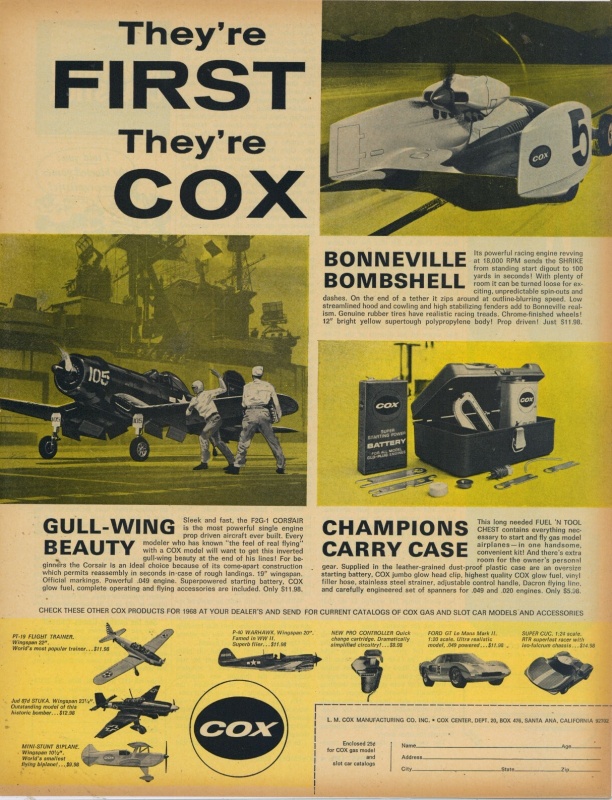
The Cox Manufacturing Company had spent the 20 years after WWII becoming a leading maker of hobby cars, and planes powered by tiny internal combustion “gas” engines. We called it gas, but it was actually Cox “glow fuel”, which research reveals was a concoction of methanol, nitromethane and oil. I am sure it was perfectly safe.
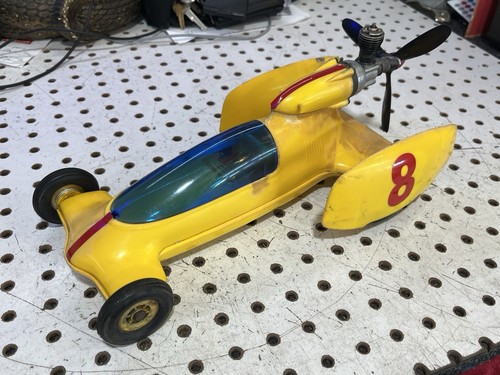
The Shrike was a curious hybrid of car and airplane. It was a car because it had 4 wheels and traveled on the ground. It was like a plane because it was powered by a propeller. I found pictures of later models that put a big guard around the propeller, but in my day we didn’t need such trivialities. The primary safety feature was the good sense to keep our fingers away from the spinning propeller.
And it was fast! (How fast? Check out this guy’s video where he lets his vintage Shrike loose in a parking lot at about the 1:15 mark.) Our quiet suburban street saw very little traffic, so it was the perfect place for our scale model land speed record attempts. We didn’t have access to enough asphalt to do a big circle on a guide string, so Tim’s Shrike was kept on a straight-ahead course by a long string fastened to the ground at each end, which ran through an eyelet on the front of the car.
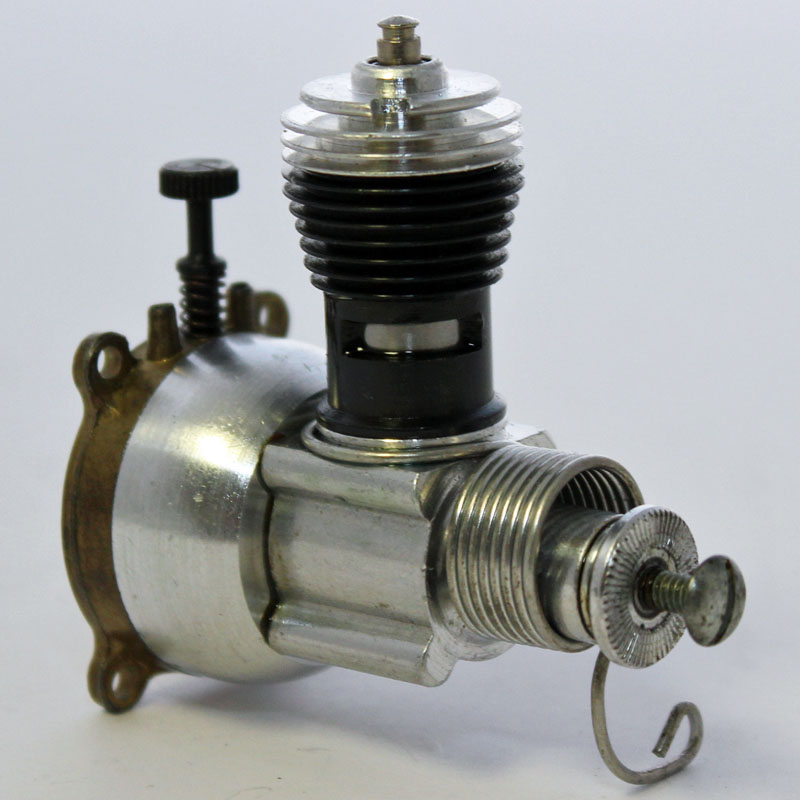
Tim was generous at taking turns, giving me the chance to learn how it worked. There was a little clear tube on the can of fuel that was squeezed onto a nipple that protruded from the tiny fuel tank. How could you tell when it was full? When fuel started pouring out of second of the two filler tubes, of course. I can still smell the raw fuel and feel the spilled excess that would coat my fingers. Then there was a battery pack with wires that clipped onto the top of the engine. This got a glow plug hot enough for the teeny engine to fire. Two or three tries at winding the plastic propeller backwards against a spring would explode into the sound of a insect-scale leaf blower and the thing was ready to roll like mad.
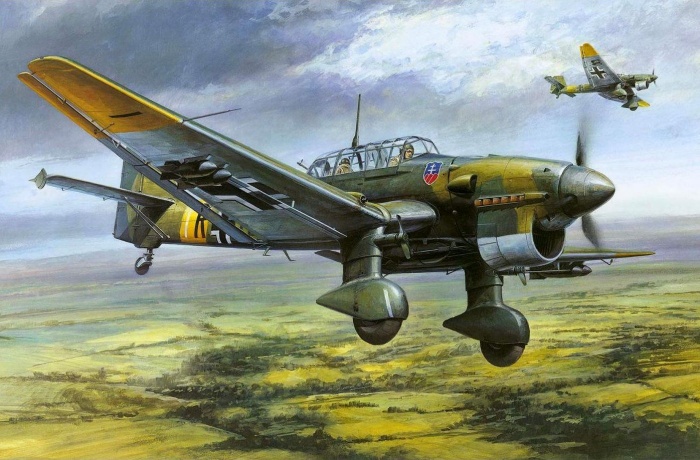
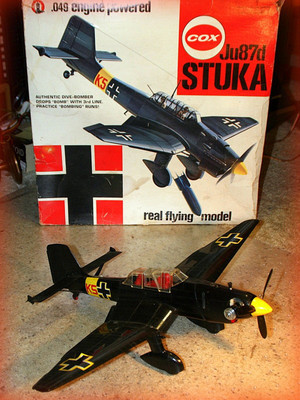
My birthday is at the end of June, so right at peak summer for a kid. Cox offered series of gas-powered airplanes, but the one that caught my eye was the jet-black German Stuka. Why did an American kid want a Nazi dive bomber for his 11th birthday? All I can say is that I was (and still am) a sucker for its aggressive look, mostly courtesy of those bent wings.
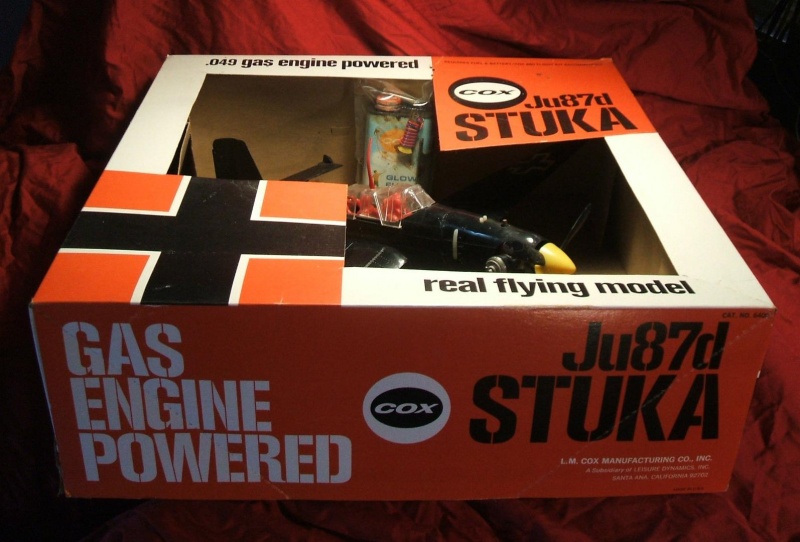
I am sure that my hints to my father as a gift idea were none too subtle, but a successful life all came together as I unwrapped a gleaming new Stuka on the big day. These were called “guide string” planes, and were designed to fly in a big circle, controlled by strings that operated the ailerons on the tail for climbing and keeping level.
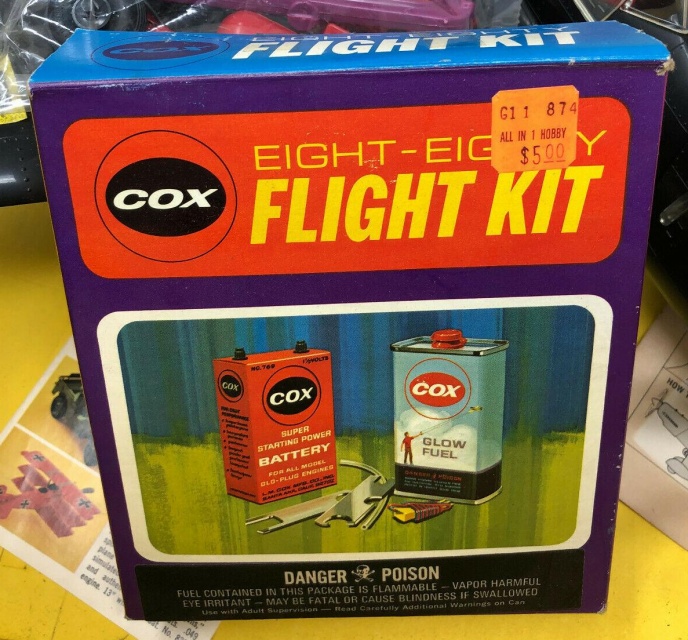
By then, I was an expert at the work of a ground crew. I had the little .49 cubic inch engine fueled and ready. And I was quite sure that I could quickly get the hang of the flying part. But Dad said not so fast. (I think the actual phrase used was “hold your horses”, which Dad said a lot, despite neither of us ever spending time around actual horses).
I did indeed hold my horses so that Dad could show me how to do it. This plan made a certain amount of sense. First, Dad had been schooled as a mechanical engineer, so he knew how such things worked. But more importantly, my father was an actual licensed pilot. And not one of those guys who would take a dinky little Cesena out on an occasional sunny Saturday afternoon, but an accomplished pilot with ratings on his license just short of the one needed for flying passenger jets. Who better to give me flying lessons in the front yard?
And so we were ready. The Stuka was at the end of its string, Dad was confidently holding the control handle and I was ready to spin the propeller to bring my gleaming new airplane to life and give it a taste of sky.
The engine started, I pulled it tight against the string and then let it go. I watched in ecstasy as the Stuka climbed sharply aloft. My ecstasy turned to alarm as the craft went into an aerodynamic stall and plummeted towards the grass. The alarm made the full circuit to horror as I saw one of the Stuka’s wings snap in two upon impact. My prized birthday present had lasted something like 6 seconds in actual flight. It’s first, last, and only.
I have no memory of anything else that day. I’m sure that my father felt bad and that he sincerely apologized. But I was 11 and had gone all too quickly from desperately wanting that Stuka to actually having it to being left with it in 2 unusable pieces. As much as I thought I might be owed a replacement from the guy who had broken it, no replacement was forthcoming. Something was said about this plane being too advanced for someone my age (which was probably not untrue), and that was the end of that.
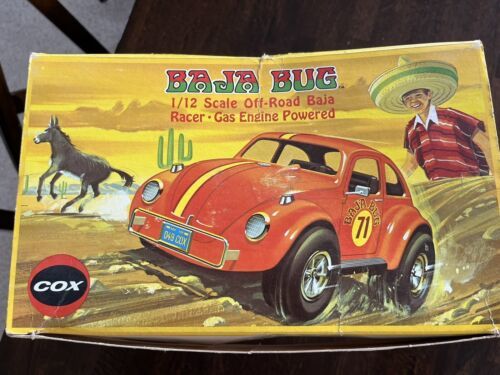
I think it was the next Christmas that my father got me another Cox vehicle – the Baja Bug. This should have been one of my favorite presents ever. I always loved cars more than planes, and this car’s reduction gearing and big, super-soft tires made it perfect for traversing the bumpy lawns of my suburban habitat. But by the time the weather warmed, 1970’s Summer Of Internal Combustion was over and the Baja Bug did not get a lot of use.
In adult hindsight, I know that even if the Stuka had not crashed on its maiden flight, I would not have had many opportunities to fly it. And if I am going to be brutally honest, I almost certainly would have crashed it and broken it just as quickly and as badly as my father did. I also have to acknowledge that it wasn’t so much the actual Stuka that I was in love with, but the idealized version of how I imagined my life to be with it. But as much as I wanted to live the brochure-version of life, actual life (even with a Stuka in one piece) would have been pretty much just like it was both before and after that crash.
My early life (and even sometimes later life) involved a long series of infatuations with things, almost all of which turned to either boredom or disappointment after obtaining that latest object of desire. This is something that I eventually figured out (much to the chagrin of our system of consumerist consumption) and have usually been able to understand that my life after getting some desired item will almost certainly be exactly what it was before. I have to admit, though, that for a few minutes in the summer of 1970, life with that Stuka was everything I thought it would be.
Thanks to my blogging friend Ted Shideler, who recently shared some childhood memories of toy disasters (here) and (here) that brought this one out of some forgotten place in my brain and gave me the impetus to share it.
Thanks also to those kids who never grew up and have kept their old Cox cars and planes going, and whose pictures and videos have reminded me of what fun these were.
 J. P.'s Blog