AI – Is It Just Me?

Everyone is all wrapped up in AI these days. And by AI, I mean that thing known as artificial intelligence. Am I the only one who just doesn’t get it and is trying my best to avoid it in my life?
The idea of AI apparently goes back to the 1950s, but it has only been in the last decade when something has credibly claimed the right to the title. What is it? I suppose I could do some research on this question, but prefer to offer my own functional understanding: it is powerful computing something something machine learning something something output. Does this help?
Really, all I can comprehend is the HAL 9000 (better known as HAL) from the 1968 film 2001: A Space Odyssey. I should have paid more attention to this glimpse into our future when my father took my little sister and 9-year-old me to see the film. He was probably right to take us – the movie we wanted to see (Gentle Ben) would not have taught us a thing about navigating life in the future. As time has proved, I have come across far more computers in my life than I have encountered live bears, gentle or otherwise.
I know a couple of the AI things by name – ChatGTP and Grok. Really, does something named Grok sound even the least bit intelligent? It sounds more like a cave man character in a cartoon. And ChatGTP sounds more like a virtual conversation partner for lonely shut-ins.
Part of me wants to find one of these things and say “Hey you, write me a couple of paragraphs to justify your existence.” Or maybe “write me a blog post like I would write.” I like to think that I would end up with the kind of dry, repetitive output that seems to populate so many websites these days. I suppose I should prepare for the possibility that I will get a blog post that is far better than anything I could write. And that would just be depressing. Especially coming from something called Grok.
I think the problem with AI is that its makers are focusing on the wrong things. Instead of AI being used to replace the kinds of human creativity that most of us enjoy, why can AI not be made practical. “Hey Grok, why won’t my snowblower start?” or “What would Marianne like for her birthday?” or “Where is the phone charger that was plugged in in the kitchen?” Maybe because AI cannot do useful things? It’s not like I’m asking it to actually get the snowblower started or buy my wife a gift or actually hand me my missing phone charger – we have to leave something for humans to do. But no – questions like these require good old fashioned real intelligence. (RI?)
Maybe AI’s greatest strength is that it can fool lots of people into thinking that it can really answer questions in the first place. We all know that life is complicated and full of contradictory ideas. “No two people are alike” is something we have known since we were all kids. We are a fascinating (or is it an irritating) mix of the rational and the irrational. Is something like AI capable of doing anything but digesting gobs of information from all kinds of sources and then sanding off the rough edges by throwing out the stuff that doesn’t fit the main thrust of “what everyone says”? I already know “what everyone says” – isn’t that what Wikipedia is for?
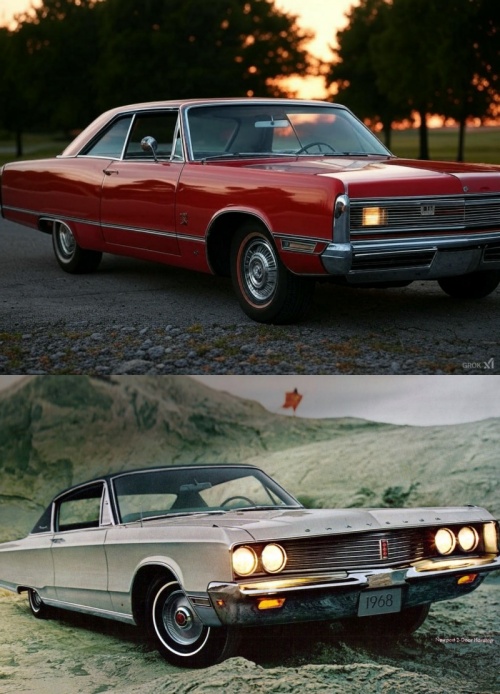
I have seen social media posts where an image of a vintage car is shown. Here is an example – just for fun I asked Grok to show me a random old car – let’s go with a 1968 Chrysler. A real 1968 Chrysler (from the original sales brochure).
I can tell that the top image was generated by AI because no such car as depicted in the image was ever made. The shapes are wrong, the details are wrong, and pretty much nothing is right. Yes, it doesn’t do badly on the overall package if you want to look at “late 60’s generic American car”, and most people won’t know the difference because they have not spent a lifetime looking at and paying attention to the details of a 1968 Chrysler. How can I have any confidence that AI does a better job of explaining to me anything that actually matters – like why I should take a particular medication or why I should support or condemn a particular government program than it does of depicting a 1968 Chrysler? In this way, is AI any different than most news articles that are woeful botches to anyone intimately familiar with the subject matter?
Is AI going to give me footnotes with sources? After all, the devil is always in the details. I am old fashioned enough to believe that the old phrase “garbage in, garbage out” is still as relevant in AI as it is in about every other area of life, whether it deals with computers or not.
Or is AI going to be used mainly to try and replicate human creativity in arts and literature? I think knowing that a talented person created something is what makes it worthy of interest. I appreciate genuine person-to-person interaction, even if those persons are separated by time and distance. That is why I write this blog – I enjoy the interaction that comes from all of you coming to read and (hopefully) comment. While my talent level is debatable, what you get here is me – who brings a quirky collection of interests and shares them in ways that can be fun, or interesting, or even occasionally irritating.
I think I will try sticking to RI, which has served me fairly well so far. When I want to know something, I will follow my tradition of looking into several sources and then, weighing the credibility of each, making my own conclusion of what makes the most sense based on whatever knowledge and experience I have been able to accumulate thus far in life. The benefit of my method is that I have yet to have my computer respond like HAL did back in 1968 with “I’m sorry J.P., I can’t let you do that.”
 J. P.'s Blog
J.P. Too late…AI has invaded almost every segment of the “creative for money” areas like illustration or photography for commercial uses. That horse has not only left through the open barn door, it’s run down the road, and headed for the hills. Personal creativity will always be what you personally want it to be, but for commercial uses or business, since the 90’s, it’s always been about eliminating physical bodies. If a single AI jockey can do the imaging work of even a few people, those people are out the door. Since digital photography took over from film, far before it was as good, what a person needs to realize is that very few people even care, that those two car pictures above are different, or even that the AI version can’t particularly accurately represent a car from that era. It’s created a picture of a car not particularly accurate to the era for people that don’t really know what that car should look like either, and don’t care? Not my world anymore, and glad I’m retired.
LikeLiked by 1 person
I am a little afraid that you might be right. One of my kids went from being a copywriter for an ad agency to a company that provides educational content for online course material. I am becoming more and more concerned that there is going to be less and less demand for someone like him to churn out the content itself or the promotional copy for the company trying to grow its business. And that the quality of what is produced is going to slowly decline as well because all of the writing will be dry, sterile copy for copy’s sake and not something to engage the imagination of another human.
LikeLike
“Maybe AI’s greatest strength is that it can fool lots of people into thinking that it can really answer questions in the first place”
As someone involved in — but harbors a healthy distrust of — so-called technology, I can say this is pretty much the case. It’s essentially regurgitation: it hasn’t ‘created’ anything.
I think the general population interested enough in it to play with it thinks it’s cool because they don’t really understand it’s not all that impressive behind the scenes. It’s the Wizard of Oz demanding you pay no attention to the man behind the curtain. But it’s nothing more special than the old computing maxim: Garbage in, Garbage out. And it’s being trained on the “None of us is as dumb as all of us” ideology.
This industry isn’t all that removed from black magic. There’s no significant difference between “select * from…” and “eye of newt, toe of frog”. However, in general, how many things in your life can you say are actually better because of the insertion of tech?
LikeLiked by 1 person
I recently read someone who articulated it this way – that in any given field, tech processes work great for the 80% of things that are completely routine and normal. They have completely failed for the remaining 20 percent that are oddball problems that will come up in any endeavor.
I also harbor a fear that AI will be great at giving you conventional wisdom from 3-5 years ago, but will do a terrible job of including those voices in the wilderness who will soon completely change the conventional wisdom.
LikeLiked by 1 person
Long time reader first time commenter. I think I may be on the younger end of readers here, but AI absolutely has the potential to be one of the most revolutionary technologies in human history. Two points to make, one is that AI is only as good as the person using it. Two, there inevitably will be some moral/ethical conversations to be had because there is potential for mass job displacement. For a regular person there are a lot of things that AI can do to improve daily life, it could help you diagnose why your snowblower won’t start and after being given information on your wife could help you with gift ideas. It also is a better search engine than Google. You can have it help you craft custom recipes to better suit your taste or needs. It can help you find new music to listen to. AI isn’t meant to be perfectly correct and it never will be. It is up to the user to take the information given and apply it in the most appropriate way. We are in the beginning stages of AI and there are a lot of ways it is being used now that will seem quaint as both AI and its users continue to adapt and evolve.
LikeLiked by 1 person
I suspect there is much truth in what you say. And perhaps my biggest problem is living through too many generations of tech that over promise and under deliver (except for reducing costs, and sometimes under delivering on this too). I can also agree that AI is still in its infancy and will look hilariously crude in five years.
I still have a fear, though, that AI will be the product of the same kind of thinking that has ruled the tech world. At the beginning of the internet, everyone promised how amazing it would be to bring the world together. Those folks either ignored or never considered what has actually happened – an internet that has become a bonanza for scammers to hack your data and steal your savings and to pit everyone against one another by fomenting genuine hostility from what were once mere differences of opinion. So I can see AI being able to make life better, but that is going to come with some costs that we cannot now begin to comprehend. I suppose getting to be my age requires a healthy dose of skepticism of new things. Or maybe I’m just shouting for AI to get off my lawn. 🙂
And thanks for adding your thoughts!
LikeLike
Pardon me if I say that “none” espouses the same sort of philosophies that similar aged people were saying about advertising, thirty years ago, when computers were taking over design, and photoshop was taking over a lot of quality film based photography. Back then, people eventually realized that those opinions were voiced by people that put their eggs in the digital basket and had a vested interest in not only promoting the digital workspace (since they intended to make their living that way), but also killing any talk of film being superior, which it was for many years after. I’m here to tell you that the imaging and creative world is certainly NOT better than it was forty years ago, when creative directors and art directors, and copy writers had intelligent backgrounds and working together as a team was a fantastic experience! The money that use to go into doing superior creative assignments for even small operations, has been sucked into the abyss of constant technology upgrades, and many jobs that used to be wonderful to have and accomplish, have been rendered mindless factory work.
LikeLiked by 1 person
I’ll respond to myself but to add on to Andy Umbo’s thoughts, “The money that use to go into doing superior creative assignments for even small operations, has been sucked into the abyss of constant technology upgrades, and many jobs that used to be wonderful to have and accomplish, have been rendered mindless factory work.” I 100% agree with that. I don’t believe that AI will bring about more positive change than it does negative. I do believe that it is a transformative technology that has already been partially let out of the bottle. There will be, and are, numerous positive changes AI brings. But the potential job displacement, and as Andy said, jobs being “rendered mindless factory work”, is something I fear is coming sooner rather than later.
LikeLiked by 1 person
“You can have it help you craft custom recipes to better suit your taste or needs.”
I respectfully disagree. AI will only craft recipes that suit your taste or needs IF your taste or needs hew toward a consensus of the existing. Because AI does not “create”…it only summarizes and presents that summary as a creation. For some (arguably, many) that summary may present as new information or knowledge, and if that works for you individually, good for you. But please do not misinterpret that as anything creative.
LikeLiked by 1 person
AI is a double-edged sword of sorts.
The bad is the lack of creativity. When we visited Los Angeles in 2023, and toured Paramount Studios, we had to avoid the picket line of the writer’s strike for our entrance (although the cab driver took us through the line, we got cussed at, and we took a picture of picketers which included someone who looks like an un-madeup Susan Sarandon) but had to cross the picket line on the way out. My wife struck up a conversation with a guy who had been a writer for Seinfeld. He said the strike was two-fold; one, to get royalties for shows shown in syndication outside the US. The other was to prevent the use of AI in writing scripts. He had AI generate a new script for a Seinfeld episode that he said was simply a distillation of various scripts he had written and, as a whole, wasn’t that good. He maintained the human element needs to remain.
The good is the aid with mundane tasks. At a conference of the American Public Works Association later in 2023 I heard a talk about the Indiana DOT. They have applied AI to their pretreatment of bridges on the interstate loop around Indianapolis. Given the number of bridges, and having to turn the spray guns on and off so many times, they were able to intertwine GPS coordinates for the bridges with the GPS system on the tanker truck so the guns knew when to turn themselves on and off. This allowed the driver to drive instead of being focused on the gun activation.
There are uses for AI, but like you, I suspect further expansion of capabilities may serve to amplify its inherent limitations.
LikeLiked by 1 person
The Indiana DOT thing is interesting. I guess the difference is the use of AI/advanced tech to do a job better compared with using it to do a worse job cheaper.
LikeLike
You’re not the only one. I avoid AI whenever posssible. The promise of AI is it can turn everyone into s genius. The thing is People are idiots. If AI can make a decision, write a better paper, draw a better car; Why do I have to?? AI is rapidly turning people into Cavemen. Hmm, Maybe Grok is an approiate name after all. 🤣😎🙃
LikeLiked by 1 person
I think what has everyone so excited about AI is the prospect of doing a job more cheaply. Of course, the work isn’t done as well. If AI gets to the place it does everything better than we do, I guess we’re all screwed. 🥴
LikeLiked by 1 person
I used AI to help make the cover of my last book. The photo I used wasn’t tall enough, so I asked AI (in Photoshop) to add the needed space at the bottom and fill it in consistent with the rest of the image. It did a great job.
I use AI at work here and there, to summarize long documents and to write abstracts/exec summaries of the things I write. Any writing AI does for me, I edit, because it gets things wrong. But it cuts out a fair amount of time.
LikeLiked by 1 person
My son the content creator has said something similar to me. He uses it for outlines/rough drafts and saves some time, allowing more time for writing and editing where that time will be put to better use.
Me? I’m glad I am old enough and am now in a field where I can completely ignore it.
LikeLike
I have used AI to generate two photos to use in two blog posts after WordPress introduced AI to the platform, but not used AI to write anything (I am wordy enough). I was amazed it was able to generate the photo so quickly and I identified them as an AI images, though it was obvious. So that was fun. What was NOT fun, was the other day when I got an e-mail from WordPress that I should immediately pay my renewal or risk having my blog go down. Concerned, I looked on the accounting part of my blog – everything was fine. Usually I get a notice one month ahead to say something will be auto-renewed and billed to the credit card on file. The credit card wasn’t expiring, nor did I neglect to change the expiration date.
So, I went to a chat session to find out why – I got a bot and it was downright creepy. It didn’t just spit out the information i.e. to ensure I checked the boxes for auto-renewal, as perhaps something was unchecked, but when I wrote “in twelve years of blogging, it has been a seamless auto-renewal” … the bot wrote “wow, 12 years of blogging!” It said I needed human intervention and to write “I need a have a human” or something like that, then it said “goodby, have a good weekend.” A chatty bot – that was a first for me. Furthermore, I wrote this reply and went back to proofread it and hit a stray key and found myself listening to your blog post, including how many words were in the post. I have no clue what I touched or clicked but that was strange.
LikeLiked by 1 person
Wow, you got quite the AI experience, and not in a good way. It sounds like a fabulous system – for WordPress.
LikeLiked by 1 person
Well, I mentioned this little escapade to another blogger who does a lot of troubleshooting with WordPress over blogging issues on the platform. She also is using Windows 11 and suggested that I might have triggered the “speak” button somehow. I only use the microphone for my French lessons and it only turns itself on when prompted to speak in French and repeat after the speaker. So I researched this so I didn’t do it again and learned it is a multi-step procedure to set up the talk function, so that was not triggered by a stray finger. So this was bizarre.
When I first began using a computer after using a typewriter for so long, the numeric keypad was problematic in that I kept hitting keys over there, so, for the longest time, I taped a 3 X 5″ index card over it to avoid stray pinky “hits”.
LikeLiked by 1 person
After pushing “send” I got to listen to my reply in its entirety. Me, I’d just like to be able to “like” something and have the “like” stick. Very odd!
LikeLiked by 1 person
I first encountered the word “grok” in a Robert Heinlein book, “Stranger in a Strange Land.” Merriam-Webster says it means, “to understand profoundly and intuitively” and refers to Heinlein as the source. As to AI, I don’t trust it, either.
LikeLiked by 1 person
The background on the name/word Grok is interesting, thanks. I suspect there is an age cutoff for who is interested in AI and who wants to cover his ears and sing “la la la la”. I suspect both you and I are on the far side of that line.
LikeLiked by 1 person
I am. sticking my fingers in my ears and saying, “La, la, la, I can’t hear you!” helped me a little bit.
LikeLiked by 1 person
A few thoughts on AI:
1) As part of my master’s degree I took a course on Artificial Neural Networks (the modern basis of AI) and so I understand (at least in the simplest models) the mathematical principals behind how AI is constructed and how it works. Namely, that a complicated, multistep mathematical function is designed, and then principals from differential calculus are employed to adjust the constants of that function in order to minimize the difference between what the function predicts or generates and what is considered correct or acceptable. Part of why AI created things feel generic or a regurgitation is because it is sometimes literally an average of whatever it was trained on, essentially. (Side note, whenever folks say that AI “learns” what they’re really talking about is mathematical optimization; which is not quite the same thing as what human beings do when they “learn”; I wish that distinction was made clearer to the general public, but alas).
2) I did check out Grok after you mentioned it in your article. I asked it the following: “Here’s a riddle, what can hold water or float in it?” It answered “barrel” (somewhat logical because barrels do float). When I responded that the correct answer was “schooner”, it did seem to get why that made sense as the answer to the riddle. I’m not going to lie, I know it’s not really “thinking” but it’s ability to seemingly fill in the logic gaps with little prompting impressed (and kind of scared) me and reminds me that even a lot of the “clever” things we do and say can still be mathematically modeled and predicted at the end of the day.
3) I’m not sure how much I like AI overall. It will undoubtedly have applications that will be extremely useful to people (they are currently using it to design new proteins, which is extraordinary). But the disruptions to the labor market will be real. A lot of white collar office work might get wiped out (even as a software engineer, I am not immune, they are increasingly using AI to write code); and while jobs that require skilled physical labor look to be relatively safe, not everyone can become a plumber or electrician. That and I feel that essential neurological skills may be lost in the coming generations. Will younger folks write or create anything from scratch anymore? Or will they feed it through an AI first? What does that do for us as a people? I guess we’ll have to wait and see and hope we can adapt.
4) To add to your reading list, Kurt Vonnegut seemingly anticipated some of these concerns with his 1952 novel, Player Piano. In the book, most jobs have been automated away; the majority of the population, now unemployed, is made to survive on a dysfunctional welfare program, while an elite few, engineers and politicians essentially, still work and wield power. As the novel progresses, there’s ever increasing social discontent leading to upheaval. It’s a good book, I recommend reading it.
LikeLiked by 1 person
Interestingly enough, just came across a video showing ChatGPT unable to create an image of a full glass of wine because, in all the images of wine it has access to or has trained on, the wine glass is not full and so the AI doesn’t understand
what “full to the brim” means for a wine glass. For me that kind of limitation is reassuring.
https://www.youtube.com/watch?v=160F8F8mXlo
LikeLiked by 1 person
This is all interesting stuff. As one whose talents were more in language than in math, I have never been inclined to dig into AI, and your explanation is helpful.
And I share your concerns.
LikeLike
Being old enough to ignore the next big thing is a mixed blessing. I had a boss who ignored email because he was close enough to retirement to get away with it. When I inherited his job, I discovered his secretary had been covering for him. She printed out every email he received and he wrote his response on the printout. Then she typed the response into an email from him. Or he just wrote an instruction like “delete.” His son worked for Microsoft and carried the torch into the future. My Mom was always a part of her times until email came along and she wouldn’t use the account we set up for her. We tried to keep her updated offline with all the news, photos, and invitations she missed but it was impossible. And it was sad to see her life diminish because she could no longer adapt to the curveballs thrown by the future.
LikeLiked by 1 person
We got my mother a computer and hooked up to the internet. It promptly caught a virus and that was it – she wouldn’t touch the internet after that.
I know that someday I will be unable to deal with modern technology and that my children will treat me like an old fool. Maybe AI is the first step?
LikeLiked by 1 person
I’m already treated like an old fool because I have a flip phone!
LikeLiked by 2 people
My parents took me to see 2001 as well when it came out. It was a bit much for my 7 year old head…but I appreciated it and have seen it many more times since to the extent that it is one of my favorite films.
I have many thoughts about AI. Whether I like it or not, it’s become a fixture in my work world, since as someone who works in education, AI is at the forefront of both what concerns educators and also what is being aggressively developed as the next wave in education. I spent all day yesterday in meetings where projects I work with were presenting their latest AI models and solutions for student tools. Let’s just say that (and I hate being so simplistic, but it’s unavoidable) it seems absolutely a given that in less than 20 years there will be very little market for human-to-human interaction in the education sphere. Yes, there will still be bespoke human teachers…likely available to those with the resources to employ such individuals or pay the tuition to go to such schools. But the mainstream will be dominated by AI technology.
I’ll be glad to be around to be proven wrong as an 80+ year old crank. But having lived thus far through a number of transformations and disruptions, I am quite skeptical that all of the people put out of work by AI are going to be anything but unemployed and left behind by the 1% (or maybe by then the .001%) who control the technology.
LikeLiked by 1 person
Well isn’t this depressing! It’s worse that I don’t think I have any reason to disagree with you.
I do have to wonder if there aren’t better models for an education system than the Germanic mass-production method we have been following for the past century, but I fear that AI may not be it. It will certainly be cheaper, and as you note, cheaper seems to work out best for the few in control of the organization.
LikeLike
There most certainly is a better model than the mass production method that many of us who came up in the 20th century were provided. And that method is one that relies on educators to frame situations that students can have as meaningful experiences that then drive and inspire learning. Unfortunately, we live in a culture where as a society we refuse to invest in education and so it’s not surprising that we end up with teachers who if they’re being paid as mindless unempowered production workers are going to perform as mindless unempowered production workers (save for a minority who have taken it upon themselves to essentially perform God’s work and would engage in their avocation regardless of monetary compensation…and that works fine if we want to go back to the Middle Ages – a time of kings and paupers – where the educational “system” could only handle a tiny fraction of the population. Hummmmmm.).
The solution to our presently inadequate system is not to further drive humans out of the process and fork over the entire enterprise to machines …machines created by humans who are the output of a diminishing end of a functional educational system, at least one that teaches the variety of soft skills that are at the core of a vibrant culture. But that’s where we seem to be.
None of which says that I’m not thankful every day for what I have been able to extract from my experiences with a better than average educational system and the life that it has provided me and my family. I’m just fearful for the future.
LikeLiked by 1 person
Someone just reminded me the other day, that I had sent them an article a few weeks ago, from either the WSJ or the NYT, about how one of the largest ad agencies in the world was working with their AI contractors to literally scan famous and/or award wining advertising into their system to “teach” AI how to generate proven advertising concepts and designs at a moments notice! Without the need for a “creative” person in the process! Darren Stevens, pick up your last paycheck please.
Then there’s this:
https://www.marketingdive.com/news/forrester-generative-ai-marketing-agencies-report/719285/
LikeLiked by 1 person
Fortunately, I do not have to use AI at work. I expect to be retired by the time that day comes.
I will say that it’s too bad Elwood Engel and his staff didn’t have AI in the 1960s…that AI generated front end would have been an improvement over the one that was used for the production 1969 Plymouth Sport Fury and VIP.
LikeLiked by 1 person
It would not surprise me if legal research and writing services using AI become a thing soon. I’m glad I will not have to deal with it.
LikeLike
And I actually kinda liked the front of the 69 Plymouth better than the 70-71 with the loop bumpers.
LikeLike
I retired a year ago and am SO glad I did. I can only imagine how difficult it would be to deal with this stuff while working.
I’m getting very tired of the AI obsession, everywhere I turn, its another story about AI. (along with the never ending Jardiance commercials). I have to double check every time I try and read a news article that its not something generated by AI.
Yes I’m an old coot, but so far I can honestly say that I have not been generated by AI.
AI AI AI Aye yi yi!
LikeLiked by 1 person
You are right – either AI itself or someone writing/talking about AI is never-ending anymore.
LikeLike
We are on the same page w/ our opinions and understanding of AI. Leave creative expression to us humans please (or at least identify what/who I am looking at as AI when it is). Focus instead on interpretation (not manipulation) of factual data. And for heaven’s sake, please don’t pursue my bank accounts and other assets. We have plenty of Nigerians doing that already.
LikeLiked by 1 person
You just made me think of something frightening: hackers and criminals have used every other kinds of tech to steal from the unsuspecting, so it’s only a matter of time before something called Fraudster AI is set loose against us.
LikeLike
This comment is a candidate for a “Don’t Like” button, sigh…
LikeLiked by 1 person