The Short But Melodious Life of Clifford Brown

When the topic is jazz music, there are so many stories that involve tragedy. Often, those tragedies involve players who succumb at a young age to the drink and the drugs that were so often a part of the world in which they lived. But sometimes, tragedy came in the form of an unlucky accident. That is the kind that cut short the promising career of trumpeter Clifford Brown.
Clifford Brown was born October 30, 1930 in Wilmington, Delaware. His father was the head of a musical family in which all four of his sons took part. Young Clifford sung until he became entranced by the trumpet in grade school, and began to take lessons. Those lessons led to playing with a local jazz group in the later 1940’s.

Like some other musicians, Brown tried to follow a more practical path in life when he enrolled at Delaware State University as a math major. But music kept its hold on him and he played as much as classes permitted. It was while traveling back from one of those gigs in 1950 that Brown was in a serious car accident that involved multiple broken bones and even skin grafts. He had received enough local notoriety that no less than Dizzy Gillespie visited him during his lengthy recuperation and encouraged him to stick with music.
From the late 1940’s, young up-and-coming jazz musicians were under the spell of a new style of jazz known as bebop, or just bop. Bop was less restricted by formal structures and gave players more freedom than the jazz played by the older guys. Brown naturally followed some of the emerging bop trumpeters like Gillespie Fats Navarro, but was also influenced by older players such as Louis Armstrong (who wasn’t?) and Roy Eldridge. He also toured with the likes of Lionel Hampton, Art Blakey and Quincy Jones.
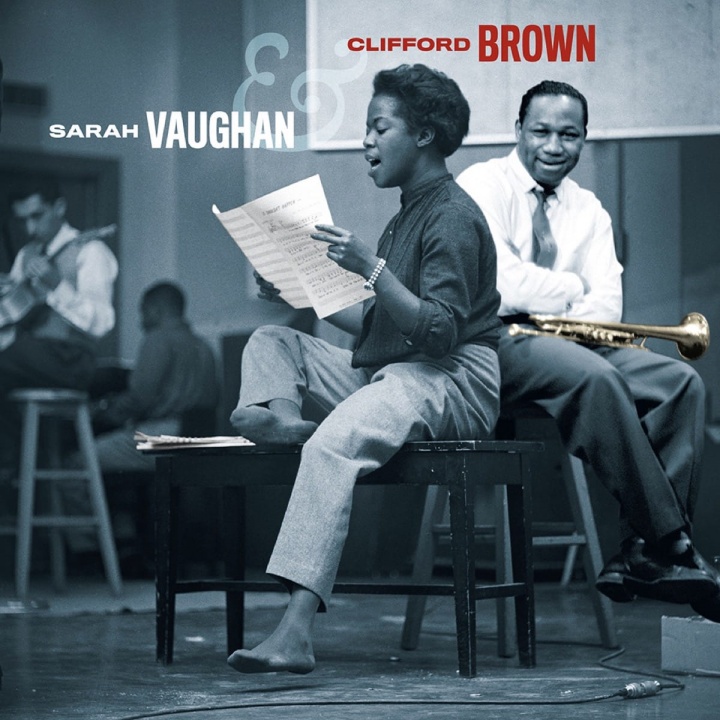
Clifford Brown’s recording career lasted a mere four years. In that time he wrote at least three legitimate jazz standards and performed on some classic sessions, including one with the great Sarah Vaughan, who insisted on Clifford’s involvement.
One such standard is Joy Spring, the title of which is also the nickname he gave his wife. There is a longer version which Brown recorded about a month later as part of a quintet with drummer Max Roach, but I prefer this shorter, earlier version from July of 1954. Part of that is because most any recording that features a baritone sax is better than one that does not.

Much of Brown’s recording output was as part of the Clifford Brown – Max Roach Quintet. Roach was a an accomplished drummer who was a favorite of the bebop crowd,
Perhaps Brown’s best known album was the 1955 release Study In Brown, with the Clifford Brown – Max Roach Quintet. Sandu is a favorite track from this album and another of Brown’s own compositions. It begins and ends with the bop-typical unison pairing of trumpet and tenor saxophone before letting each of the players have their solo moment before the mic. But unlike much bop of the 1950’s, this recording never strays from its rhythmic and melodic base.
I am funny with trumpets (and trumpet players). I find some of them too brassy, and others too involved in displays of musical pyrotechnics to the detriment of everything else. Brown took a back seat to very few others in terms of his abilities (and to probably nobody else his age) but his playing always remained musical, even in pieces with a much faster pace than these. Also, there was that lovely tone that was both clean and soft.
There is no known film of Clifford Brown playing, but there is at least one kinescope of Brown appearing as a guest on the Soupy Sales television show in 1955. This performance is all about Brown, who plays short versions of two standards – Lady Be Good and Memories of You.
This video puts on display Brown’s total concentration when he played. He was known as perhaps the most diligent musician there was when it came to practice, spending hours a day honing his playing abilities. He was also one of the rare musicians of his era who totally eschewed drugs of all kind and who rarely touched alcohol. Saxophonist Sonny Rollins credits Brown’s example in helping him through a stint of rehab and staying clean afterwards. Another unusual trait was that “Brownie” (as he was universally known) was universally liked and respected among his peers for his kindness and decency.
This makes his fate all the more tragic. On the night of June 26, 1956, Brown accompanied his group’s pianist Richie Powell and Powell’s wife in an automobile trip from Philadelphia to Chicago. It is believed that the musicians slept as Powell’s wife was driving on a rain-slickened Pennsylvania Turnpike near Bedford, PA when she lost control of the car and struck a bridge abutment and rolled down a 75-foot embankment. Everyone in the car was killed. Clifford Brown was just twenty-five years old.
In just four years, Clifford Brown had earned the respect of his one-time idols. Louis Armstrong was known to frequently play a copy of Study In Brown, and Roy Eldridge was quoted as saying “I just liked the way Clifford blew his horn. As good as he was, he was going to be better.” (1) And in 2013, Quincy Jones included Brown with All-Stars Dizzy Gillespie, Miles Davis, Charlie Parker and Ella Fitzgerald as the players people will remember “a hundred years from now” as the greatest of all time. (Id.)
There is no telling where Brown’s career may have gone had he lived longer. As the 1950’s progressed, many of his age group went off in directions that I have difficulty mustering much enthusiasm over. But as it was, is music was almost always eminently listenable, whether in his own group or with some of the biggest stars of the day. We are fortunate that he left us some really great music to help us remember him.
Recording Session Credits:
Joy Spring by the Clifford Brown Ensemble: Clifford Brown, trumpet; Stu Williamson, valve trombone; Zoot Sims, tenor sax; Bob Gordon, baritone sax; Russ Freeman, piano; Joe Mondragon, bass; Shelly Manne, drums; Jack Montrose, arranger. Recorded at Capitol Melrose Studios, Los Angeles, CA, July 12, 1954.
Sandu by the Clifford Brown – Max Roach Quintet: Clifford Brown, trumpet; Shelly Manne, drums; Harold Land, tenor sax; Richie Powell, piano; George Morrow, bass; Recorded at Capitol New York Studios, February 25, 1955.
(1) The Lasting Legacy of Legendary Trumpeter Clifford Brown by Martin Chilton, October 30, 2023 ( https://www.udiscovermusic.com/stories/clifford-brown-legacy-feature/ ).
 J. P.'s Blog
Great entry this week! His death legend is probably more well known by jazz lovers than his work. Sad, and so young! I have to say I always like Browns work when I hear it, and you hear a fair amount of it on jazz radio, especially with Max Roach, but for some reason, I’ve never bought any of his offerings on vinyl or CD. I might have to rectify that!
LikeLiked by 2 people
Thanks! I don’t listen to much jazz radio – my local station’s tastes trend more modern than mine do – so I have only occasionally stumbled across Brown, and always by accident. I have listened to him on purpose lately and have enjoyed his stuff.
He is one far better known among hard core jazz fans than among those less into 50s jazz. I suspect that would have changed if he had enjoyed a longer career.
LikeLiked by 1 person
Thanks for this! It’s always great to learn of other Clifford brown fans. Years ago, I bought a few of his recordings, and was later gifted the EmArcy box set. “Clifford Brown with Strings” is one of favorite recordings. Happy listening!
LikeLiked by 2 people
I have not listened to that album, will have to put it on my list!
LikeLike
Fascinating account J P, especially how Brown developed a lasting reputation among his peers in such a short time frame. I envy those who made their music on “portable” instruments because they could do so anywhere they wanted. As much as I enjoyed many years developing my classical piano skills, it wasn’t lost on me how my practicing/playing/performing was limited to wherever I could find a piano.
LikeLiked by 2 people
I read about a discussion among musicians from the era of the big bands. The consensus was that the piano player was the luckiest because he didn’t have to carry a thing from place to place, because every hall had a piano. The bass player was considered as the guy who had it worst.
Yes, to become so liked and respected in such a short time is amazing.
LikeLiked by 2 people
Well now, there’s the opposite angle. I like it!
LikeLiked by 2 people
That’s very sad how Brown had two serious auto accidents impact his life, sadly not surviving the second one. So many vehicle or plane accidents taking the lives of famous musicians, so you always wonder how much further they could have gone in their careers as you wrote. He did accomplish a lot in four years. I think I saw Sonny Rollins at The Raven Gallery in Southfield back in the mid-70s. It was a coffee house where jazz musicians played.
LikeLiked by 2 people
Not many people get in 2 serious car accidents in a six year stretch. That’s some really bad luck.
I have not listened to much Sonny Rollins, he is newer than my tastes generally run.
LikeLiked by 2 people
Yes, it’s very unfortunate and sad that he was such a rising star. As to double tragedies for musicians, there was Teddy Pendergrass, first paralyzed by a vehicle accident, then he passed away from cancer years later. But unlike Clifford Brown, Pendergrass dabbled in drugs, alcohol, etc.
It was my first and only time there and he was the featured musician and someone else (Mcgee maybe).
LikeLiked by 2 people
Saw Sonny Rollins live back in the 90’s and it was incredible! Definitely a highlight of my live jazz concert watching career!
LikeLiked by 1 person
Andy, I wish I could remember who else was there that night as they appeared together. That was my first brush with jazz!
LikeLiked by 1 person
Linda, it was a great night for me! I took a client and he looked around at the crowd and said: “There are guys here older than our Dads and hipper than us!” Truth!
LikeLiked by 1 person
Sad but at least he used his 25 years well enough to be still remembered today.
LikeLiked by 1 person
I am glad I had more than 25 years to make whatever mark I have made.
LikeLiked by 1 person