A Century Of Chef Boy-Ar-Dee
Who doesn’t love Italian food? And who doesn’t love convenience? One way to get those things together is to go to a nice Italian ristorante and order up your favorite zesty, cheesy pasta feast. It won’t be cheap, of course.
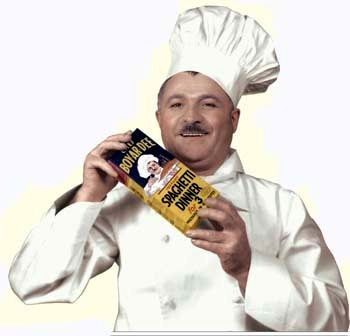
But if you are old enough, you remember another convenient way to enjoy real Italian food. At least we were told it was real Italian food. And a little research reveals that we were told correctly – in a certain way. For those of us in the Midwest and whose last name did not end in a vowel, the only way to get real Italian-style food at home was brought to us by a jovial, mustachioed Italian chef named Boy-Ar-Dee.

There really was a Chef Boy-Ar-Dee. His name was actually Ettore Boiardi, and he was born in northern Italy in 1897. After some time spent working in restaurants in his native Italy, he did the same in France and England before immigrating to the U.S. in 1914. His older brother Paul was a waiter at New York’s Plaza Hotel and young Ettore (who later Americanized his first name to Hector) got a job in the kitchen of that august establishment.
Young Boiardi proved to be a talented chef and was soon in charge of the kitchen at the Plaza. By 1918 he had overseen a massive dinner for returning veterans by request of President Woodrow Wilson, and then moved to Cleveland, Ohio to become head chef of that city’s prestigious Winton Hotel. After he married in 1923, Boiardi and his wife opened their own place, Il Giardino D’Italia (The Garden of Italy) in 1924. That event, exactly one hundred years ago, when the Chef was only 27 years old, became one of the first popular Italian restaurants in the midwestern U.S. and began to form multiple generations’ expectations on what Italian food was all about.

The chef’s meals were so popular that customers pestered him for his sauce so that they could make Italian meals at home, requests that Boiardi fulfilled by washing milk bottles and filling them with his locally famous sauces. One customer owned a local chain of self-service grocery stores and convinced the chef that he should can and sell his sauces on a larger scale. By 1928 Hector and his two brothers were running a separate processing plant. His brand was born when he changed the spelling of his last name to Boy-Ar-Dee because his non-Italian customers had trouble pronouncing his name. We should note that in 1928, another famous culinary name, Colonel Sanders, would not perfect his fried chicken recipe for another dozen years.
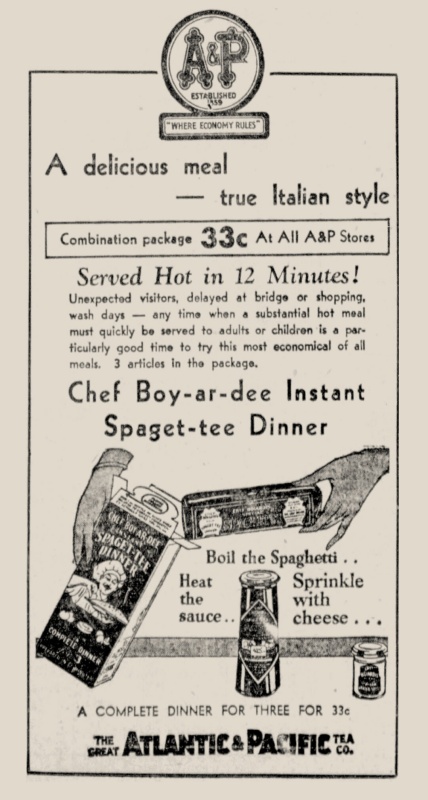
Boy-Ar-Dee’s Italian sauces (three varieties) and his boxed spaghetti dinners proved so popular after being taken up by A&P, then America’s largest grocery chain, that Boiardi moved the company to Milton, Pennsylvania in 1936. Milton was chosen because the company could contract with local growers for abundant supplies of tomatoes and mushrooms needed for the company’s offerings. As America mobilized for WWII, Chef Boy-Ar-Dee continued to, well, mushroom by packaging a line of G.I. rations in addition to their products destined for kitchens on the home front. By this time products included canned spaghetti and meatballs and beef ravioli.

At the end of the war, Boiardi was reluctant to go back to the company’s pre-war size, which would have required massive employee layoffs. As an example of that scale, you probably did not know that Boy-Ar-Dee was, at that time, the largest importer of grated parmesan cheese into the U.S. The Chef’s solution was to sell the company he had built to a big commercial food company, American Home Products. The Chef got $6 million for his efforts (a LOT of money in 1946), and also a deal to remain as company spokesman – a role he filled until 1978!
This television commercial from the early 1950’s shows us what Italian food at home looked like at that time. And tells me that I have been mispronouncing his name for quite a few decades now. In a rare rebellion against box and can food, my non-Italian mother insisted on making her own spaghetti sauce in the late 1950s and into the mid 1960’s, much to my chagrin. I would have preferred The Chef’s version.
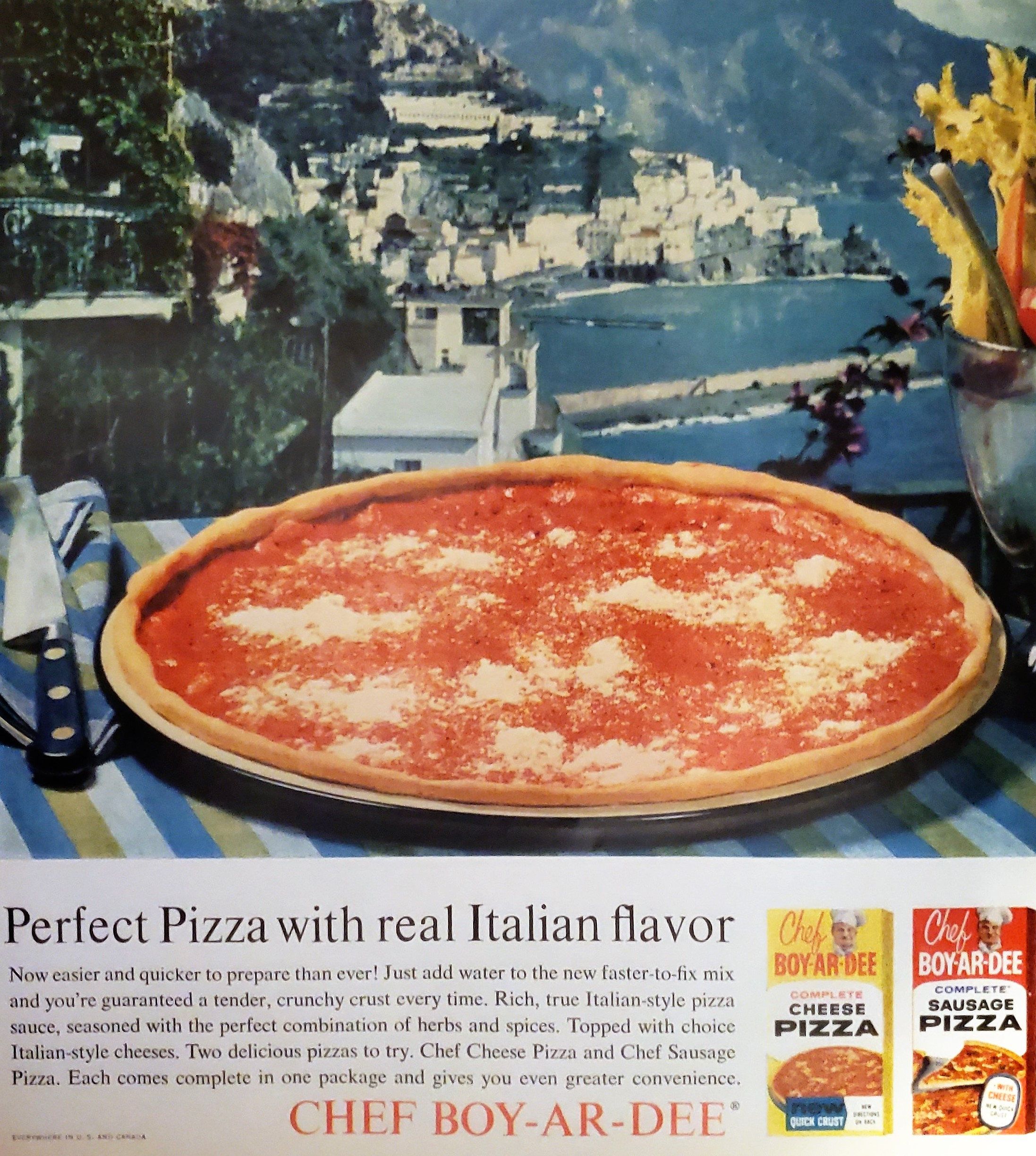
Mom also avoided the boxed pizza kits. I lucked out in those days before convenient delivery of professionally-made pizzas when my step-mom would occasionally break out the Chef Boy-Ar-Dee cheese pizza from a box. I have to admit that the Chef’s pizzas did not stack up to pies that we experienced (if rarely) from pizzarias.
Fortunately, Mom had no problem buying the canned ravioli. Is there anyone who does not relish Chef Boy-Ar-Dee (Sorry ConAgra, I’m keeping the hyphens out of respect for the Chef’s spelling choice) canned ravioli, if only in secret? That product has remained a staple in the JPC pantry until the present day. In fact, it was during the heating of the last can on hand that it occurred to me that the stuff deserved some attention from this blog. And am I the only one who considered the sauce in Chef Boy-Ar-Dee’s canned pasta products to have a taste and texture far superior to that of Franco-American and their Spaghetti-Os?

I steadfastly cling to a saucepan as my choice for heating a can of The Chef’s Ravioli. Sorry, but a microwave just doesn’t provide the same evenly-heated texture. Does anyone else shake the can when choosing them at the store? Some cans are saucier than others and you can hear it in the internal glop-glop sound when you shake them.
A meal of hot Chef Boy-Ar-Dee Ravioli served in a bowl is improved only by a slice or two of Wonder Bread, which is wonderful (I just can’t help myself today) for sopping up the Chef’s signature sauce. Who didn’t hear “clean your plate” as a kid? The soft white bread is perfect way to obey that old parental command.

I think we all must admit that America has moved beyond old Chef Hector when we have a taste for real Italian food. It is my theory that the ubiquity of Pizza Hut after the early 1970’s is what finished off the Chef Boy-Ar-Dee pizza kit. And spaghetti sauce in a jar from Ragu in that same decade advanced our collective tastes from what they might have been before WWII. Today, my millennial children laugh at their father’s love of The Olive Garden when someone suggests an Italian restaurant. In my defense, I think that The OG picked up where Chef Boy-Ar-Dee left off in giving America a taste of decently made Italian food for a reasonable price. I don’t expect a spaghetti dinner for 15 cents a serving, but I will balk at a plate of spaghetti and meatballs that runs over $20, as is often the case when the establishment’s sign includes the term “Ristorante” or some other Italian phrase.
Everyone and everything has to start somewhere, and I think it is a fair statement that middle America’s love for Italian food started in Cleveland, Ohio one hundred years go when Chef Hector Boiardi started sending sauce in milk bottles home with his customers. Boiardi’s is a uniquely American story which combines the foods from his homeland with 20th Century America’s desire to expand every housewife’s culinary repertoire on a budget via the miracle of mass production.
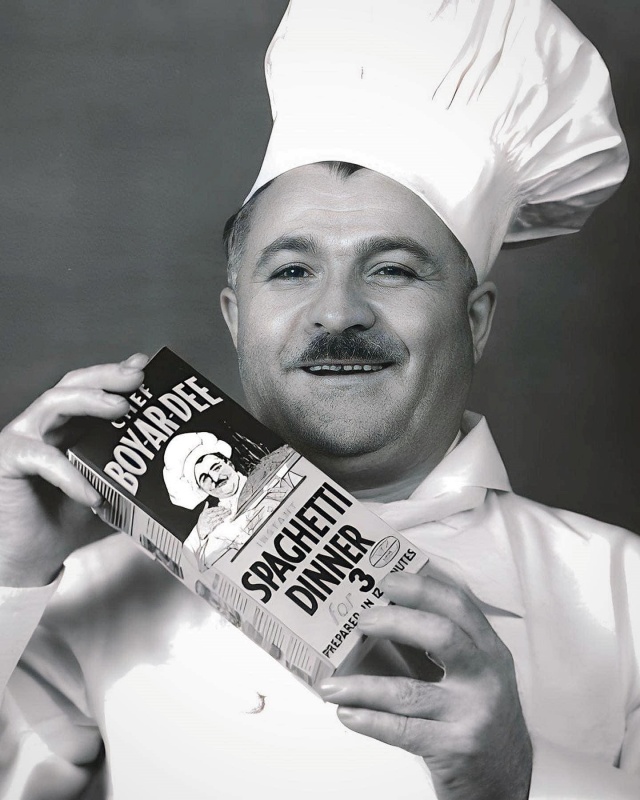
I, for one, am glad that Chef Boy-Ar-Dee’s meaty, saucy ravioli is readily available so that I can always have a can (or six) on hand when I have a taste for the Italian food of my childhood. And after researching for this little tribute, I am also glad that Chef Ettore Boiardi’s smiling visage is still on the cans so that I can salute this great Italian-American and his “only in America” success story.
 J. P.'s Blog
A great history of The Chef. I knew none of this, thinking Chef Boy-Ar-Dee was simply a fictitious person portrayed by some unknown actor. Sometimes it’s good to be mistaken.
Mr. Boiardi’s story is a very good one and truly could only happen in America. I grew up eating canned ravioli and always wondered how it came about. I’m also wondering if it was Mr. Boiardi’s brand or some cheap knockoff. It likely ran about 50/50.
It sounds like researching this was fun to do. A can of ravioli heated in a saucepan (the only way to heat it) is called for as a toast to Mr. Boiardi.
LikeLiked by 1 person
I went into this with the same understanding you had. I think The Chef was the 800 pound gorilla of the canned pasta segment. I’m out and need to buy some!
LikeLike
It’s kind of awesome to bring some details up about this guy. I knew a lot of this already, being a bit of a nerd. I didn’t realize how far west he’d come… and it was genius shipping canned rations to GIs (I didn’t know that part).
I don’t think I have the same fondness for the food though. I can’t say for certain, because it’s been a really long time since I’ve tried it. Your mention of Spaghetti-Os’s being from another company made me wonder if I’d just lumped them all together in my mind. I’d probably be horrified by what’s on the ingredients list, though. I’m a “young guy” around here, I suspect — I was born the year the Chef died and I can’t imagine whatever standards for quality Boiardi had have been maintained. Not that I’m a ‘clean-eating’ snob (I have my love of junk food, too), but I do try to minimise the “garbage in” part of the equation.
I think what strikes me most interesting is his willingness to share his sauces with his neighbors — or customers, as they could also be called. Seems the man had a passion for generously spreading the gospel of Italian food.
I never know what I’m going to get here; thanks for another interesting post.
LikeLiked by 1 person
Thanks, Matt! It seems that when The Chef was in charge, he cared about the quality of the ingredients. I can’t speak to corporate ownership (ConAgra bought American Home Products some time ago), but even now they boast that there are no preservatives. Except for salt, I would guess, and there’s probably plenty of that.
LikeLiked by 1 person
You know, it’s not the preservatives that I try to avoid, and I’m not at all concerned about Salt — I’d be more concerned about the sugar content.
LikeLiked by 1 person
Good point
LikeLiked by 1 person
I would have to say that Boy Ar Dee was one of my favourite staple foods when growing up. Ravioli in a can was one of the best at the time. You had to make sure to stir it in the saucepan (pot?) to ensure even heating, and to avoid burning the pasta (food?). I recall it supplemented my usual lunch of Campbell’s soups, and eventually became a regular selection.
I also enjoyed the pizza in a box, but I seem to recall that Kraft foods was the one I preferred over the Chef’s.
I also had no idea there was a real chef behind all this, I thought it was all made up.
LikeLiked by 1 person
I loved his story. And how he remained affiliated with the company in some way for most of the rest of his life. If he ever had complaints about the quality of the food under new owners, I found no evidence of it. Unlike the time Col. Sanders made the papers in Fort Wayne in the early 70s by ripping on the quality of the food offered by the local franchise.
LikeLike
Well that was interesting, I wonder what percentage of people on food containers are real? Probably pretty low.
Once again this illustrates the difference in our culinary upbringing. My mother was quite an accomplished cook, and she had a hard line in the sand about processed food. Somehow a can of spaghetti sauce was OK, but a can of heat and serve ravioli was not. I must have eaten Chef Boy-Ar-Dee ravioli at some point in my life, but I can’t recall ever doing so.
On her post university trip to Europe Mrs DougD ate a can of it cold, sitting on a curb in Switzerland because everything was so expensive there it was all she could afford.
LikeLiked by 1 person
I guess Chef Hector did Mrs DougD a solid!
If not for food in boxes and cans, I would probably have starvred to death as a child. 🙂
LikeLike
Hector Boiardi was a great man who did great things, but the truth is . . . no real Italians or Italian-Americans ate this stuff. This was for “L’Ah-mehr-ree-cahns” (average white-bread Americans). In the real Italian-American household, Mom or Grandma made sauce from tomatoes grown in Grandpa’s backyard garden. Other ingredients came from “the Italian store” (small grocery). No one ate Wonder Bread ever.
Grandma would say “You wanna peetz?” (Pizza). And would proceed to make pizza with a shell crust (obtained from the Italian store) and Don Pepino pizza sauce in a can (if tomatoes were out of season). The can label looked liked it was designed in the 1940s and never changed. Grandma would then cut thin hunks of mootz-zah-rell’ cheese and lay them on the pizza. Cooked a long time in a really hot oven. That was pizza!
Speaking of pizza, in my view Pizza Hut/Domino’s is NOT pizza. Neither is that thick goopy stuff known as Chicago pizza. I have had fights over this. Here in NJ/NY where we have the best pizza in North America, you go to a small, independently owned pizzeria, and you know the good ones from the mediocre ones. The best pizza I’ve ever had was in Hoboken NJ at a place called World’s Largest Slice. Don’t know if they’re still there.
Stata buon!
https://m.media-amazon.com/images/I/51hmAhcZuOL._AC_.jpg
LikeLiked by 1 person
I think the big divide was between those from Italian families and others in the Northeast who lived under their influence and we non-Italians out in the middle of the country. Italian and other ethnic foods were not part of our parents’ experience. My wife remembers her mother making spaghetti in the 60s and using Campbell’s Tomato Soup as the sauce. Chef Boyardee was a touch of real Italian compared with what we got at home. That eventually changed, of course, but the cans of Chef Boyardee sure beat a peanut butter sandwich at lunchtime.
I would have loved growing up around real Italian food!
LikeLike
That reminds me, Italian Canadians used to insult English Canadians by calling them mangia-cakes. Or cake eaters because white bread was like cake compared to traditional Italian breads.
LikeLiked by 1 person
I hadn’t thought about this brand in a long time. You’ve brought back many tasty memories. Maybe i’ll buy a can of the Chef’s ravioli within the next week or two.
LikeLiked by 1 person
Haha, look at me being a bad influence! 🙂
LikeLiked by 1 person
I got a chuckle. My mother is Italian, no way would she allow us to eat this awful food. In fact, when we FINALLY tried it once, we thought it was made by an American, it certainly wasn’t Italian food. So, I enjoyed reading about the history of Hector Boiardi, his name, his food, etc. I bet his restaurant food was more authentic. Thanks for doing the research.
LikeLiked by 1 person
I also wonder about how peoples’ tastes in food have changed. I wonder what we would think today of the restaurant Italian food people raved about in the 1920s.
And I agree: on this topic, it’s those of Italian heritage vs. everyone else.
LikeLiked by 1 person
When I was a kid, I thought the guy’s name was Chefboy Ardee. What can I say? Kids are dumb.
The Chef’s spaghetti and meatballs remain a favorite of mine.
LikeLiked by 1 person
Haha, love it! I ought to try the Spaghetti and Meatballs. I don’t think I have ventured beyond the ravioli, with an occasional foray into Beefaroni (that I don’t think is as good).
LikeLiked by 1 person
My mom would have scoffed at having it in the house, but I saw the commercials at Dad’s, where I picked up the weird pronunciation. I don’t think I ever tried it until I was broke and in college. Now, I’m a half-snob and always grace it with some shredded Parmesan from Fresh Thyme:)
LikeLiked by 1 person
The concept of half-snob deserves more exploration, but I get it. I grind coffee beans for use in my Mr. Coffee with tap water.
LikeLiked by 1 person
Your blog post is where I learned of it!
LikeLiked by 1 person
Ahh, Ravioli! Cold from the can, warmed in a pan, heated in the microwave, I love it! Oh, and I love Olive Garden, too. And sopping up anything, spaghetti sauce, gravy, etc. with a piece of buttered white bread? Yeah, buddy! And how! Great post.
LikeLiked by 2 people
Thanks, you kindred spirit you!
LikeLiked by 1 person
I can’t remember ever having Chef Boyardee. My mom used to make a meat sauce that she served over spaghetti. She usually had garlic bread too. When I make it, we serve it with a Caesar Salad too. All very American-Italian!
LikeLiked by 1 person
How different my life would have been with a mother who cooked!
And it’s hard to get more Italian than Caesar!
LikeLiked by 1 person
I enjoyed reading about the history of the Chef and his business expertise JP. I didn’t know about the Parmesan cheese venture either. We never had pizza in those days and I can’t remember if my mom used the boxed spaghetti meal or made her own when I was growing up, but we often had canned spaghetti or ravioli on hand and enjoyed it through the years. My personal favorite was always the Fettucine Alfredo – very delicious! Yes, a bit high on the sodium, but it was not like I ate it every day! About a year ago when my grocery store Meijer quit carrying it, I searched online at Kroger – nope, they didn’t carry it, so I searched the website and discovered it was no longer a product they made. Bummer! I’m not a good enough cook to make my own.
LikeLiked by 1 person
It’s a terrible thing when a beloved item at the grocery is discontinued!
LikeLiked by 2 people
Yes, I miss it and even checked Amazon to see if they carried it, perhaps having bought up a supply before they quit making it – nope.
LikeLiked by 1 person
Another fun post. The ads look much better in color than they did in black and white. In the late 1980’s while my wife and I were on a vacation with our three young sons, I ordered spaghetti in the restaurant in our hotel in Hopkinsville, Kentucky. It was clearly SpaghettiOs from a can. We were definitely surprised. I ate it because I love Italian food and am not fussy about spaghetti as long as it has red sauce. I would probably eat it with ketchup. But we laugh about that experience still.
LikeLiked by 1 person
Wow, that would have been a surprise!
I loved the old television ad. Has any other commercial ever started with “Hello! May I come in?” And he doesn’t wait for an answer.
LikeLiked by 1 person
I used to really like the ravioli, but over the years it’s been cheapened and just doesn’t taste good anymore.
As a kid, we made pizza at home using the Boy-ar-dee crust mix. That was always fun.
LikeLiked by 1 person
It was certainly more of a project that picking up the phone.
LikeLike
Fascinating! I never imagined that Chef Boy-Ar-Dee was a real person. Next thing you’ll tell me that Mr. Coffee was a real person too!
I used to eat Chef Boy-Ar-Dee ravioli as a kid, but haven’t thought of the brand for years. Actually, I assumed it was defunct, but apparently it’s not. My daughter read this article too, and now wants to try some, so we’ll be getting some Boy-Ar-Dee cans this week.
Just for fun, I looked up Hector Boiardi in old Census records, just to see where he lived. In the 1930 Census, he still lived in Cleveland (in a rented house in what looked like a heavily Jewish neighborhood… address was 3455 E. 142nd St. for those who are interested). He listed his occupation as “Manager, Spaghetti Restaurant & Factory. In 1940 he rented a house at 542 Broadway in Milton, and then in ’50 he appeared to have moved to a larger house outside of town (address unknown).
Well, thanks for this writeup!
LikeLiked by 1 person
Leave it to you to trace the good Chef’s residence history! I figure he ended up in something pretty splendid after the 1946 sale. I just did the calculation: $6M in 1946 is over $16M today. It would certainly have been life changing.
LikeLike
I never imagined that there really was a Chef Boy-Ar-Dee! This was very educational. Growing up on a non-Italian household in a small town where German and Scotch-Irish influences were extremely strong, I never had real Italian food until I was well into my 20s. Neither I nor my friends would have known that we weren’t getting the real thing when our moms served a Chef Boy-Ar-Dee product.
Interesting that his factory was located in Pennsylvania.
LikeLiked by 1 person
I know! My favorite restaurant when I was a tot in Fort Wayne was a place called “The Spaghetti Bowl”. I don’t know how Italian it was, but it sure beat what I got at home. Chef B from the can was the next best thing.
LikeLike