
Jazz Where The Stars Are The Stars
Stars. Stars in the night sky have inspired songs throughout the ages. Actors, singers and musicians are called stars when they become famous, and those of us who follow them can become starry-eyed.
It recently occurred to me that some of my favorite jazz tunes rely on the stars for their titles and their inspirations. I thought about it and chose three songs about stars to feature this week. Each was a hit record at some point in the long-distant past, and each has had a long life as a canvas on which jazz artists have woven their celestial strains for our listening enjoyment. So, let’s have a listen to three of my favorite compositions about stars – “Star Eyes”, “Stella By Starlight” and “Star Dust”.
There are a couple of more common themes that run through these selections. First, each features a saxophone player from the smooth and mellow end of the spectrum – perfect players for jazz under and about) the stars.
The second is the songs themselves. Much vintage jazz is based on simple Tin Pan Alley tunes that were ground out like so many mass produced things in the 1920’s. These three tunes are quite the opposite – each is a complex and well-crafted piece of popular music that has become part of the jazz canon. Let’s open with “Star Eyes”.

The song “Star Eyes” first appeared in a 1943 film called “I Dood It”, where it was performed by the Jimmy Dorsey Orchestra. Dorsey had a hit record with the song, though I will confess that it is far from my favorite version. Others have picked up the song in the decades since and have done some great things with it. It was my recent discovery of the version below that started me on this topic, when I thought about how much I have always liked this often-underappreciated song.
Today’s featured version was recorded in 1957 by a collaboration of tenor saxophonist Richie Kamuka and baritone saxophonist Bill Holman for an album entitled “Jazz Erotica”. The album (sans the racy cover art” was re-released in 1959 under the less provocative title “West Coast Jazz In Hi Fi”. Another notable participant in the eight-man combo was Vince Guaraldi, who later became known as the man responsible for the signature sound of the Peanuts television specials.
“West Coast” jazz had a cool, reserved sound to it, and the style really works well on a lovely ballad like Star Eyes. This performance starts with a bit of a bossa nova rhythm, but soon settles into a relaxed groove that can bring the stars out in anyone’s eyes. Kamuka is not well remembered, but was a fine player who (with his collaborators) did full justice to the song.

The second on our tour of the stars is “Stella By Starlight”. Stella is another song from film, this one written by Victor Young as a theme for the 1944 film “The Uninvited”. “Stella” became quite popular with a 1947 instrumental version by bandleader/trumpeter Harry James. That record featured James’ singular trumpet sound backed by a lush arrangement complete with strings. The song got a vocal treatment that same year by Frank Sinatra, then nearing the tail end of his first career as a headlining romantic crooner. Say what you will about Sinatra’s early records, he exhibited a level of good taste in material that was far from universal in those years.
The jazz version I have chosen to feature here is a 1952 recording by tenor saxophonist Stan Getz. Awhile back we featured Getz for his early 1960’s fame from “The Girl From Ipanema”, and now we can hear Getz in some of his earlier solo work after coming to fame as a player in Woody Herman’s great band. Getz takes the tempo a bit faster than the earlier versions of the song, but his smooth, cool sound makes it all work out just marvelously.
“Stella”, like all of these complex tunes, is one that most people cannot whistle after hearing it once or twice. It is also a challenge for singers because of the range it requires, so not just anyone can sing it. It is one of those songs that I can listen to over and over, and there are so many great versions that I had a tough time deciding on this one.
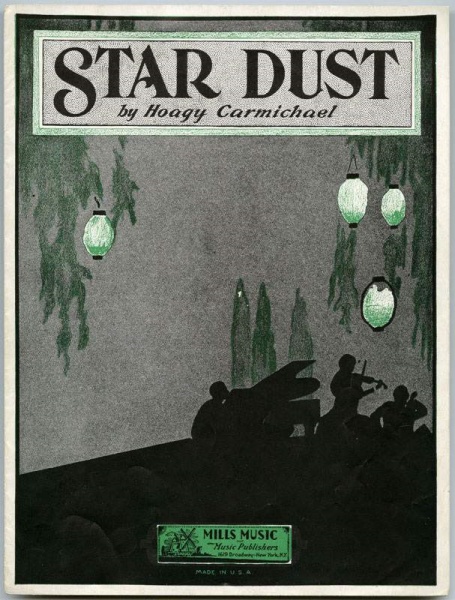
The final selection of our romp through the stars is the oldest of the three, and one of the greatest pieces of music ever written. It is also one of the most-recorded pieces of its era: “Star Dust” (also known by the one-word title “Stardust”). Many people do not know that the song’s author, Hoagy Carmichael, was from Indiana, and even fewer know that he started out life as a lawyer with a law firm in Indianapolis, until he decided that he hated it and would much rather write and play music. Carmichael wrote many songs over the years, but if he had only written just this one, his star would have been permanently affixed in the firmament of jazz.
Carmichael himself recorded the song as early as 1927, and that version is a lovely example of some of the relaxed jazz that was being played in the late 1920’s (if you knew where to look for it). But the song’s level of refinement begs for the equally refined style of playing that was common in the early years after WWII.
This version is a particularly lovely one. Oscar Peterson and his jazz trio were just getting rolling in 1952. That year they linked up with veteran tenor sax man Lester Young for an album, and Stardust was one of the songs they decided to include. Peterson may have been relatively fresh on the music scene then, but he was a good enough musician to know that when you have someone like the great Lester Young in front of you, you stay out of the way and let him do his thing. This record shows how Peterson let Stardust be Stardust, too.
Lester Young was among the most lyrical of players. Young was a hugely influential player over his career, and is undoubtedly the guy younger players like Getz and Kamuka looked to as their inspiration. This record was made a few years before Young’s playing began to decline from the poor health brought on by a lifetime of hard living, and this performance comes from a heart that had experienced the full range of life. It is no overstatement to say that this is one of the most beautiful performances of “Stardust” I have ever heard.
Surely it would not take long to list a dozen other great jazz standards inspired (in their titles or otherwise) by the stars. But it is easier to just go back and enjoy these, which I have done fairly extensively over the past several days. Both the songs and the players are stars that I cannot get enough of.
 J. P.'s Blog
Can’t say enough about Hoagy Carmichael, nor Stardust. As a mere child watching old movies on TV, I distinctly remember asking my parents about Carmichael, as I was fascinated by his film presence. Those interested can check the Google, but I believe he appeared in fourteen films, and people can get a real feel for him by seeing him in some of his bigger appearances.
LikeLiked by 1 person
I have seen Hoagy in several films over the years. He always came across as a bit of a rube to me in his film roles, but then he was always just an old-school Hoosier. If I had to imagine the kind of person who could write a song as beautiful as Stardust, I would not have imagined someone like Hoagy. Which goes to show that people can surprise us with talents we might not expect.
LikeLike
When you read his wiki entry, he was the product of poverty, but like a lot of families, the mother pushed the talent and education. A college grad when only about 6% of people had a college education! He certainly paid his dues, but his “aw shucks” Indiana rube character was certainly “earned”, but pretty much of a “Schtick”. I read plenty of first person stories about him hanging around Indiana Avenue in the clubs and taking it all in when he was still pretty young!
LikeLiked by 1 person
Crazy to think one might decide being a lawyer just isn’t doing it and getting into “something completely different”.
LikeLiked by 1 person
Haha, I know, right?
LikeLiked by 1 person
Stardust is truly a beautiful composition. I imagine that hundreds if not thousands of artists have recorded it.
LikeLiked by 1 person
It really is! I would not want to guess at the number of versions out there – the actual number would probably surprise both of us.
LikeLiked by 1 person
I love your posts, the stars, and all that jazz!
LikeLiked by 1 person
Thanks! I particularly enjoyed the listening-research required for this one.
LikeLike